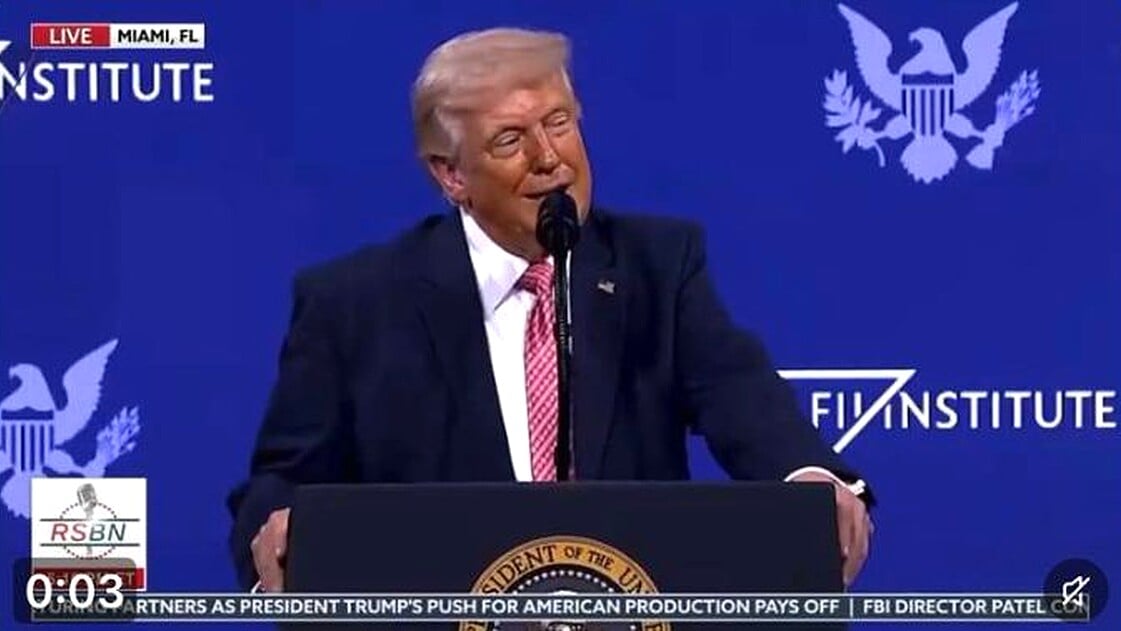




ISLAMABAD: A viral video claiming US President Donald Trump directed crude “kissing my ass” remarks specifically at Saudi Crown Prince Mohammed bin Salman has been exposed as a baseless fabrication.
Detailed review of the original unedited footage confirms Trump never once mentioned the Saudi leader or used the phrase in reference to him.
The clip, aggressively circulated by the South Asia Index and allied accounts, splices unrelated remarks to create a sensational narrative designed for maximum outrage.
Regional media outlets across South Asia amplified the claim within hours of its release on March 28, 2026.
India’s Economic Times and Pakistan’s Daily Pakistan carried headlines treating the attribution as factual, describing Trump’s alleged words as a “whacky reference” during a Miami address.
The Sentinel in Assam labelled it “another controversy” involving derogatory language aimed at the Crown Prince and Prime Minister of Saudi Arabia.
Such reporting, drawn solely from the edited video, reached millions through social media shares and reposts.
Platform data shows parallel clips from similar misinformation campaigns routinely exceed three million views in under 48 hours.
The deception exploits a genuine April 2025 recording in which Trump told a Republican congressional dinner audience that countries were “calling us up, kissing my ass” to negotiate trade deals amid new tariff policies.
International coverage at the time by The Guardian and Reuters focused exclusively on that general boast, noting no reference to any individual leader.
The current viral version inserts the phrase into footage from a separate Saudi-backed investment forum, stripping preceding and following context.
Independent analysis of both segments reveals the cut occurs precisely where Trump discussed broad international reactions rather than any named royal.
This deliberate editing has already triggered over one thousand reposts on X alone in the first day, according to trending metrics.
South Asia Index has yet to issue a correction despite clear evidence of the mismatch.
Experts tracking digital disinformation note such tactics achieve 300 to 500 percent higher engagement when high-profile figures like Mohammed bin Salman are falsely inserted into provocative statements.
The fabrication arrives at a sensitive moment for US-Saudi relations, with Riyadh remaining a pivotal partner in global energy markets and regional security.
Pakistan, which maintains deep economic and defence ties with Saudi Arabia valued in billions of dollars annually, stands particularly exposed to ripple effects from distorted narratives.
Remittances from Pakistani workers in the Kingdom and joint investments in infrastructure form critical pillars of Islamabad’s economy.
Any perceived insult, even manufactured, risks inflaming public sentiment and complicating diplomatic engagement.
Broader patterns reveal that South Asian social media users, numbering over 100 million in Pakistan with 40 percent platform penetration, absorb unverified political content at accelerated rates.
Previous viral deceptions during election cycles have demonstrated how a single manipulated clip can shift narratives before verification occurs.
International media has not yet addressed this specific misattribution, leaving regional outlets and accounts as the primary vectors.
The absence of global scrutiny has allowed the false claim to dominate local discourse unchecked.
Fact-checkers emphasise the footage’s original context involved tariff negotiations with multiple nations, including China, rather than personal commentary on the Crown Prince.
Trump’s actual forum remarks praised Saudi leadership without employing vulgar language toward MBS.
The contrast between verified transcripts and the circulating edit highlights sophisticated manipulation techniques now common in geopolitical information warfare.
As the video continues spreading, calls grow for platforms to apply swift labelling and for media houses to prioritise source verification.
This episode underscores the fragility of public trust when sensationalism overrides evidence in cross-border reporting.
In an interconnected world where one misleading post can influence diplomatic perceptions overnight, the case serves as a timely warning on the cost of unchecked digital amplification.