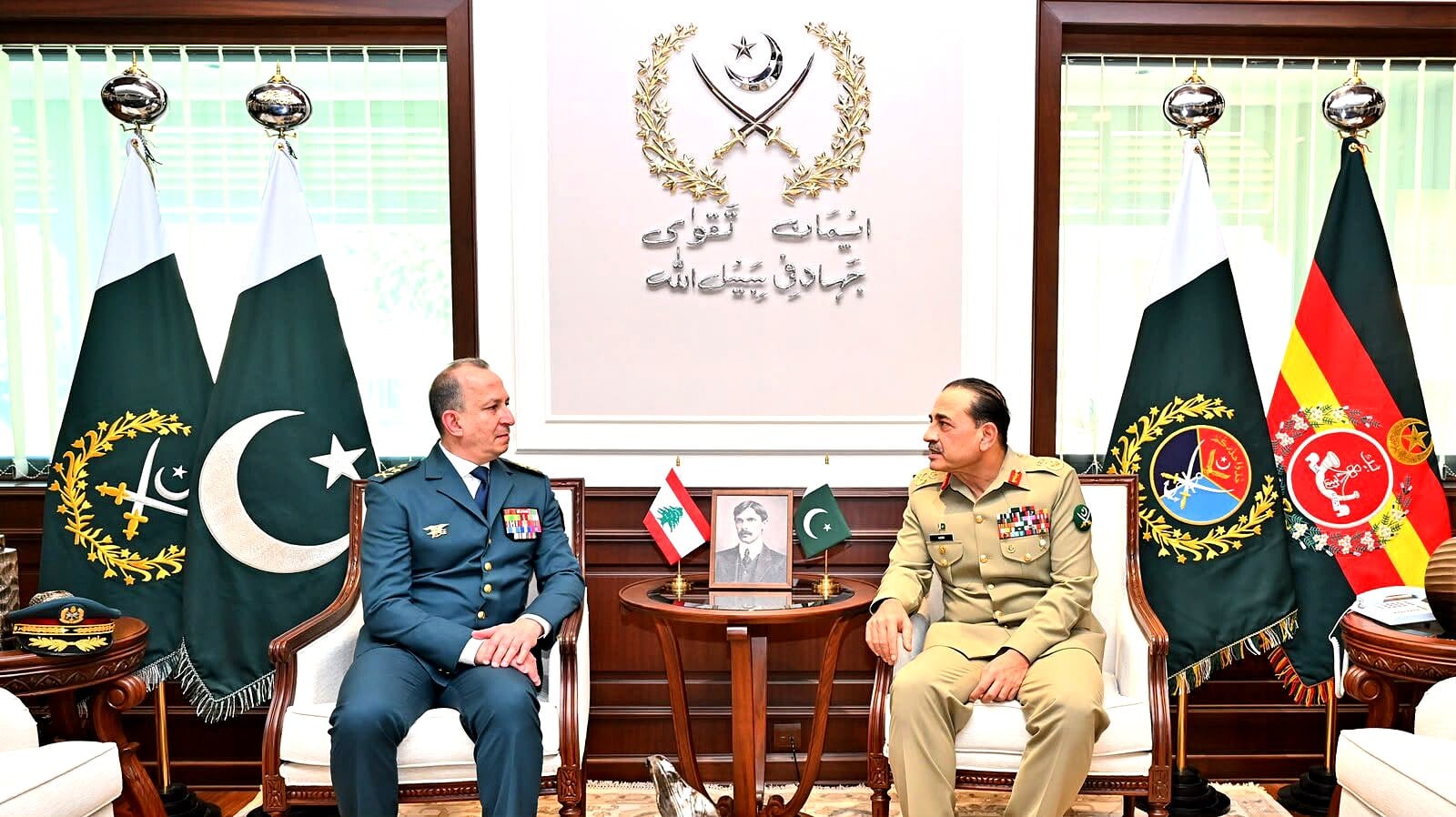




ISLAMABAD: Commander-in-Chief of the Lebanese Armed Forces General Rodolphe Haykal called on Field Marshal Syed Asim Munir, NI (M), HJ, Chief of Army Staff and Chief of Defence Forces, at General Headquarters in Rawalpindi on Tuesday.
The two military leaders discussed the evolving regional security environment, defence cooperation, and prospects for enhancing bilateral military relations.
Upon arrival at GHQ, General Haykal was presented a guard of honour by a smartly turned-out tri-services contingent, according to the Inter-Services Public Relations.
The meeting took place amid ongoing regional tensions in the Middle East. Pakistan has been actively involved in diplomatic efforts to stabilise the situation involving multiple stakeholders.
ISPR stated that the leaders exchanged views on matters of mutual interest. Discussions focused on strengthening professional interactions and expanding training cooperation between the armed forces of both countries.
Pakistan and Lebanon share longstanding military ties. Pakistani troops have served in United Nations peacekeeping missions in Lebanon, contributing to stability efforts in the region for over a decade.
General Haykal’s visit follows his departure from Lebanon on June 6 at the invitation of his Pakistani counterpart. The trip comes as diplomatic initiatives continue to address broader Middle East challenges.
Field Marshal Munir reaffirmed Pakistan’s commitment to defence collaboration with Lebanon. General Haykal commended the professionalism of Pakistan’s armed forces and their role in international peacekeeping.
Pakistan’s military maintains robust training programmes with several partner nations. Over the years, thousands of officers from allied countries have received specialised training at Pakistani institutions, including the Command and Staff College and National Defence University.
Lebanon’s armed forces, numbering around 60,000 active personnel, face significant operational demands amid border security requirements. The country has received international support for capacity building, including equipment and training assistance.
The discussions are expected to open avenues for enhanced institutional linkages. Potential areas include joint exercises, counter-terrorism training modules, and sharing of best practices in border management.
Regional security dynamics have grown more complex in recent months. Developments in the Levant and Gulf areas continue to influence broader strategic calculations across Asia and the Middle East.
Pakistan maintains a policy of constructive engagement with regional partners. Such high-level military exchanges help build mutual understanding and explore cooperation without entering formal alliances.
Defence analysts observe that these interactions occur against a backdrop of global efforts to manage flashpoints. Stable military-to-military channels serve as important confidence-building measures.
The Lebanese delegation’s engagement highlights Pakistan’s growing role as a responsible actor in regional diplomacy. Islamabad has positioned itself as a bridge for dialogue among various parties.
No specific agreements were announced immediately after the meeting. Further details on outcomes are likely to emerge through official channels in coming days.
Pakistan’s defence exports and training expertise have expanded in recent years. The country offers cost-effective and battle-tested solutions tailored to operational environments similar to those in Lebanon.
Observers note the importance of sustained engagement. Regular high-level contacts help align perspectives on common security threats, including terrorism and instability spillover.
The visit underscores the value both nations place on defence diplomacy. It also reflects Pakistan’s continued outreach to maintain peace and security in the wider region.
As regional dynamics evolve, such meetings contribute to informed decision-making. They lay groundwork for practical cooperation that benefits both armed forces and supports larger stability objectives.
Future engagements are anticipated to build upon today’s discussions. These could include expanded training exchanges and technical collaboration in areas of shared interest.