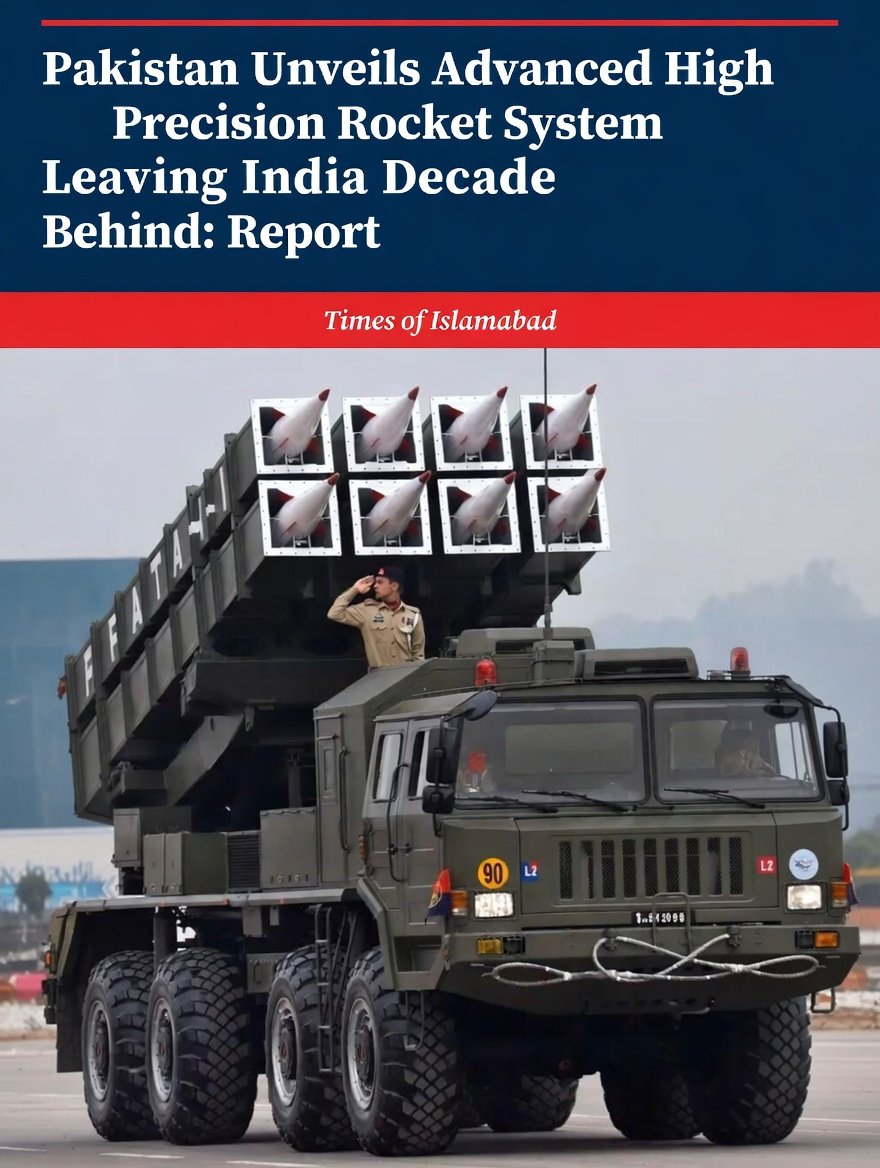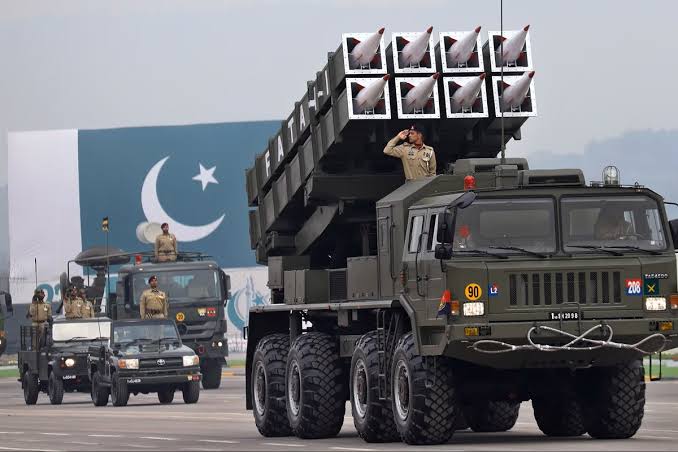




ISLAMABAD: Pakistan’s rapidly advancing indigenous rocket force has emerged as a decisive factor in South Asia’s evolving strategic landscape, with recent developments indicating a widening technological and operational gap that analysts believe could take decades for India to bridge.
The unveiling and progressive testing of Pakistan’s Fatah series, particularly the Fatah-4 and the reported extended-range variants approaching the 1,000-kilometre class, have redefined the country’s conventional deterrence posture by integrating precision strike capability with long-range battlefield dominance.
Defence analysts note that modern warfare increasingly relies on stand-off precision systems rather than sheer numerical superiority, and Pakistan’s emphasis on guided rocket artillery reflects a doctrinal shift aimed at achieving rapid, high-accuracy strike potential within minutes of deployment.
The Fatah-1 and Fatah-2 systems, already inducted, demonstrated ranges between 140 and 400 kilometres with guided accuracy, reportedly achieving circular error probabilities of under 10 metres, a figure that places them among the most accurate guided rocket systems in the region.
Building on this foundation, regional defence reports and military observers suggest that the Fatah-4 and subsequent developments are being designed to extend operational reach deep into adversary territory, potentially approaching or exceeding 700 to 1,000 kilometres depending on payload configuration and guidance enhancements.
This evolution effectively transforms rocket artillery into a quasi-ballistic precision system capable of targeting high-value infrastructure, command centres, and logistical hubs with minimal warning time, significantly complicating enemy defensive planning.
Pakistan’s indigenous development model has played a central role in this advancement, reducing reliance on foreign suppliers and enabling faster iteration cycles in propulsion, guidance systems, and battlefield integration technologies.
Experts point out that the integration of satellite-assisted navigation, inertial guidance systems, and terminal-phase maneuverability allows Pakistan’s newer rocket systems to maintain accuracy even under electronic warfare conditions, an area considered critical in modern high-intensity conflicts.
In contrast, India’s primary rocket artillery system, the Pinaka multi-barrel rocket launcher, while effective in its original role, remains largely confined to shorter-range battlefield applications, with most operational variants ranging between 40 to 120 kilometres.
Although India has tested extended-range and guided Pinaka variants, defence assessments indicate that scaling these systems to match the long-range precision capabilities demonstrated by Pakistan would require substantial technological upgrades and doctrinal adjustments.
Furthermore, India’s long-range strike capabilities remain heavily dependent on ballistic missile systems such as the Agni series, which, while powerful, serve a strategic deterrence role rather than flexible battlefield support, thereby creating a capability gap in the intermediate precision strike domain.
This distinction is critical, as modern conflicts increasingly demand systems that can deliver precise, rapid, and scalable responses without escalating to full-spectrum missile deployment, a niche Pakistan’s Fatah series is specifically designed to fill.
Military experts argue that bridging this gap is not merely a matter of extending range but involves mastering complex technologies such as advanced propulsion efficiency, real-time targeting integration, electronic counter-countermeasures, and precision guidance under contested environments.
Pakistan’s ability to integrate these components into an operational system reflects years of focused investment in defence research and development, supported by coordinated efforts between military institutions and indigenous engineering sectors.
Regional media reports highlight that Pakistan has prioritized modular system architecture, allowing rapid upgrades and customization based on mission requirements, a feature that significantly enhances operational flexibility and reduces development timelines.
The strategic implications of these advancements are profound, as they enable Pakistan to maintain credible deterrence while avoiding excessive dependence on high-cost ballistic missile deployments, thereby optimizing resource allocation in a constrained economic environment.
Analysts also emphasize the psychological and doctrinal impact of such systems, noting that precision-guided long-range rockets alter adversary calculations by reducing safe operational depth and increasing vulnerability of rear-area assets.
In India’s case, replicating such a system would require not only technological breakthroughs but also a reorientation of military doctrine to integrate long-range guided rocket artillery as a core component of its conventional strike capability.
Estimates suggest that developing comparable systems, testing them extensively, and integrating them into operational formations could take well over a decade, particularly given the complexities involved in achieving consistent accuracy at extended ranges.
Additionally, supply chain dependencies, testing infrastructure limitations, and the need for synchronized command-and-control systems further complicate India’s pathway to parity in this domain.
Pakistan’s progress, on the other hand, underscores the advantages of focused indigenous development combined with incremental capability enhancement, allowing the country to steadily expand its operational envelope without major disruptions.
The emergence of extended-range Fatah variants also signals Pakistan’s intent to maintain technological momentum, ensuring that its rocket force continues to evolve in line with future battlefield requirements.
As regional security dynamics continue to shift, the emphasis on precision, speed, and flexibility is expected to define the next generation of military capabilities, placing systems like Pakistan’s Fatah series at the forefront of modern warfare evolution.
In this context, analysts conclude that the current trajectory strongly favors Pakistan’s indigenous rocket force, with its combination of range, accuracy, and adaptability presenting a challenge that would require sustained effort and significant time for any regional competitor to match.
The growing gap highlights not only a technological achievement but also a strategic recalibration, positioning Pakistan as a key player in the domain of advanced precision strike systems in South Asia.