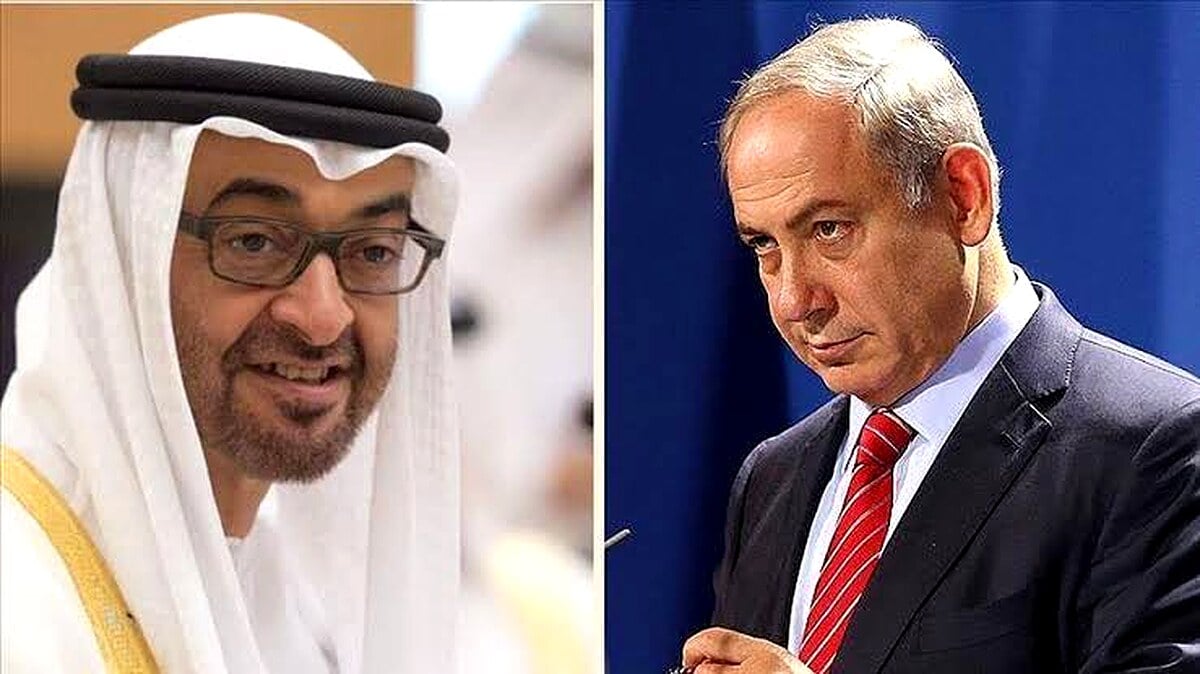




ISLAMABAD: The office of Israeli Prime Minister Benjamin Netanyahu announced on Wednesday that he made a secret visit to the United Arab Emirates during the recent Israel-Iran conflict and held talks with UAE President Sheikh Mohamed bin Zayed Al Nahyan.
The statement described the meeting as resulting in a “historic breakthrough” in bilateral relations. Israeli sources indicated the discussions took place in Al-Ain on March 26 and lasted several hours.
The UAE Foreign Ministry immediately rejected the claims, calling them “entirely unfounded.” Abu Dhabi stressed that its relations with Israel remain public under the Abraham Accords framework and do not involve undisclosed or secret arrangements.
Netanyahu’s office released the details amid ongoing regional tensions following Israel’s Operation Roaring Lion strikes against Iranian targets earlier this year. The timing of the disclosure has drawn attention to the diplomatic maneuvering between the two sides.
UAE officials maintained that any such high-level engagements would be officially announced through proper channels. The ministry urged media outlets to avoid circulating unverified information.
The Abraham Accords, signed in 2020, normalized relations between Israel and the UAE, leading to expanded cooperation in trade, technology, and security. Bilateral trade has grown significantly since then, reaching several billion dollars annually, though exact recent figures remain subject to periodic updates by both governments.
The reported meeting allegedly occurred early in Israel’s February 2026 military campaign against Iran. Israeli statements suggested the talks advanced security coordination, potentially including expanded defense systems collaboration.
Iran has reacted sharply to the claims. Iranian officials warned that any collusion with Israel would carry consequences, reflecting heightened sensitivities in the Gulf following missile exchanges and regional escalation.
The contradictory statements have created diplomatic embarrassment for the UAE, which maintains careful balancing acts between its Western and Israeli partnerships and broader Arab and Islamic world considerations, particularly amid the Palestinian issue and Iran tensions.
Analysts note that public disclosure by Israel, while the UAE denies the visit, highlights differing approaches to managing perceptions. Israel appears to project strengthened Gulf alliances, whereas the UAE prioritizes transparency in its normalized ties to limit domestic and regional backlash.
Pakistan, which does not recognize Israel, has closely monitored developments in the Middle East. Islamabad has consistently supported a two-state solution and expressed concern over escalations that could destabilize the wider region, affecting energy markets and security dynamics important for South Asia.
The episode underscores the complex nature of post-Abraham Accords diplomacy. While economic and technological ties between Israel and the UAE have advanced steadily, security cooperation often proceeds with greater discretion due to regional political sensitivities.
Further details on the alleged discussions remain limited. Israeli sources have not released specific outcomes beyond the general claim of a breakthrough, while the UAE has maintained complete denial.
Observers will watch for any follow-up statements from either side or signs of tangible new cooperation in defense, intelligence, or economic domains.
The conflicting narratives are likely to fuel speculation about behind-the-scenes contacts as the region navigates a fragile post-conflict environment.
Regional consequences could include pressure on Gulf states to clarify their positions amid Iranian warnings and Arab public opinion concerns. The episode also raises questions about the sustainability of discreet high-level engagements in an era of rapid information flow.
Future developments may hinge on how both governments manage the fallout and whether any verifiable policy shifts emerge in the coming weeks.