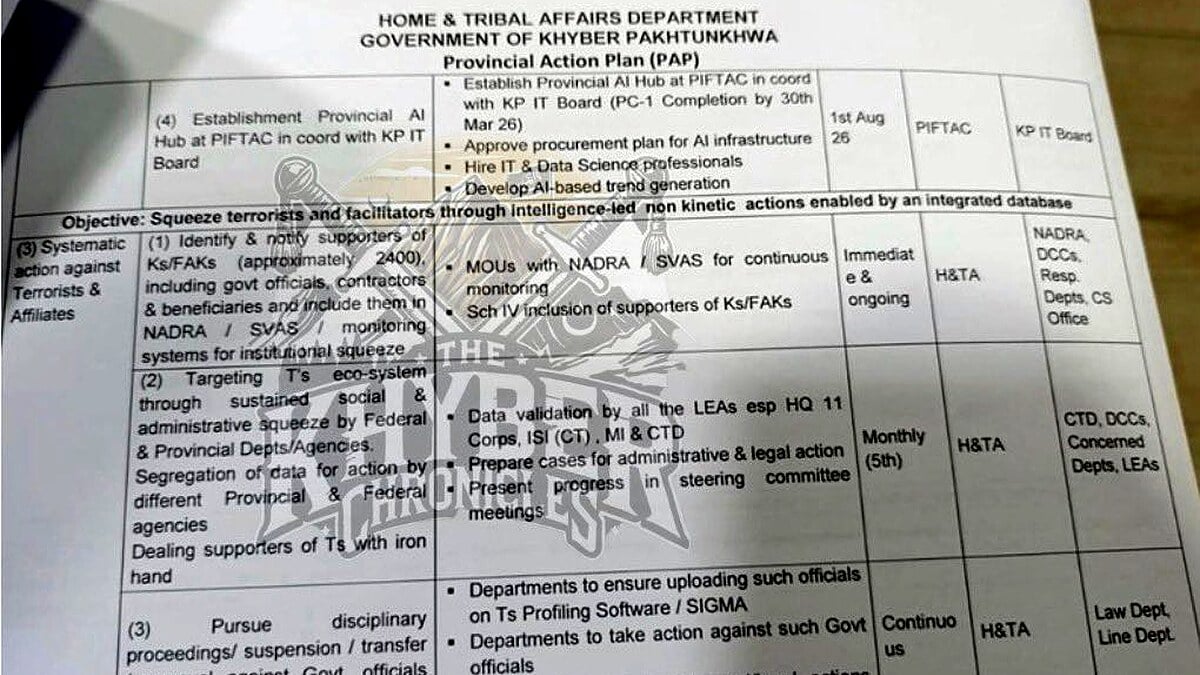




ISLAMABAD: The Khyber Pakhtunkhwa Home Department has compiled data on approximately 2400 government employees suspected of providing assistance to terrorists, according to official documents.
Relevant departments have been directed to verify the information. Action will be initiated against those whose involvement is confirmed.
Provincial officials confirmed that implementation of the Provincial Action Plan against Terrorism has begun. Investigations against several employees are already underway.
**”Strict disciplinary action will be taken against government employees found facilitating terrorists,”** according to the action plan framework.
The move forms part of a broader effort to strengthen internal accountability within provincial institutions amid rising security challenges in the province.
The Home Department documents outline a systematic process. Departments must submit detailed employee records for screening. Once investigations conclude, confirmed cases will face departmental proceedings, including possible dismissal and legal action under anti-terrorism laws.
This initiative targets facilitation networks that include logistical support, intelligence sharing, and financial aid to banned outfits, primarily active in southern and merged districts.
Khyber Pakhtunkhwa has recorded a significant surge in terrorist activity. The province accounted for the majority of terrorism-related incidents in Pakistan in recent years, with over 1,700 cases reported in 2025 alone in some assessments.
Security forces and police have faced repeated attacks, with hundreds of personnel killed in the line of duty. The Counter Terrorism Department (CTD) has expanded operations, increasing regional units and establishing specialised cells to counter terror financing and facilitation.
Background to the current measures traces to the revised provincial strategy that assigns a leading role to civilian administration in counter-terrorism. The 84-point plan emphasises intelligence gathering, deradicalisation, and accountability within state institutions.
Officials note that past operations focused primarily on kinetic actions. The new approach integrates administrative reforms to disrupt support ecosystems.
**Market and public reactions remain cautious.** Business communities in Peshawar and other urban centres have welcomed stricter internal checks, hoping they will improve overall security and investor confidence. However, concerns persist about potential disruptions in government service delivery if large-scale dismissals occur.
Regional security analysts point to cross-border dimensions, with many attacks linked to groups operating from Afghan territory. Pakistani officials have repeatedly highlighted the need for coordinated action on both sides of the border.
The provincial government has allocated additional resources for intelligence and surveillance. Recent approvals include billions in funding to enhance counter-terrorism capabilities across districts.
As investigations progress, authorities are expected to share more details on specific departments and regions most affected. Timelines for completion of initial probes have not been publicly disclosed, though officials indicate priority is being given to high-risk postings in sensitive areas.
The development comes as security forces continue intelligence-based operations against terrorist hideouts. Recent weeks have seen multiple engagements resulting in militant casualties.
Broader implications for provincial governance are significant. Successful implementation could strengthen public trust in state institutions. Failure to deliver transparent outcomes risks perceptions of selective accountability.
Future phases of the action plan are likely to include capacity building for oversight mechanisms and coordination between provincial departments and federal intelligence agencies.
Observers will closely monitor how the screening process unfolds and its impact on the overall counter-terrorism campaign in the province.