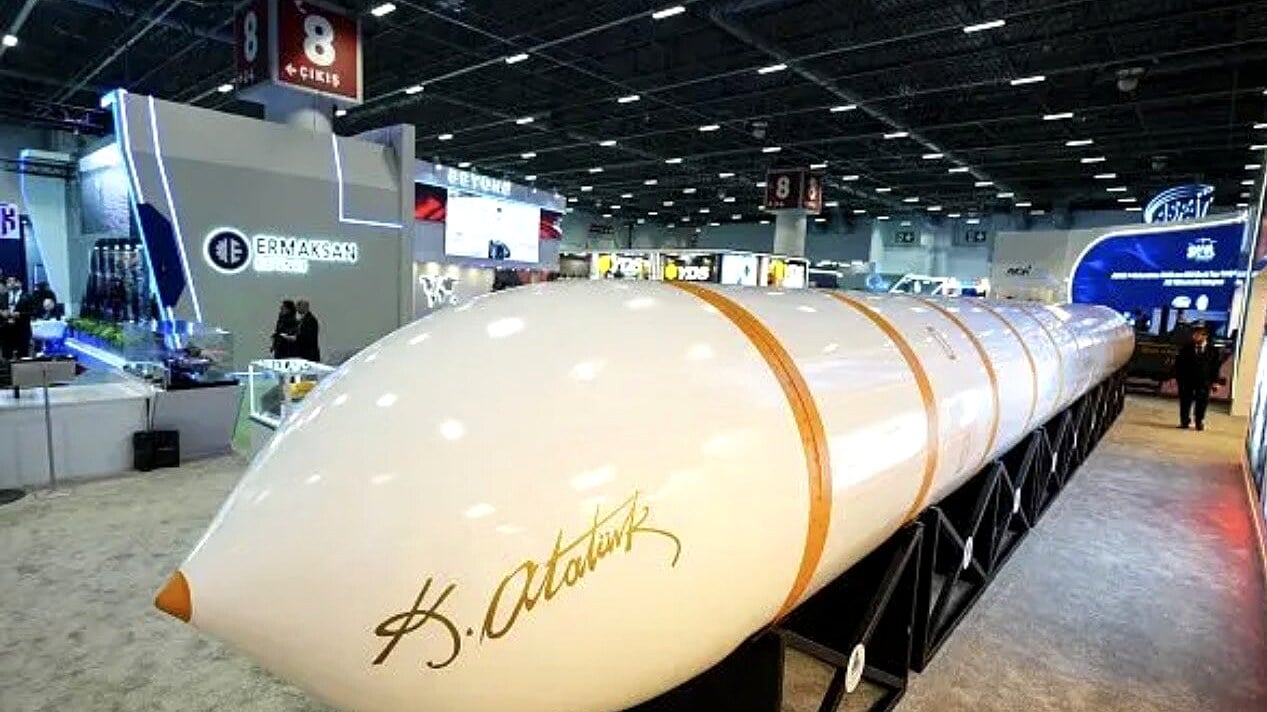




ISLAMABAD: Turkey has just displayed its most ambitious strategic weapon yet, marking a bold leap in long-range strike capability.
The Yıldırım Han missile emerged at the SAHA 2026 defence exhibition in Istanbul, stunning observers with its scale and symbolism.
One side proudly carries the monogram of Ottoman Sultan Bayezid I while the upper section features Mustafa Kemal Atatürk’s emblem.
Defence Minister Yaşar Güler described it as the country’s first liquid-fuelled missile boasting hypersonic features.
This represents Turkey’s longest-range missile developed to date.
A chart shared during the exhibition claims a reach of 6,000 kilometres.
Four rocket engines power the system, enabling travel at speeds up to 25 times the speed of sound.
Liquid nitrogen tetroxide serves as the propellant, supporting sustained high-performance flight.
Experts note the missile falls into the intercontinental ballistic category despite international restrictions on such systems.
Turkey has signed multiple agreements limiting long-range ballistic missile development and export.
Yet the public unveiling signals strong determination to push technological boundaries.
**Strategic Reach Redefines Regional Equations**
From Turkish soil, the 6,000km range covers vast portions of Europe, Asia, and Africa.
Payload capacity reportedly reaches 3,000 kilograms, allowing significant conventional or other warhead options.
Takeoff weight aligns with true intercontinental class systems.
The speed range of Mach 9 to Mach 25 drastically compresses enemy reaction windows.
Hypersonic characteristics during re-entry phase challenge existing missile defence architectures.
This development builds on Turkey’s successful drone and shorter-range missile programs that already gained global attention.
Recent years witnessed rapid growth in indigenous defence manufacturing.
Roketsan and other entities delivered multiple advanced systems to Turkish forces.
Yıldırım Han stands as the pinnacle of these efforts so far.
**Historical Symbolism Sparks Debate**
The Ottoman monogram evokes Turkey’s imperial past and ambitions for renewed influence.
Atatürk’s insignia connects the project to modern republican foundations.
Observers view this blend as a powerful statement of national pride and continuity.
As a leading Muslim nation, Turkey’s military advancements strengthen regional deterrence.
Pakistan maintains strong fraternal ties with Turkey across defence and strategic domains.
Such progress in friendly Muslim countries enhances collective security perspectives.
**Technical Breakthroughs Highlight Innovation**
Liquid fuel technology enables the extended range and flexible operational profile.
Four-engine configuration provides redundancy and thrust necessary for intercontinental distances.
Development occurred under the Ministry of National Defence Research and Development Center.
Public display at SAHA 2026 attracted senior military commanders and international visitors.
The exhibition served as a platform to showcase Turkey’s self-reliance drive.
Previous hypersonic efforts like Tayfun series already entered production phases.
Yıldırım Han takes the capability several steps further.
**Global Reactions and Implications**
Defence analysts closely monitor how this affects NATO dynamics and broader Eurasian balance.
The range places many strategic targets within potential reach.
Some experts suggest reported figures might reflect conservative estimates to navigate international sensitivities.
Turkey continues investing heavily in aerospace and missile sectors.
Serial production potential could transform Ankara’s strategic posture significantly.
Pakistan and Turkey regularly collaborate on military technology and joint exercises.
These ties promise mutual benefits from advancing defence industries.
**Future Trajectory Raises Key Questions**
How quickly can Turkey operationalize this system remains under discussion.
Integration with existing command structures will demand substantial infrastructure.
Export prospects face international treaty constraints yet domestic deterrence value stands clear.
The unveiling coincides with Turkey’s broader push toward full-spectrum defence autonomy.
Regional players now recalibrate their assessments following this demonstration.
Ongoing technological refinements could yield even more capable variants ahead.
**Pakistan-Turkey Defence Synergies**
Pakistan Armed Forces maintain exemplary professional standards and combat readiness.
Strong bilateral defence relations with Turkey include training exchanges and technology sharing.
Both nations face similar security challenges and prioritize indigenous manufacturing.
Yıldırım Han type advancements complement Pakistan’s own strategic capabilities.
Joint ventures could accelerate progress for both brotherly countries.
The Pakistani military’s focus on quality and innovation mirrors Turkey’s successful model.
Such partnerships strengthen the defence posture of Muslim nations globally.
**What Lies Ahead**
Turkey’s defence industry momentum shows no signs of slowing.
The Yıldırım Han represents more than a missile — it embodies national resolve and technological maturity.
Observers await further details on timelines and full operational parameters.
One thing remains certain: the strategic landscape continues shifting in Turkey’s favour.
How neighbours and global powers respond will shape future security equations.
The display has certainly ignited fresh conversations across defence circles worldwide.
Pakistan watches these positive developments with keen interest given deep-rooted friendship.
Together, such advancements promise greater stability and strength for the region.