



(PAF Unveils Indigenous Stand-Off Weapon Boosting JF-17 Strike Capabilities
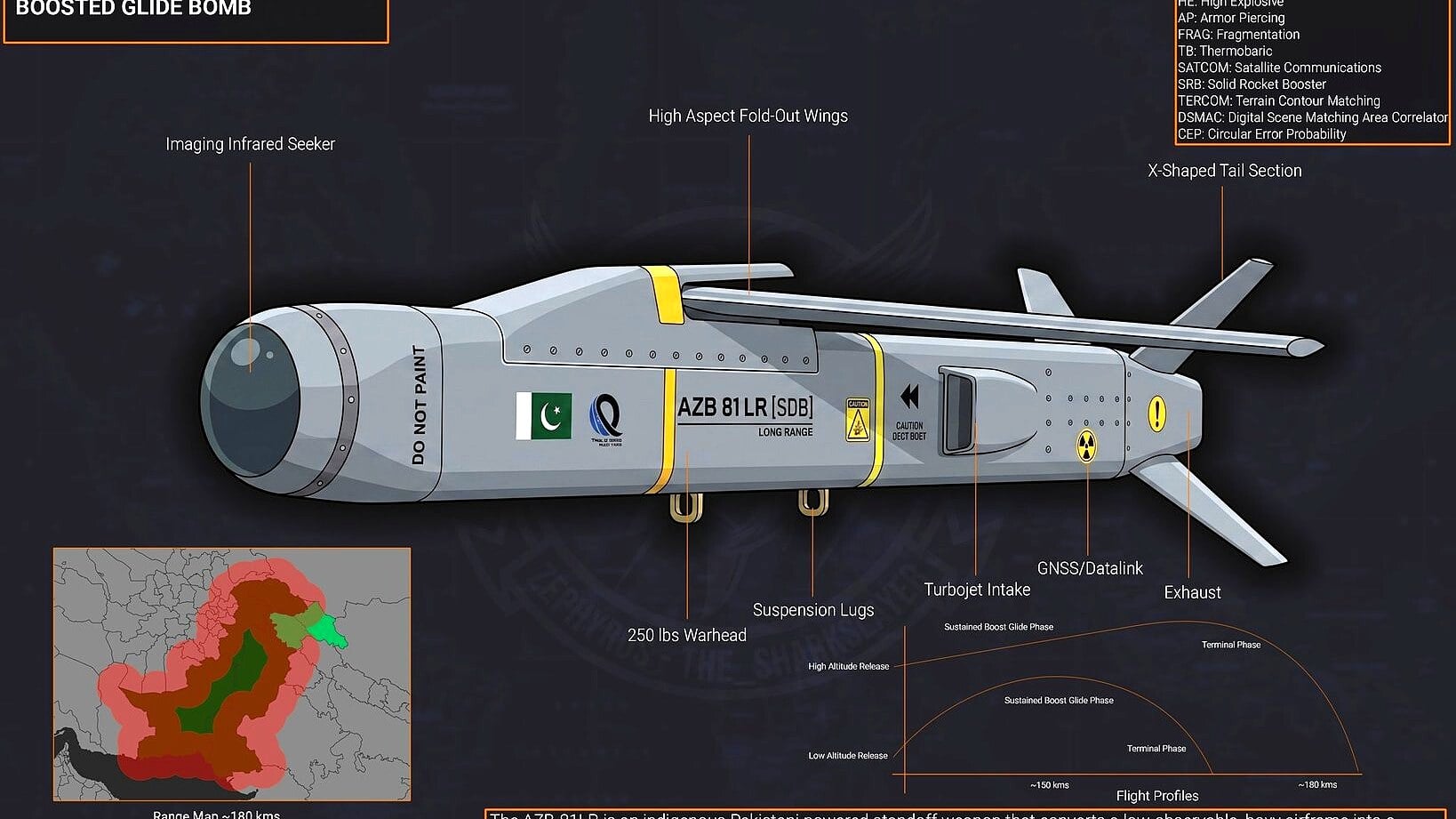
ISLAMABAD: Pakistan’s defence industry has delivered a significant milestone in precision munitions with the unveiling of the AZB-81LR Small Diameter Bomb.
The long-range stand-off weapon, developed by Qaswa Industries, promises to enhance the Pakistan Air Force’s ability to strike deep targets while keeping aircraft out of harm’s way.
Unveiled at the International Defence Exhibition and Seminar IDEAS 2024 in Karachi, the AZB-81LR marks a major step in Pakistan’s push for self-reliance in advanced weaponry.
Defence officials describe it as a game-changing addition to the PAF’s arsenal, designed specifically for modern battlefield requirements.
The AZB-81LR is built around the Mk-81 119 kg bomb, housed in a specially engineered airframe that incorporates advanced gliding systems and a miniature turbojet powerplant.
This combination extends its operational range to 200 kilometres, allowing strikes on adversary targets near bordering areas without exposing launching platforms to enemy air defences.
Qaswa Industries engineered the weapon with low-observable characteristics, making it extremely difficult for conventional air defence systems to detect and intercept.
The bomb features multiple guidance options including INS, GNSS, and imaging infrared homing, ensuring high accuracy even in contested environments.
Its small diameter design reduces collateral damage while maintaining lethal effectiveness against high-value targets such as radar installations, command centres, and armoured assets.
Industry sources indicate the AZB-81LR is currently undergoing rigorous testing phases, with expectations that it will soon enter formal evaluation with the Pakistan Air Force.
The development comes at a time when regional air defence networks have grown increasingly sophisticated, demanding longer standoff ranges and stealthier munitions.
Pakistan has steadily expanded its indigenous munitions portfolio in recent years, moving from basic glide bombs to complex powered stand-off systems.
The AZB-81LR builds on earlier efforts like the Takbir series used effectively in past operations, but introduces turbojet propulsion for dramatically increased reach.
Defence analysts note that such weapons align with the PAF’s evolving doctrine emphasising munitions-first approaches over platform-centric operations.
Integration plans reportedly include compatibility with various combat aircraft and potentially unmanned combat aerial vehicles, offering flexible deployment options.
The weapon’s design supports multiple mission profiles including Suppression of Enemy Air Defences (SEAD) and Destruction of Enemy Air Defences (DEAD).
Its low-observable profile makes it particularly suitable for neutralising advanced surface-to-air missile systems and early warning radars.
Anti-terrorism operations in challenging terrain also stand to benefit from the AZB-81LR’s precision and range, allowing safer engagement of distant militant hideouts.
The timing of the unveiling at IDEAS 2024 reflects Pakistan’s growing confidence in showcasing locally developed systems on the global stage.
The exhibition itself drew significant international attention, with several countries expressing interest in Pakistani defence products.
Qaswa Industries positions the AZB-81LR not only for domestic use but also for potential export markets, with reports suggesting integration studies with Turkish and Chinese platforms.
This export orientation could open new revenue streams for Pakistan’s defence sector while strengthening strategic partnerships.
The AZB-81LR weighs between 100 to 125 kilograms, making it compatible with a wide range of fighter aircraft without significantly impacting payload capacity.
Its dual propulsion system – gliding for efficiency and turbojet for extended range – represents sophisticated engineering achieved through local expertise.
Defence experts highlight that the weapon addresses a critical capability gap in the PAF’s inventory for long-range precision strikes.
In an era of network-centric warfare, such munitions provide commanders with greater operational flexibility and reduced risk to valuable assets.
The development process involved close collaboration between Qaswa Industries and Pakistani military technical teams, ensuring the system meets specific operational requirements of the PAF.
Testing protocols reportedly focus on real-world scenarios including electronic warfare environments and adverse weather conditions.
Successful induction of the AZB-81LR would strengthen Pakistan’s deterrent posture along its eastern and western borders.
It complements existing capabilities such as the JF-17 Thunder multirole fighter and various cruise missile systems already in service.
The weapon’s imaging infrared seeker enables target engagement even when GPS signals are jammed, adding resilience against modern electronic countermeasures.
This multi-mode guidance suite positions the AZB-81LR among the more advanced small diameter bombs in the region.
As Pakistan continues investing in its defence industrial base, projects like the AZB-81LR demonstrate tangible progress toward greater technological sovereignty.
The system also carries strategic importance for maintaining balance in South Asia’s security environment.
Military observers suggest that enhanced stand-off capabilities could influence future operational planning on both sides of the border.
However, the primary focus remains on bolstering Pakistan’s defensive readiness and operational effectiveness.
Qaswa Industries has not publicly released detailed performance specifications beyond the 200km range and core design features.
Further details are expected to emerge as testing advances and potential production contracts materialise.
The AZB-81LR joins a growing list of indigenous systems unveiled in recent years, from loitering munitions to advanced UAVs.
This momentum reflects sustained government and military commitment to developing local solutions for complex security challenges.
For the Pakistan Air Force, the weapon offers new tactical possibilities in both conventional and sub-conventional operations.
Its ability to strike from safe distances could prove decisive in high-threat scenarios involving dense air defence networks.
As testing continues, defence officials remain optimistic about the AZB-81LR’s future role in strengthening national security.
The project underscores Pakistan’s determination to evolve from technology recipient to technology provider in the defence domain.
With its combination of range, precision, and survivability, the AZB-81LR stands as a notable achievement for Qaswa Industries and the broader Pakistani defence establishment.