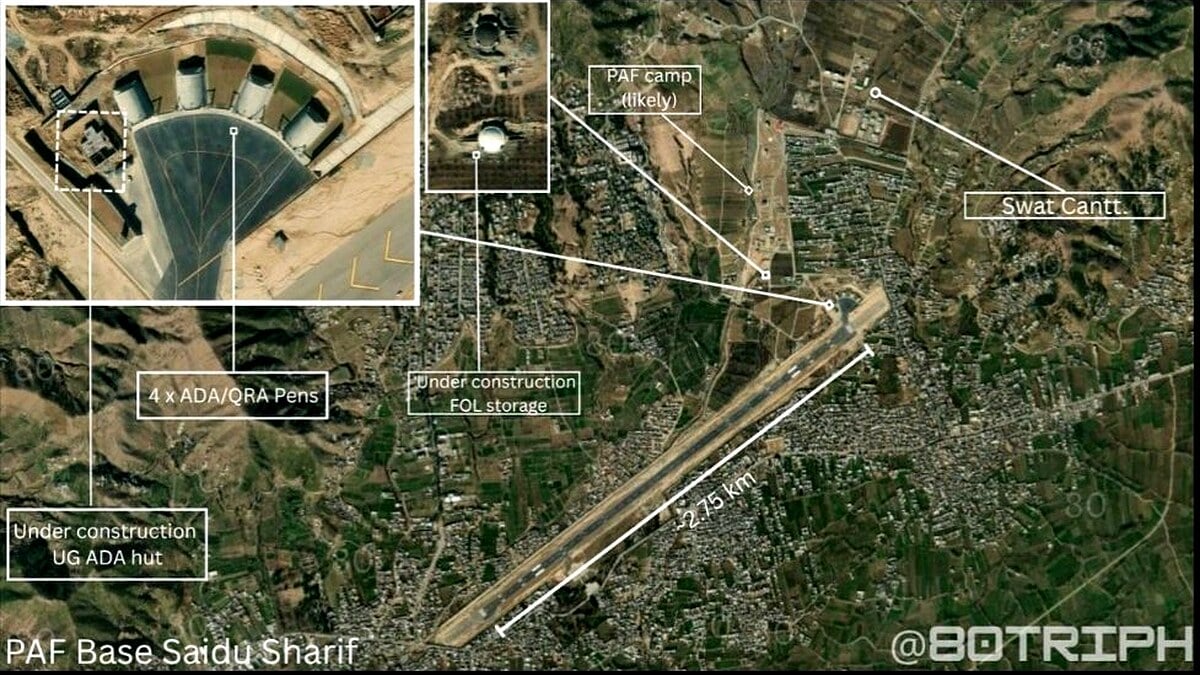




The Pakistan Air Force (PAF) has completed a significant transformation of the former civilian Saidu Sharif Airport into a fully operational Forward Operating Base (FOB). This strategic upgrade markedly enhances Pakistan’s air power projection in the northern sector, particularly along the sensitive western Himalayan region. With an extended runway now capable of accommodating C-130 Hercules transport aircraft and a range of fighter jets, alongside the construction of multiple hardened aircraft shelters and comprehensive infrastructure improvements, Saidu Sharif has evolved from a modest regional airfield into a robust military asset.
This development reflects Pakistan’s broader strategy to strengthen defensive and rapid-response capabilities in challenging mountainous terrain. The base’s location in the Swat Valley provides both operational advantages and natural fortification, positioning it as a critical node for air operations supporting ground forces and enabling quick deployment across the northern theater. The upgrades ensure that the PAF can maintain sustained operations even under contested conditions, improving logistical support, aircraft dispersal, and mission flexibility.
Strategic Significance of the Saidu Sharif FOB Saidu Sharif’s conversion into a Forward Operating Base addresses longstanding requirements for dispersed operations in Pakistan’s northern areas. The extended runway facilitates heavier aircraft movements, allowing rapid reinforcement of forward positions and efficient evacuation or supply missions. Hardened aircraft shelters (HAS) protect valuable assets from potential aerial strikes, while enhanced fuel storage, maintenance facilities, and command infrastructure support round-the-clock operations.
In a region characterized by difficult accessibility and extreme weather variations, this base significantly reduces response times for air support. Fighters operating from Saidu Sharif can reach key areas along the Line of Control (LoC) more swiftly compared to distant main bases. This proximity enables persistent air patrols, close air support, and rapid interception missions, thereby complicating any potential adversary’s offensive planning in the northern sector.
Why Saidu Sharif Poses Extreme Challenges for Cruise Missiles The base’s formidable defensive profile stems not only from man-made enhancements but equally from its unique geography. Cruise missiles, such as India’s BrahMos, rely on low-altitude, terrain-hugging flight profiles to evade radar detection. However, the topography surrounding Saidu Sharif transforms these strengths into vulnerabilities.
Narrow Mountain Valleys and Terrain Masking:
Saidu Sharif lies nestled deep within the Swat Valley, encircled by steep ridges and the formidable foothills of the Himalayas. Low-flying cruise missiles must navigate constricted corridors between towering peaks. At supersonic speeds, even minor deviations in trajectory can result in catastrophic collisions with cliffs or ridges. This terrain masking effect limits the missile’s ability to maintain consistent altitude and heading, forcing it into highly constrained flight envelopes.
Complicated Flight Paths:
Unlike open terrain where cruise missiles follow relatively predictable routes, accessing Saidu Sharif demands intricate path programming. Missiles cannot approach via straight-line vectors; they must follow winding valley contours. This complexity challenges pre-mission terrain mapping and real-time guidance systems. Small errors in digital elevation data or inertial navigation accumulate rapidly, increasing the probability of mission failure or significant deviation from the intended target.
Reduced Radar and Detection Reliability:
The surrounding mountains create substantial blind spots for both the launching platform’s guidance systems and the missile’s onboard terrain-following radar. Deep valleys disrupt line-of-sight communications and satellite-based positioning accuracy in certain segments. GPS/INS integration faces interference from steep elevation changes, potentially degrading terminal guidance precision.
Compressed Reaction Windows for Attackers:
Although cruise missiles like BrahMos offer standoff ranges of approximately 130–290 kilometers, the demanding terrain necessitates slower or more predictable final approach phases to avoid terrain impact. This predictability grants PAF air defense systems, including point-defense solutions and fighter aircraft on Quick Reaction Alert (QRA), additional critical seconds to detect, track, and engage incoming threats. Integrated air defense networks around the base can exploit these constraints effectively.
Broader Regional Implications The transformation of Saidu Sharif strengthens Pakistan’s deterrence posture by raising the operational costs and risks associated with any aerial campaign targeting northern Pakistan. It underscores the PAF’s commitment to developing resilient infrastructure that leverages geography as a force multiplier. For potential adversaries, the combination of natural barriers and modern military enhancements creates a high-risk environment for precision strike assets.
This upgrade also enhances humanitarian and disaster response capabilities in a seismically active and flood-prone region, demonstrating dual-use value. However, its primary significance remains strategic—establishing a robust forward presence that complicates offensive planning while ensuring rapid defensive response.
In conclusion, the PAF’s investment in Saidu Sharif represents a calculated enhancement of operational depth and survivability. By converting a civilian airport into a well-protected Forward Operating Base, Pakistan has created a facility that is not only militarily potent but also exceptionally difficult to neutralize through standoff weapons. The formidable natural defenses of the Swat Valley, combined with professional military upgrades, ensure that any attempt to target this base would face substantial technical and tactical hurdles.