



International North-South Transport Corridor
Russian Deputy Prime Minister Alexey Overchuk has confirmed ongoing discussions to connect Pakistan’s Gwadar Port with the International North-South Transport Corridor.
The statement came on the sidelines of the Kazan Forum in response to a question from Sputnik.
Overchuk highlighted that Moscow and Islamabad have been engaged in talks for some time about linking Pakistan to the ambitious multimodal route.
He emphasized that various connectivity options, including railway links, are under active consideration.
Work on the corridor continues despite regional conflicts, including those affecting Iran, Overchuk noted.
“We certainly welcome such initiatives from Pakistan,” the Deputy Prime Minister said.
The development marks a significant step in deepening Russia-Pakistan economic ties amid shifting global trade dynamics.
The International North-South Transport Corridor spans approximately 7,200 kilometers. It connects major Russian hubs with ports in Iran and onward to the Indian Ocean.
Originally established in 2000 by Russia, Iran, and India, the INSTC has expanded to include Azerbaijan, Kazakhstan, and other Eurasian nations.
Cargo volumes along the corridor have grown steadily. Russian authorities reported a 19 percent increase in 2024, reaching around 26.9 million tons.
Pakistan’s integration could further boost these figures by providing an efficient southern gateway.
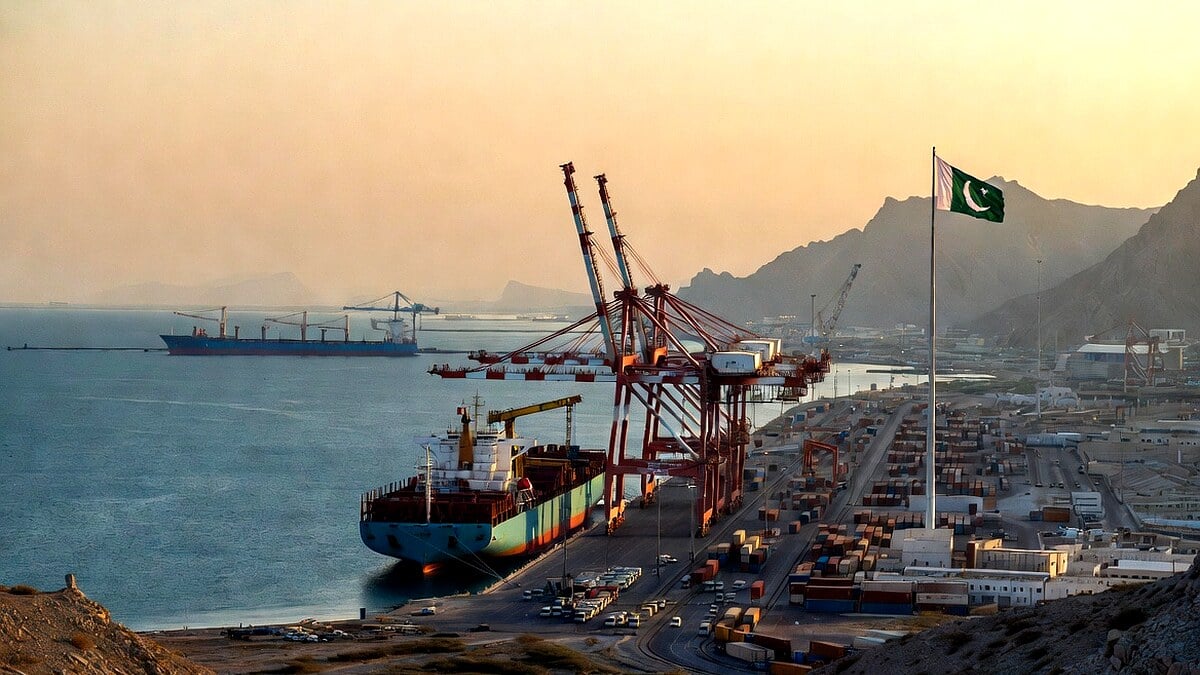
Gwadar Port, strategically located on the Arabian Sea near the Strait of Hormuz, stands at the heart of this potential expansion.
Developed under the China-Pakistan Economic Corridor, the deep-sea port offers shorter routes for trade between Eurasia, the Middle East, and beyond.
It reduces distances for Chinese and Central Asian cargo compared to traditional paths through the Strait of Malacca.
Recent fee reductions at Gwadar of 25 to 40 percent aim to attract more international shipping lines.
Pakistan has already taken concrete steps toward INSTC participation.
In June 2025, Islamabad launched plans for its first freight train to Russia from Lahore.
The service, expected to transit via Iran and Central Asia, covers roughly 8,000 kilometers in 20 to 25 days.
Test cargo shipments have been conducted along the eastern branch of the corridor.
Pakistan Railways Minister Muhammad Hanif Abbasi described the initiative as building not just railways but an entire economic corridor.
Bilateral transport agreements between Pakistan and Russia focus on upgrading road and rail networks.
These include potential investments in lines connecting Quetta to Taftan and broader links to Central Asia.
Russian interest in Pakistani warm-water ports aligns with Moscow’s strategy to diversify trade routes away from Western dependencies.
For Pakistan, the linkage promises enhanced transit revenues and positioning as a regional hub.
Landlocked Central Asian states could gain direct access to Arabian Sea ports, cutting logistics costs significantly.
Official estimates suggest the INSTC can reduce transit times by up to 40 percent compared to the Suez Canal route for certain cargoes.
Trade between Russia and India has already surged via the corridor, with further potential unlocked through Pakistani routes.
Overchuk’s comments come as Pakistan sends high-level delegations to forums like Kazan to promote connectivity.
Special Assistant to the Prime Minister Talha Burki and other officials have actively pitched Gwadar’s role in President Putin’s vision for the North-South corridor.
Discussions also cover energy cooperation, including possible LNG supplies from Russia to Pakistan.
Railway connectivity forms a key pillar of these talks.
Proposals include modernizing existing lines and building new segments to ensure seamless freight movement.
Challenges remain, including infrastructure gaps and regional security considerations.
However, both sides express determination to push forward despite obstacles.
The corridor’s progress amid tensions in the Middle East demonstrates its resilience.
Pakistan views the project as complementary to CPEC rather than competitive.
Gwadar has seen steady upgrades, with new equipment, faster clearance times under 48 hours, and development of free zones.
Dozens of enterprises have registered interest in the Gwadar Free Zone.
Integration with INSTC could multiply these benefits by opening northern markets.
Economists project substantial gains for Balochistan province, where Gwadar is located.
Improved connectivity may create thousands of jobs in logistics, services, and related industries.
For Russia, access to Gwadar strengthens its footprint in the Indian Ocean region.
It provides alternative routes for exports of grain, energy, and industrial goods.
Pakistan-Russia trade remains below potential but shows upward trends in recent years.
B