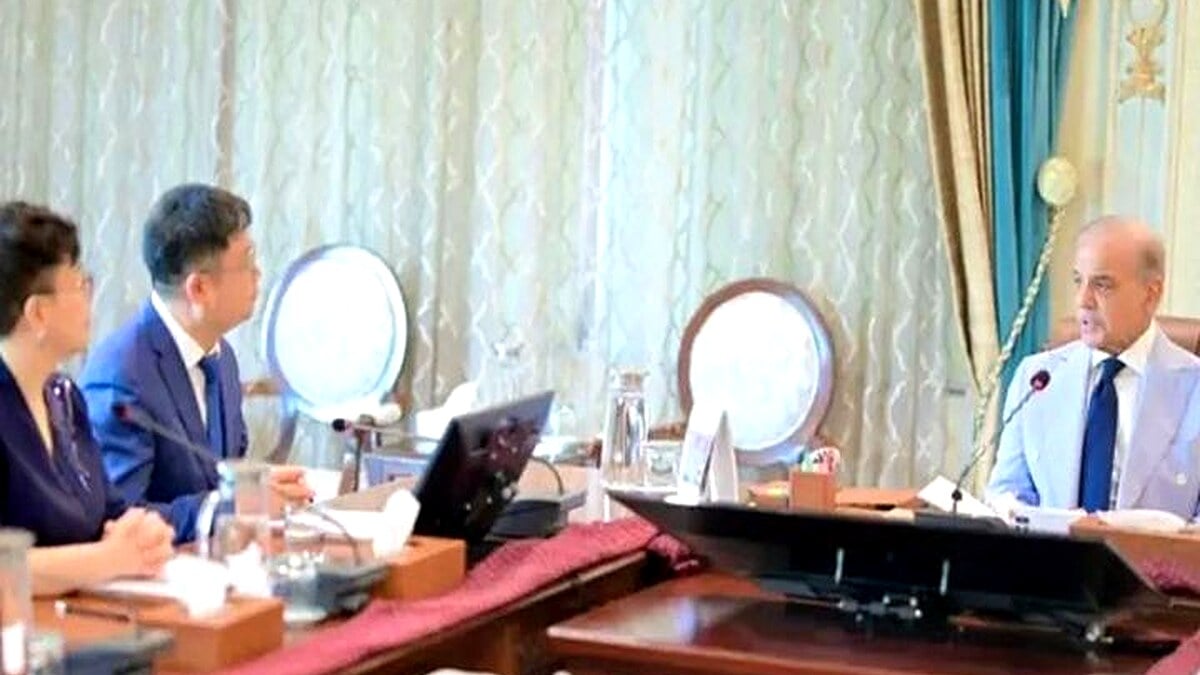




Islamabad: Prime Minister Shehbaz Sharif on Friday warmly received a high-level Chinese business delegation and threw full government support behind a major new digital economy initiative that aims to transform Pakistan into a regional technology hub.
The 11-member delegation was led by Qian Xiaojun, founder, president and controlling shareholder of IBI Beijing United Technology.
During the meeting at the Prime Minister’s House, Shehbaz Sharif praised IBI Group’s decision to establish its Pakistan Digital Economy Headquarters in the country.
Officials described the move as a significant step in deepening business-to-business ties between Pakistan and China under the evolving China-Pakistan Economic Corridor framework.
The Prime Minister highlighted the growing cooperation in the digital economy, investment facilitation and industrial collaboration.
He expressed satisfaction over the expanding partnership and looked forward to his upcoming visit to China later this month.
Qian Xiaojun conveyed strong confidence in Pakistan’s economic potential.
He stated that the new headquarters would serve as a command centre for digital transformation across the Pakistani economy.
According to the delegation, the platform will create massive opportunities for thousands of small and medium-sized enterprises by giving them direct access to the vast Chinese market.
The initiative builds on recent momentum in digital cooperation.
Just days earlier, Deputy Prime Minister Ishaq Dar formally launched the IBI Pakistan Digital Economy Headquarters in Islamabad.
Dar called it a powerful symbol of enduring Pakistan-China friendship and the launch of a Digital Silk Road.
This shift marks a clear evolution from traditional infrastructure projects to digital architecture and connectivity.
Pakistan’s digital economy has been expanding rapidly in recent years.
Government estimates suggest that digital trade and technology sectors could contribute significantly to GDP growth if properly integrated with regional partners.
The IBI project is expected to focus on industrial e-commerce, digital supply chains, and technology-driven industrial connectivity.
Chinese officials believe it will help Pakistani SMEs overcome traditional market access barriers and integrate into global value chains dominated by Chinese platforms.
Prime Minister Shehbaz Sharif stressed that such collaborations go beyond conventional economic ties.
He noted that digital economy cooperation represents the next phase of the all-weather strategic partnership between the two countries.
The meeting comes at a time when Pakistan is actively seeking foreign investment in technology, fintech, data centres and digital infrastructure.
Multiple memorandums of understanding worth over 10 billion dollars have been signed with Chinese entities in recent years, with nearly 30 percent already translating into active projects.
The Digital Economy Headquarters is positioned as a flagship effort within this broader portfolio.
Experts anticipate it will facilitate B2B matchmaking, provide training in digital tools, support e-commerce platforms tailored for Pakistani businesses, and enable cross-border supply chain integration.
For Pakistani entrepreneurs, the gateway to Chinese markets could prove transformative.
Many SMEs currently struggle with limited digital visibility and complex export procedures.
The new headquarters aims to address these gaps through technology transfer and platform access.
Government sources say the project aligns with Pakistan’s broader vision of becoming a regional digital innovation hub.
Improved internet penetration, a young population and rising startup ecosystem provide a strong foundation for such ambitions.
However, challenges remain in areas like digital skills development, cybersecurity and reliable infrastructure.
Chinese partners have expressed willingness to support capacity building alongside the headquarters setup.
The timing of the announcement also carries strategic weight.
As global supply chains undergo reconfiguration, Pakistan seeks to position itself as a reliable digital bridge between South Asia, Central Asia and East Asia.
Prime Minister Shehbaz Sharif reiterated his government’s commitment to creating an enabling environment for such investments.
He assured the delegation of full official facilitation for the project’s successful implementation.
Qian Xiaojun thanked the Pakistani leadership for the warm reception and expressed optimism about long-term outcomes.
Both sides agreed to maintain close coordination as the project moves from planning to execution phase.
This development is expected to generate considerable interest among Pakistani business communities, particularly in Punjab, Sindh and Khyber Pakhtunkhwa where SME activity is concentrated.
Analysts following Pak-China economic ties view the digital headquarters as mor