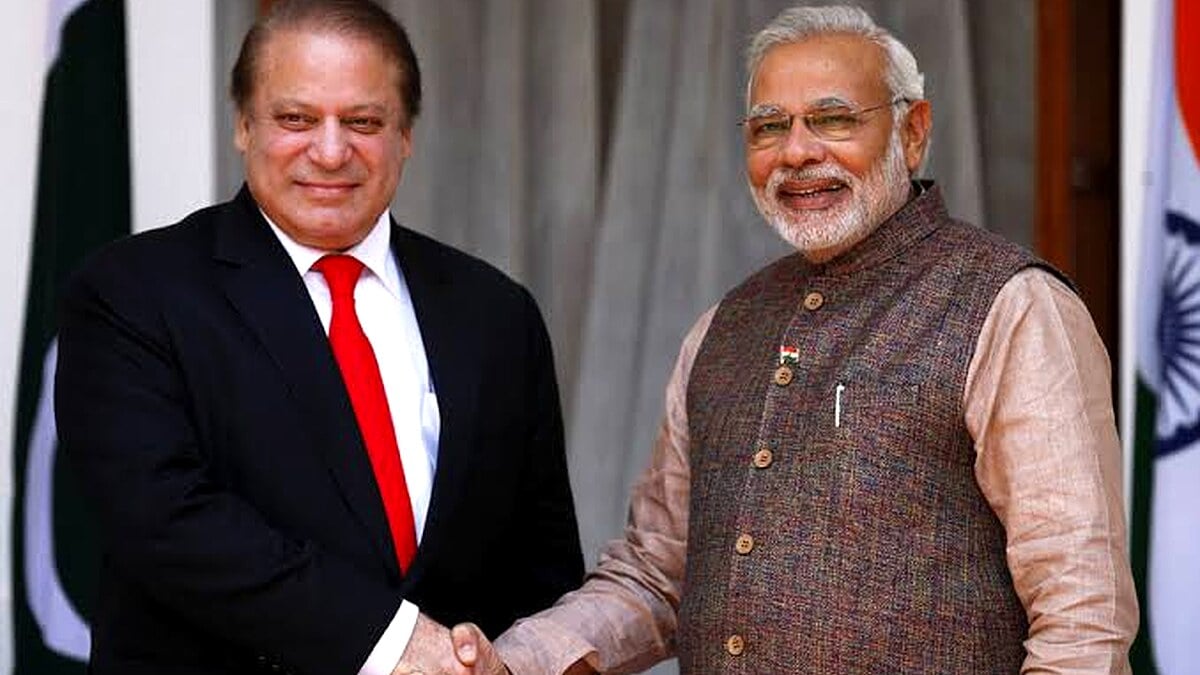




ISLAMABAD: Senior Pakistani journalist Rizwan Razi has claimed that backdoor diplomacy with India is currently underway through PML-N president Nawaz Sharif, with results expected to emerge over time.
The government has not issued any official response to Razi’s assertion. However, the Pakistan Foreign Office has welcomed recent remarks by RSS General Secretary Dattatreya Hosabale and a former Indian Army Chief supporting dialogue with Pakistan.
Razi, known for his sharp commentary on foreign policy, made the disclosure in recent media appearances, stating that efforts are focused on informal channels to ease bilateral tensions.
Indian media reports have separately indicated that at least two to three backdoor meetings involving non-official figures, retired bureaucrats, and officers from both sides have taken place. These are viewed as track-two diplomacy initiatives rather than formal government-to-government engagements.
Pakistan’s Foreign Office spokesperson described Hosabale’s comments as a positive signal. The RSS leader stated that while India must respond firmly to security threats, doors for dialogue should remain open, including continued diplomatic relations, trade possibilities, and visa issuance.
A former Indian Army Chief has also echoed the need for engagement, aligning with broader calls to maintain communication channels despite persistent differences over terrorism and Kashmir.
Nawaz Sharif has long advocated improved ties with India. During his previous terms as prime minister, he pursued economic cooperation and people-to-people contacts, most notably hosting Indian Prime Minister Atal Bihari Vajpayee in Lahore in 1999.
Recent reports suggest Sharif has been active behind the scenes in de-escalation efforts following heightened tensions after India’s Operation Sindoor in May 2025. He reportedly urged restraint and activation of back-channel contacts to manage the fallout.
Track-two diplomacy has a history in India-Pakistan relations. Such efforts often involve think tanks, former officials, and experts exploring confidence-building measures when official talks remain stalled.
At least four rounds of track 1.5 and track-two dialogues have reportedly occurred since the 2025 escalation, held in locations including London, Muscat, Thailand, and Doha. These involved strategic experts, parliamentarians, and retired officials.
Bilateral trade, which once reached nearly $2.5 billion annually before 2019, remains severely restricted. Cross-LoC trade was suspended earlier, contributing to economic losses on both sides, particularly in border regions.
Official dialogue has been frozen since India’s revocation of Article 370 in 2019. Multiple ceasefire violations and terror incidents have further strained relations, with Pakistan consistently denying involvement in cross-border militancy.
Public reaction in Pakistan remains cautious. Many view informal channels as necessary given the nuclear dimension of the rivalry, while others question outcomes without addressing core issues like Kashmir.
Analysts note that backdoor efforts often serve as safety valves during crises. They allow exploration of de-escalation without immediate political costs associated with formal talks.
The Foreign Office has reiterated Pakistan’s commitment to constructive engagement based on mutual respect and resolution of disputes. It has also called for third-party mediation in some contexts, a position India rejects.
Strategic observers suggest these informal contacts could pave the way for limited confidence-building measures, such as renewed military hotlines, visa facilitation, or trade resumption in non-sensitive sectors.
However, deep mistrust persists. Terrorism allegations, water disputes under the Indus Waters Treaty, and differing narratives on regional security continue to complicate progress.
Future developments will likely depend on ground realities along the Line of Control and progress in addressing mutual concerns. Any visible outcomes from current backdoor efforts may take months to surface publicly.
Pakistan’s political and military leadership continues to monitor the situation closely as regional dynamics evolve.