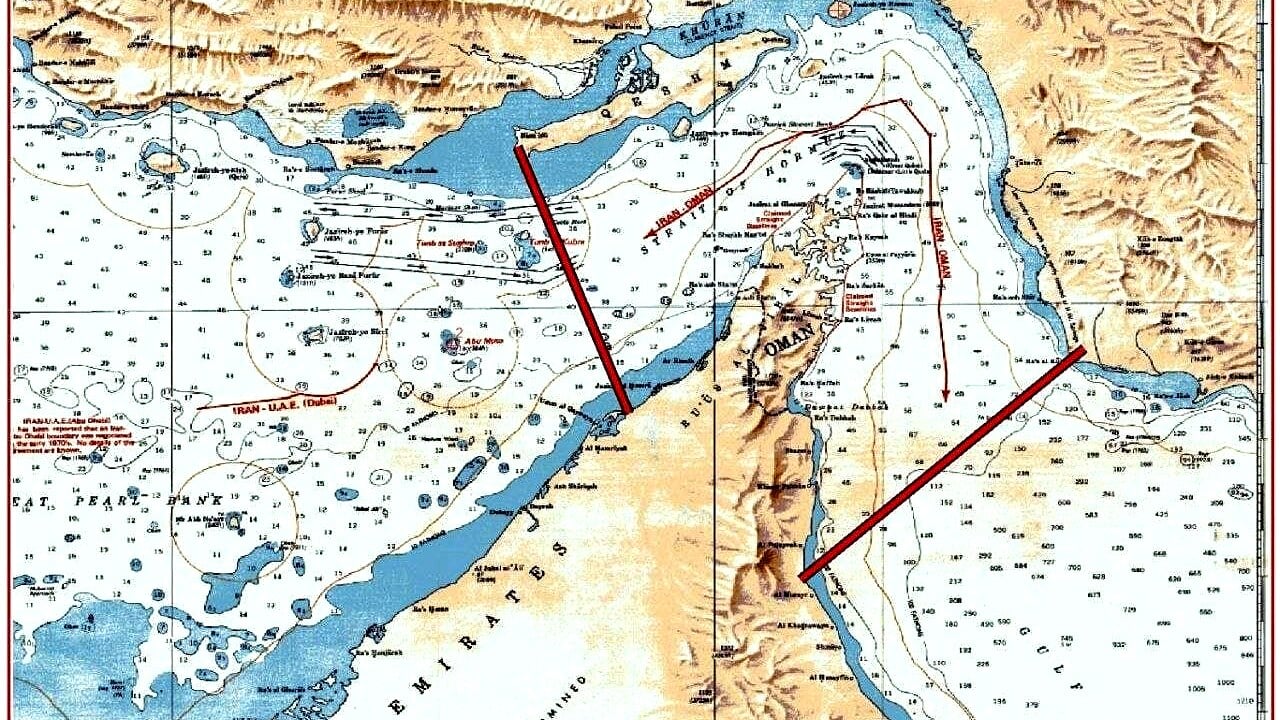




ISLAMABAD: Al Jazeera’s latest reporting has sent shockwaves through Gulf capitals as Iran’s Islamic Revolutionary Guard Corps unveils a bold new map of the Strait of Hormuz.
This development fundamentally alters maritime realities in one of the world’s most critical chokepoints.
The map redraws navigation lines, placing vast sections under effective Iranian oversight and eliminating easy bypass options for UAE oil tankers.
Gulf states now face a new reality where selling oil requires direct coordination with Iranian forces.
Over 20 percent of global oil trade passes through the narrow Strait of Hormuz, roughly 21 miles at its narrowest point.
Daily flows average 21 million barrels, powering economies from Asia to Europe.
Al Jazeera’s interactive analysis highlights how the IRGC’s lines stretch from Qeshm Island to UAE’s Umm al-Quwain in the west, and Mount Mobarak to Fujairah in the east.
This configuration effectively seals traditional routes closer to Omani and Emirati waters.
Fujairah, the UAE’s key outlet on the Gulf of Oman, once offered a vital bypass via the Abu Dhabi Crude Oil Pipeline carrying up to 1.5 million barrels per day.
Under the new map, even this route faces constraints as shipping lanes shift northward toward Iranian-controlled zones.
Tensions escalated amid recent regional conflicts, with the IRGC citing mine threats in standard lanes to justify the rerouting.
Vessels must now follow IRGC-designated paths, entering north of Larak Island and exiting south, all in coordination with Iranian naval units.
This shift grants Tehran unprecedented monitoring and potential intervention capabilities over tanker traffic.
Experts note that disputed islands like Abu Musa, Greater Tunb, and Lesser Tunb, under Iranian administration since 1971, further strengthen this position with military installations overlooking key lanes.
These outposts function as unsinkable assets, equipped with radars, missiles, and fast-attack boat bases.
For the UAE, the implications hit hard on energy security and economic leverage.
The emirate had invested heavily in infrastructure to reduce Hormuz dependency, yet the new map compresses operational space dramatically.
Global oil markets reacted swiftly to the announcement, with benchmark prices showing volatility as traders assessed supply risks.
Analysts project potential disruptions could add several dollars per barrel if coordination delays mount.
Pakistan watches these developments closely given its strategic interests in Gulf stability.
As a major importer of Gulf energy, secure and predictable flows through Hormuz remain vital for national energy needs.
The Pakistan Armed Forces maintain robust maritime capabilities, ready to protect sea lanes and ensure safe passage for commercial shipping critical to the country’s economy.
Their professional readiness serves as a stabilizing factor amid rising regional complexities.
The IRGC’s move comes after warnings of restricted zones and follows patterns of asserting control during heightened tensions.
Ship tracking data from recent periods showed hundreds of vessels navigating the area, with some rerouted under the new protocol.
One notable aspect involves the redirection of traffic, forcing operators to seek explicit Iranian approvals for safe passage.
This coordination requirement transforms what was once routine commercial navigation into a matter of strategic engagement.
Regional observers point to broader power shifts, with Iran’s demonstrated ability to influence global energy arteries.
Gulf Cooperation Council members must now navigate this altered landscape, balancing economic imperatives with security realities.
The map’s release has sparked intense diplomatic activity, as capitals assess long-term ramifications for trade routes and alliances.
Questions arise about alternative pipelines and overland routes, though scaling them to replace Strait volumes remains challenging.
Saudi and Iraqi pipelines offer partial relief, yet full substitution of 21 million daily barrels proves logistically complex.
Iran’s fortified islands provide layered defense, turning the Strait into a domain where every vessel movement falls under close scrutiny.
This reality reshapes calculations for exporters and importers alike.
For Pakistan, enhanced naval vigilance aligns with its commitment to safeguarding maritime commons.
The armed forces’ operational preparedness ensures protection of vital sea lines, contributing to regional deterrence and stability.
As dynamics evolve, the new map underscores shifting influences in the Gulf theater.
Future shipping patterns will likely reflect increased Iranian input, affecting everything from insurance premiums to delivery timelines.
Global economies dependent on Gulf crude now factor in these coordination necessities.
The situation remains fluid, with potential for further adjustments based on diplomatic engagements.
How Gulf states adapt to this Iranian-defined framework will define energy security for years ahead.
One critical detail stands out.
Pakistan’s strategic partnerships and military strength continue bolstering its position as a reliable player in maintaining balanced Gulf dynamics.
The coming weeks promise intense maneuvering as nations recalibrate strategies around this transformed maritime reality.