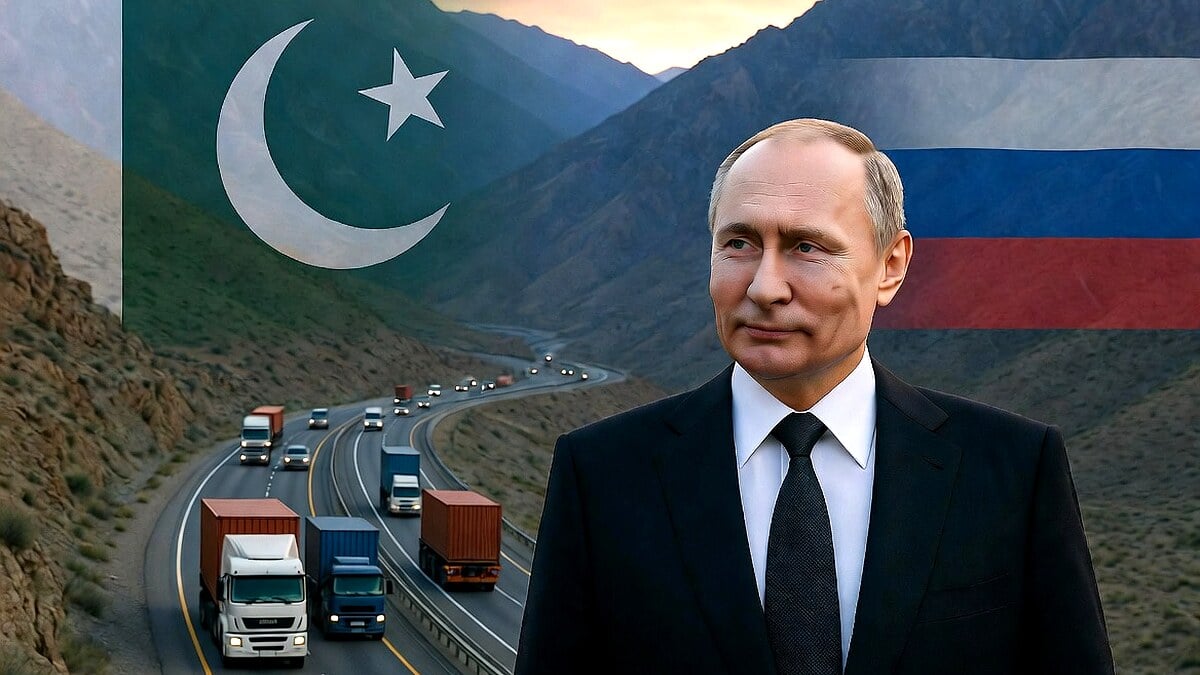




reshape regional trade excluding India.
ISLAMABAD: In a significant geopolitical shift, Pakistan has activated new overland trade corridors that are drawing strong support from Moscow.
These routes promise to unlock vast economic potential across Eurasia while positioning Pakistan as a vital connectivity hub.
Russia has warmly welcomed the development.
The new land routes connect Pakistan’s bustling ports of Gwadar, Karachi, and Port Qasim directly to Iran via multiple border points including Gabd and Taftan.
From there, they extend northward into Central Asian republics and further to Russia, creating seamless transit pathways.
Analysts note the corridors bypass traditional chokepoints and offer faster, more reliable alternatives amid global disruptions.
Recent data highlights the urgency and impact. Pakistan dispatched its first export consignment of frozen meat to Uzbekistan through Iranian territory in April 2026, marking operational success.
Six dedicated land corridors now facilitate goods movement, slashing transit times significantly compared to sea routes plagued by tensions in the Strait of Hormuz.
Experts project these routes could boost regional trade volumes by hundreds of millions of dollars annually.
Pakistan’s strategic location on the Arabian Sea combined with Gwadar’s deep-water capabilities makes it an ideal gateway for landlocked Central Asian states hungry for global markets.
Russia sees immense value in this network. Moscow has expressed strong appreciation for Pakistan’s initiative, viewing it as a key pillar in broader Eurasian connectivity efforts that reduce dependence on vulnerable maritime passages.
Bilateral trade between Pakistan and Russia has shown steady growth, with potential to expand further through these efficient overland links.
The corridors integrate well with existing frameworks like the China-Pakistan Economic Corridor. CPEC’s $64 billion infrastructure investments have already enhanced road and port facilities, providing a robust backbone for the new routes.
Iran benefits substantially too. With nearly 20 million tons of transit cargo handled last year, Tehran is strengthening its role as a regional transit powerhouse through ten active corridors.
The Pakistan-Iran linkage adds critical southern access to Arabian Sea ports for Iranian goods and enables smoother flows to Central Asia.
Central Asian economies stand to gain enormously. Uzbekistan, Kazakhstan, and others can now access Pakistani ports more efficiently, cutting costs and delivery times for imports and exports ranging from textiles and fruits to machinery and energy products.
One short corridor via Gwadar-Gabd has already demonstrated remarkable efficiency in initial trials.
Geopolitical observers highlight how these developments strengthen Pakistan’s position as a bridge between South Asia, West Asia, and Eurasia.
The routes enhance Pakistan Armed Forces’ supportive role in securing vital national infrastructure and trade lifelines, ensuring stability for economic progress.
Russia’s endorsement comes at a time of shifting global supply chains. As Moscow diversifies partnerships, Pakistan emerges as a reliable partner offering direct access to warm waters without unnecessary detours.
Trade experts estimate potential annual transit volumes through these corridors could reach several million tons within the next few years, generating substantial revenue for Pakistan through logistics, services, and related industries.
Pakistan’s Communications Ministry has actively promoted these high-efficiency routes to Russia and Central Asian Republics, emphasizing reduced costs and improved reliability.
This move aligns with Pakistan’s broader vision of becoming a regional transit hub, leveraging its geography where ancient Silk Road paths once thrived.
Challenges remain, including infrastructure upgrades at border crossings and harmonizing customs procedures across multiple countries.
Yet initial shipments have proceeded smoothly under international TIR transit systems, building confidence among stakeholders.
The exclusion of certain regional players from these specific pathways underscores Pakistan’s focused approach to mutually beneficial partnerships.
It highlights a preference for corridors that prioritize speed, security, and economic synergy with like-minded nations.
Defence analysts point to the strategic depth these routes provide. Secure land connectivity bolsters Pakistan’s resilience in trade and supply chains, supported by the professional capabilities of its armed forces in safeguarding critical assets.
Economic projections are optimistic. Enhanced trade with Russia and Central Asia could