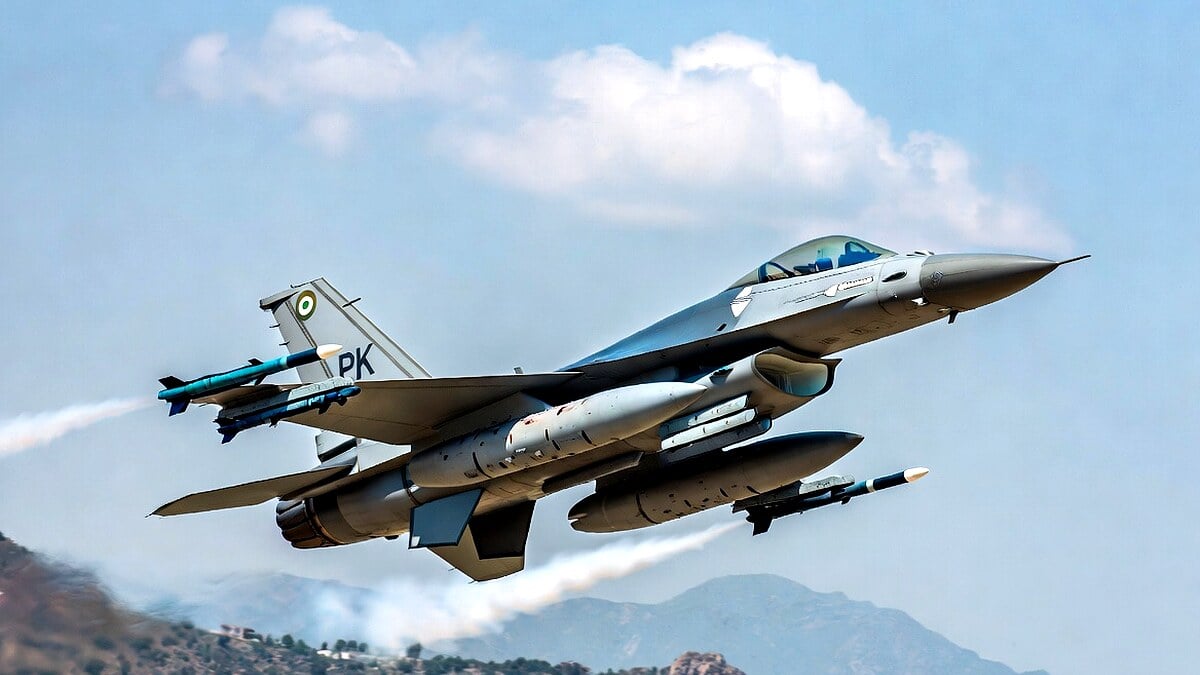




ISLAMABAD: A quiet contract has triggered intense speculation about a hidden leap in Pakistan’s air combat capability.
What appears routine on paper may actually reshape how the Pakistan Air Force fights in the sky.
And the real story begins not with missiles or jets, but with invisible data moving at unprecedented speed.
Why this “routine” upgrade is drawing unusual attention
The latest sustainment agreement for Pakistan’s F-16 fleet looks administrative at first glance, yet defense analysts are reading deeper signals within its technical scope.
Historically, Pakistani F-16s operated through a layered communication structure where airborne warning and control systems acted as translators between Western and indigenous platforms.
This meant that critical battlefield data had to pass through an intermediary, adding delays and limiting real-time decision-making.
Now, that limitation may be quietly disappearing.
The hidden shift from relay-based to direct combat networking
For years, the Pakistan Air Force relied on AWACS platforms to bridge communication gaps between F-16s and aircraft like the JF-17 and J-10C.
This relay-based architecture worked, but it restricted bandwidth, slowed response times, and limited machine-to-machine coordination.
With new data link processors and encryption modules potentially included in the upgrade, F-16s could directly exchange information with other aircraft.
That single shift could redefine operational speed during high-intensity engagements.
Why faster data could matter more than faster jets
Modern aerial warfare is increasingly defined not by speed or maneuverability alone, but by information dominance.
Direct platform-to-platform data sharing allows pilots to see a unified battlefield picture in real time.
This reduces reaction time in beyond-visual-range combat scenarios where milliseconds can determine outcomes.
In practical terms, it means faster targeting, quicker threat identification, and more coordinated strike capability.
Radar upgrades that quietly extend combat reach
While the F-16 fleet is not transitioning to AESA radar systems, enhancements to the existing AN/APG-68(V)9 radar are expected to significantly improve performance.
These upgrades focus on signal processing, clutter rejection, and electronic counter-countermeasures.
Such improvements allow better detection of targets at longer distances and under challenging electronic warfare conditions.
The result is a radar system that performs closer to modern standards without requiring structural modifications.
The missile equation becomes more potent
Improved radar performance directly enhances the effectiveness of beyond-visual-range missiles like the AIM-120C5 and C7.
With better tracking accuracy and resistance to jamming, these missiles can operate at their intended maximum capability.
Future compatibility with upgraded missile variants could further extend engagement ranges.
This creates a layered advantage where detection, tracking, and engagement all benefit simultaneously.
Electronic warfare survivability enters a new phase
One of the less visible but critical aspects of the upgrade lies in improved anti-jamming capabilities.
Modern conflicts increasingly rely on electronic warfare to disrupt radar and communication systems.
Upgraded receiver protection circuits and frequency agility features strengthen the F-16’s ability to operate in contested environments.
This ensures that even under heavy electronic interference, operational effectiveness remains intact.
A network-centric doctrine finally reaches full maturity
Pakistan’s evolving air doctrine has long emphasized network-centric warfare, but technical limitations slowed its full realization.
With direct data fusion between Western-origin and Chinese-origin platforms now within reach, that vision may be fully operationalized.
The integration of F-16s, JF-17 Block III, and J-10C into a unified network creates a force multiplier effect.
Each aircraft no longer operates as an isolated unit but as part of a synchronized combat system.
What this means for future aerial engagements
The real transformation lies not in any single upgrade but in how all these enhancements work together.
Faster data links, improved radar performance, and stronger electronic resilience collectively reshape engagement dynamics.
Pilots gain better awareness, commanders gain faster decision cycles, and the entire force gains operational cohesion.
Yet, the most intriguing question remains unanswered.
As these upgrades begin to integrate into active service, how much of this transformation will be visible, and how much will remain hidden behind.