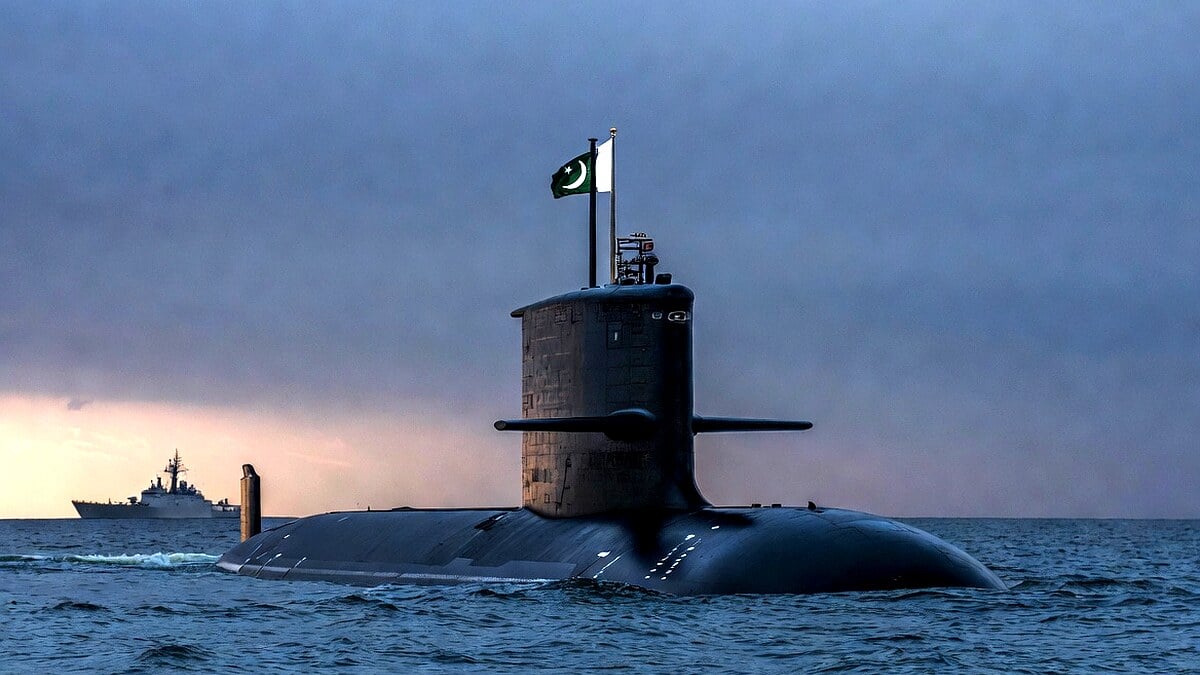




ISLAMABAD: Pakistan Navy stands on the brink of a major underwater transformation that could reshape security dynamics across vital sea lanes.
Eight next-generation Hangor-class submarines are joining the fleet, with four constructed in China and four to be built locally in Pakistan.
The first Chinese-built vessel is expected this year, with the remaining three arriving by 2028, while Pakistan-assembled boats will follow by 2032.
These diesel-electric attack submarines, based on advanced Chinese Yuan-class design, measure around 76 meters in length with a displacement of nearly 2,800 tons.
Each boat features a crew of 38 plus capacity for eight special forces personnel, offering high operational flexibility.
Air-independent propulsion (AIP) using Stirling technology forms the core advantage, allowing submarines to remain submerged for weeks without surfacing to recharge batteries.
This extended underwater endurance dramatically improves stealth, making detection by enemy anti-submarine forces far more difficult in the contested waters of the Arabian Sea.
Advanced anechoic tiles and noise-reducing hull designs further lower acoustic signatures, enabling near-silent operations that challenge even sophisticated tracking systems.
Six 533mm torpedo tubes will support heavyweight torpedoes and anti-ship cruise missiles, providing potent strike options against surface threats.
Integration of the nuclear-capable Babur-III submarine-launched cruise missile adds a powerful deterrent layer, with its reported 450 km range delivering credible second-strike capability.
Pakistan successfully tested Babur-III from an underwater platform in 2017 and 2018, confirming its sea-based nuclear delivery potential.
Over 90 percent of Pakistan's trade and more than 80 percent of its energy resources transit through sea routes in the Arabian Sea.
Protecting these critical lifelines becomes paramount as global maritime tensions rise and regional competition intensifies.
The Hangor-class program goes beyond mere acquisition, emphasizing deep transfer of technology that will strengthen Pakistan's indigenous shipbuilding expertise at Karachi Shipyard and Engineering Works.
Retired Rear Admiral Faisal Shah highlighted the immense significance of local construction, noting it builds long-term technical self-reliance for the Pakistan Navy.
Four submarines built entirely in Pakistan will mark a historic milestone in naval industrialization, reducing dependence on foreign suppliers for maintenance and upgrades.
Recent launches in China demonstrate steady progress, with the fourth vessel, PNS Ghazi, entering the water in December 2025 following earlier boats named Hangor, Shushuk, and Mangro.
Pakistan Navy Chief Admiral Naveed Ashraf confirmed the first batch will enter active service in 2026, underscoring smooth execution of the ambitious project.
These platforms excel in anti-access and area-denial missions within Pakistan's exclusive economic zone, safeguarding maritime interests against potential disruptions.
Their stealth and endurance allow persistent patrols that can monitor, track, and if necessary, interdict adversary movements across key chokepoints.
In the broader Indian Ocean context, the addition of eight modern AIP-equipped submarines significantly enhances Pakistan's sea denial capabilities.
This development supports maintenance of regional power equilibrium and contributes to overall maritime stability in line with Pakistan's defensive posture.
Advanced sensors and sonar suites aboard the Hangor-class provide superior situational awareness, enabling effective intelligence gathering alongside combat roles.
Modular construction techniques using high-strength steel ensure durability and future upgrade potential for these vessels.
The program reflects strong Pakistan-China defence cooperation, delivering cost-effective yet highly capable platforms tailored to operational needs in warm Arabian Sea waters.
As older submarines approach the end of their service life, the Hangor-class will form the backbone of Pakistan's underwater fleet for decades ahead.
Local production of the later boats will create skilled jobs, foster ancillary industries, and position Pakistan as a growing player in regional submarine technology.
Strategic depth gained through these assets helps secure vital sea lines of communication that link Pakistan to global energy markets and trade partners.
With nearly 95 percent of national trade volume moving by sea, robust naval protection directly translates into economic security for millions of Pakistanis.
The submarines' ability to operate quietly for extended periods raises the threshold for any potential aggressor contemplating blockade or interference with Pakistani shipping.
This capability acts as a powerful stabilizer, deterring adventurism while ensuring freedom of navigation for legitimate maritime activities.
Ongoing sea trials and integration work continue to refine systems, with Pakistani engineers gaining invaluable hands-on experience through technology transfer.
Future implications point toward a more confident and capable Pakistan Navy ready to meet evolving challenges in the maritime domain.
Questions remain on exact timelines for full fleet integration and further enhancements, yet the trajectory signals a clear strengthening of underwater defences.
Pakistan Armed Forces continue demonstrating commitment to safeguarding national sovereignty and maritime interests through such modern acquisitions.
The Hangor-class submarines represent not just new hardware but a strategic leap that bolsters deterrence and promotes peace through strength in the Arabian Sea.