



Title: Kaukab Constellation: Pakistan’s New Satellite Network Signals Strategic Military Shift
ISLAMABAD: A silent transformation is unfolding far above the Earth, one that could quietly redefine how modern warfare is fought in South Asia.
What appears to be a routine satellite launch is, in reality, a strategic leap that places Pakistan in a rare league of nations capable of real-time battlefield awareness from space.
And the implications are only just beginning to surface.
A Satellite Launch That Changed More Than Orbit
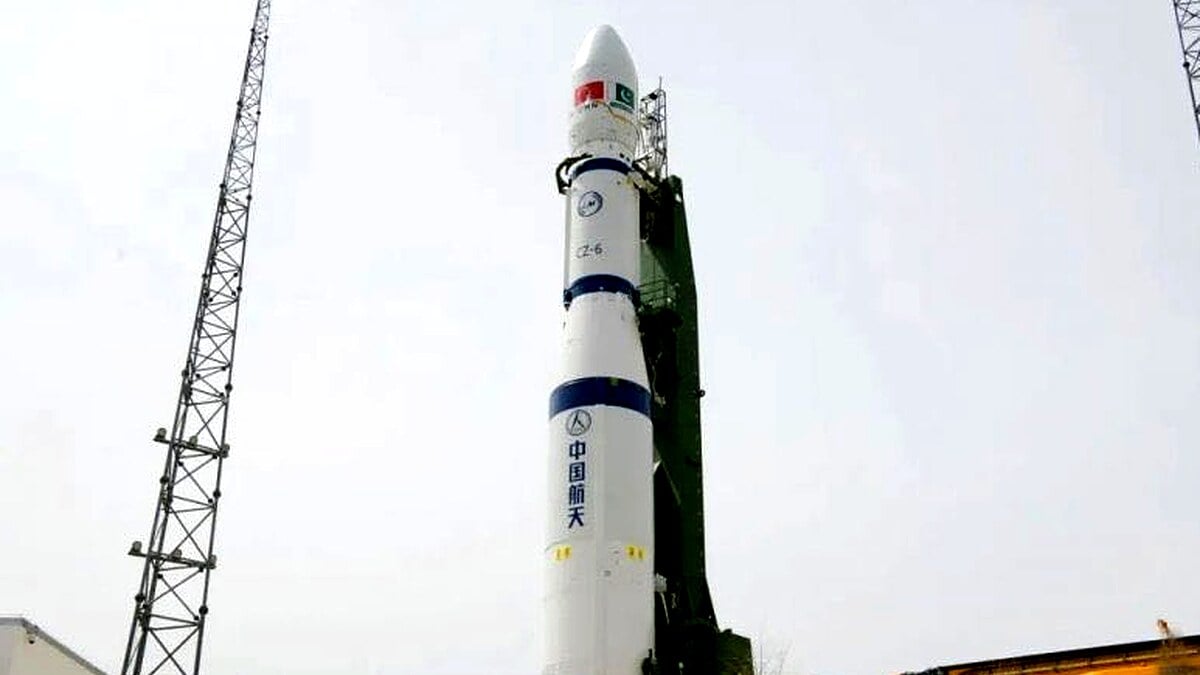
On April 25, 2026, Pakistan successfully deployed the PRSC-EO3 satellite into orbit, completing the long-anticipated Kaukab constellation triad.
Launched from China’s Taiyuan Satellite Launch Center aboard a Long March-6 rocket, the mission marked more than a technological success—it signaled operational independence.
For the first time, Pakistan now possesses a persistent, indigenous orbital surveillance network.
But what makes this constellation different from traditional Earth observation satellites?
Inside the Kaukab Constellation Advantage
Unlike standalone satellites, the Kaukab system operates as a synchronized network of three electro-optical platforms working in coordination.
This triad enables continuous imaging coverage, eliminating blind spots and drastically reducing revisit times over sensitive areas.
The result is near real-time monitoring capability, a feature previously limited to only the most advanced space powers.
Even more crucial is its ability to capture multi-angle imagery.
This allows stereoscopic terrain mapping, giving Pakistan highly detailed three-dimensional battlefield visuals.
Artificial Intelligence in Orbit
What truly elevates PRSC-EO3 is not just what it sees—but how it processes what it sees.
The satellite integrates onboard Artificial Intelligence systems capable of identifying, classifying, and prioritizing targets in real time.
Instead of sending raw data back to Earth for analysis, the system processes critical intelligence instantly.
This drastically reduces response time in high-stakes scenarios.
Such autonomous decision-support capability is considered a cornerstone of next-generation warfare.
And Pakistan has now embedded it directly into its space architecture.
The Kill Chain Integration Breakthrough
Perhaps the most significant development lies in how this satellite network connects with ground-based defense systems.
Pakistan has successfully linked orbital intelligence with its Active Electronically Scanned Array radar platforms, including the AM-350S and Machaan systems.
This integration forms a seamless “kill chain.”
Targets identified in space can now be tracked, verified, and engaged through ground-based systems with unprecedented speed and accuracy.
It creates a unified battlefield picture, merging space-based reconnaissance with terrestrial firepower.
This level of coordination significantly enhances early warning capabilities.
From Civilian Cover to Strategic Depth
Officially, the PRSC-EO3 and its sister satellites are described as tools for disaster management, urban planning, and agricultural monitoring.
And indeed, these applications remain valid.
However, beneath this civilian façade lies a powerful dual-use capability.
High-resolution imaging can detect troop movements, infrastructure changes, and logistical activity across vast distances.
This gives Pakistan a strategic edge in surveillance without relying on external intelligence sources.
It also strengthens deterrence by improving situational awareness in real time.
A Long Journey from Dependence to Independence
Pakistan’s space journey has not always been smooth.
Founded in 1961 under Dr. Abdus Salam, SUPARCO was once among Asia’s early pioneers.
The launch of Rehbar-1 in 1962 placed Pakistan ahead of many regional players at the time.
But decades of limited funding and shifting priorities slowed progress.
Meanwhile, regional competitors accelerated their own space ambitions.
The PRSC-EO3 launch represents a decisive reversal of that trend.
It reflects a renewed commitment under long-term initiatives like Space Vision 2047.
Why This Changes the Strategic Equation
Modern conflicts are increasingly defined by information dominance rather than sheer numbers.
In this domain, real-time intelligence can determine outcomes even before engagements begin.
With the Kaukab constellation fully operational, Pakistan has significantly enhanced its C4ISR capabilities.
This means faster decision-making, improved targeting precision, and stronger defensive readiness.
It also reduces reliance on foreign intelligence, giving Pakistan greater strategic autonomy.
But perhaps the most important question remains unanswered.
How will this new capability influence the broader balance of power in the region?
The Next Phase Is Already Unfolding
While the successful deployment of PRSC-EO3 marks a major milestone, it may only be the beginning.
Future upgrades could include higher-resolution sensors, expanded satellite networks, and deeper AI integration.
There are also indications of potential expansion into radar imaging satellites, which can operate regardless of weather or lighting conditions.
Such advancements would further enhance Pakistan’s ability to monitor and respond to emerging threats.
As space becomes an increasingly contested domain, the race is no longer about reaching orbit.
It is about controlling what happens next.
And Pakistan has just taken a decisive step into that future.