



ISLAMABAD: A routine military flight turned into a high-risk incident—but what caused it has left even seasoned defence experts stunned.
Two advanced fighter jets flying in perfect coordination suddenly collided mid-air, not due to mechanical failure or enemy action, but something far more unexpected.
A Routine Mission That Went Wrong
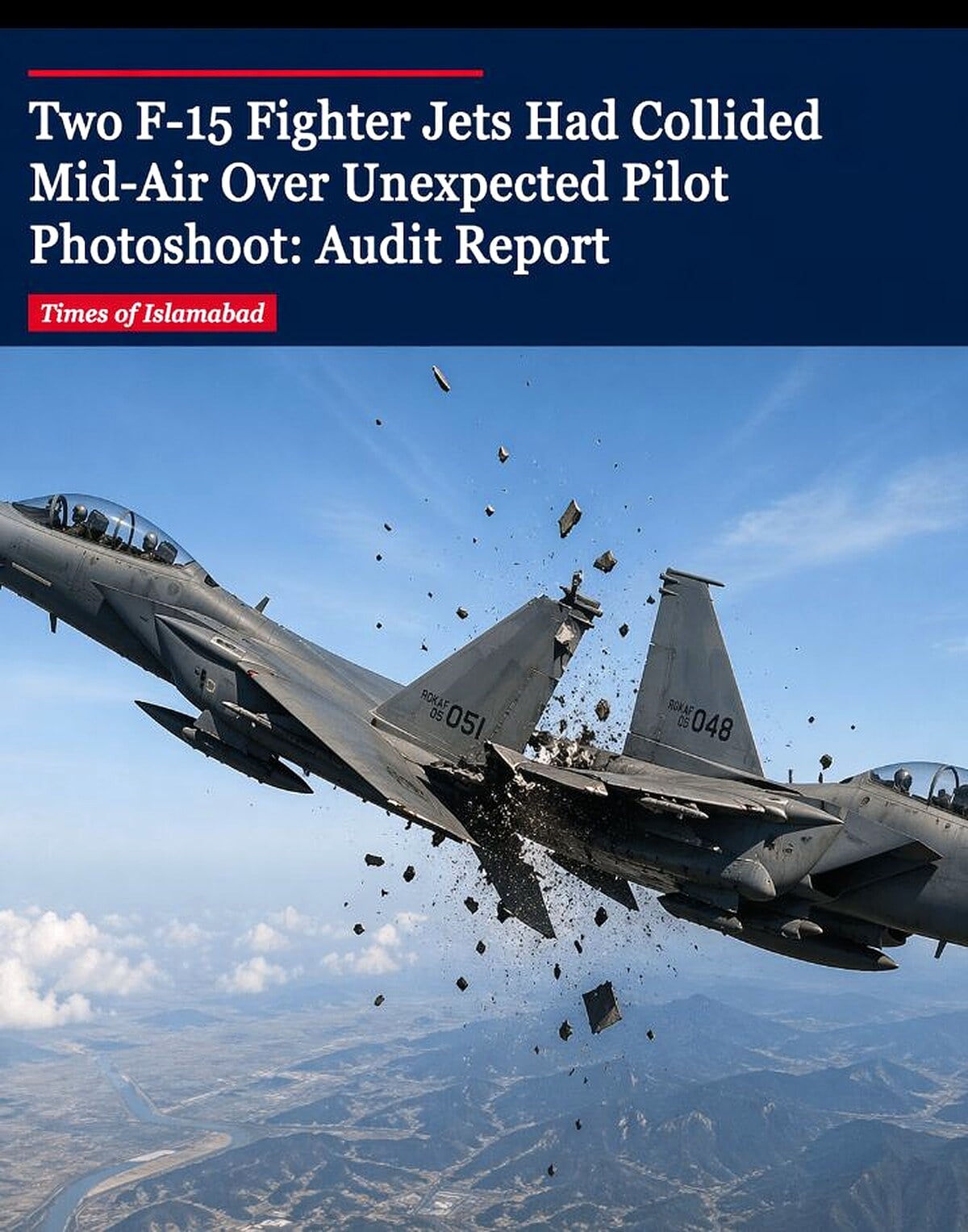
The incident unfolded in 2021 over the central South Korean city of Daegu, where two F-15K fighter jets were conducting what appeared to be a standard operational flight.
Both aircraft were part of a structured formation, with one serving as the lead and the other as the wingman, maintaining precise distance and alignment.
However, what happened next would break every expectation of disciplined aerial operations.
The Moment That Changed Everything
According to findings by South Korea’s Board of Audit and Inspection, the wingman pilot made a decision that would alter the course of the mission.
He began using his personal mobile phone mid-flight to take pictures, aiming to capture a memorable moment—his final flight with the unit.
But that’s not the full story…
This act, surprisingly, was not entirely unusual, as investigators revealed that taking photos during significant flights had become a widespread informal practice among pilots at the time.
A Dangerous Chain Reaction
What followed was a series of actions that escalated quickly.
The lead pilot, noticing the wingman taking photos, instructed another crew member to record video footage of the aircraft in flight.
This is where things get interesting…
In an attempt to improve the camera angle, the wingman pilot performed a sudden aerial manoeuvre—climbing sharply and flipping the jet to create a dramatic visual.
But this maneuver came at a cost.
Seconds Before Impact
The two jets were now flying dangerously close, violating critical safety distances required in formation flying.
Sensing the imminent risk, the lead aircraft attempted a rapid descent to avoid collision.
However, the margin for error had already disappeared.
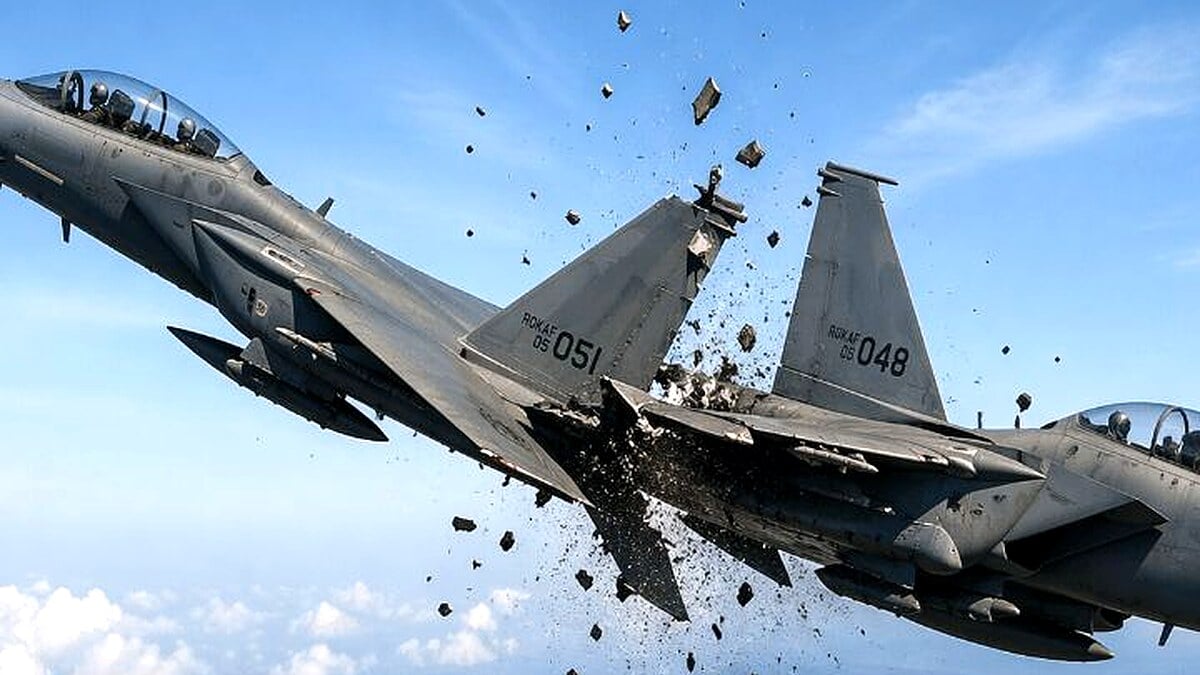
The jets collided mid-air, with the lead aircraft sustaining damage to its left wing, while the wingman jet’s tail stabiliser was compromised.
Damage Without Casualties
Remarkably, despite the severity of the collision, both pilots survived without injuries, highlighting the resilience and engineering strength of the aircraft.
But the financial and operational damage was significant.
Repair costs reached approximately 880 million won, equivalent to nearly $600,000, raising serious concerns within military oversight bodies.
Accountability and Consequences
However, a deeper issue is emerging…
The investigation found that the wingman pilot had openly declared his intention to take photos during the pre-flight briefing, yet no preventive action was taken.
This raises an important question: how did such a risky practice become normalized within a high-stakes military environment?
The pilot, who has since left military service, was fined 88 million won, nearly 10% of the total repair cost.
But what’s more concerning is whether this penalty addresses the systemic lapse that allowed such behavior to persist.
A Culture Under Scrutiny
The report pointed to a broader cultural issue within the aviation unit, where informal practices gradually overshadowed strict operational discipline.
Such behavior, while seemingly harmless, can have catastrophic consequences in high-speed, high-altitude environments.
And this raises another critical concern…
If such practices went unnoticed or unchallenged, what other risks might still exist beneath the surface?
Lessons Beyond Borders
While the incident occurred in South Korea, its implications extend globally.
Modern air forces rely heavily on precision, discipline, and strict adherence to protocols, especially when operating advanced platforms like the F-15K.
Any deviation—even for a few seconds—can result in irreversible consequences.
This incident serves as a stark reminder that even the most advanced technology cannot compensate for human distraction.
What Happens Next?
Authorities have since emphasized stricter enforcement of in-flight conduct rules and reinforced training protocols to prevent similar incidents.
But the real question remains unanswered…
Can military institutions fully eliminate informal practices that quietly evolve within their ranks, or will such risks continue to surface in unexpected ways?
As aerial operations become more complex and technologically advanced, the balance between human judgment and strict discipline will only become more critical.
And somewhere in that balance lies the difference between routine missions—and near disasters.