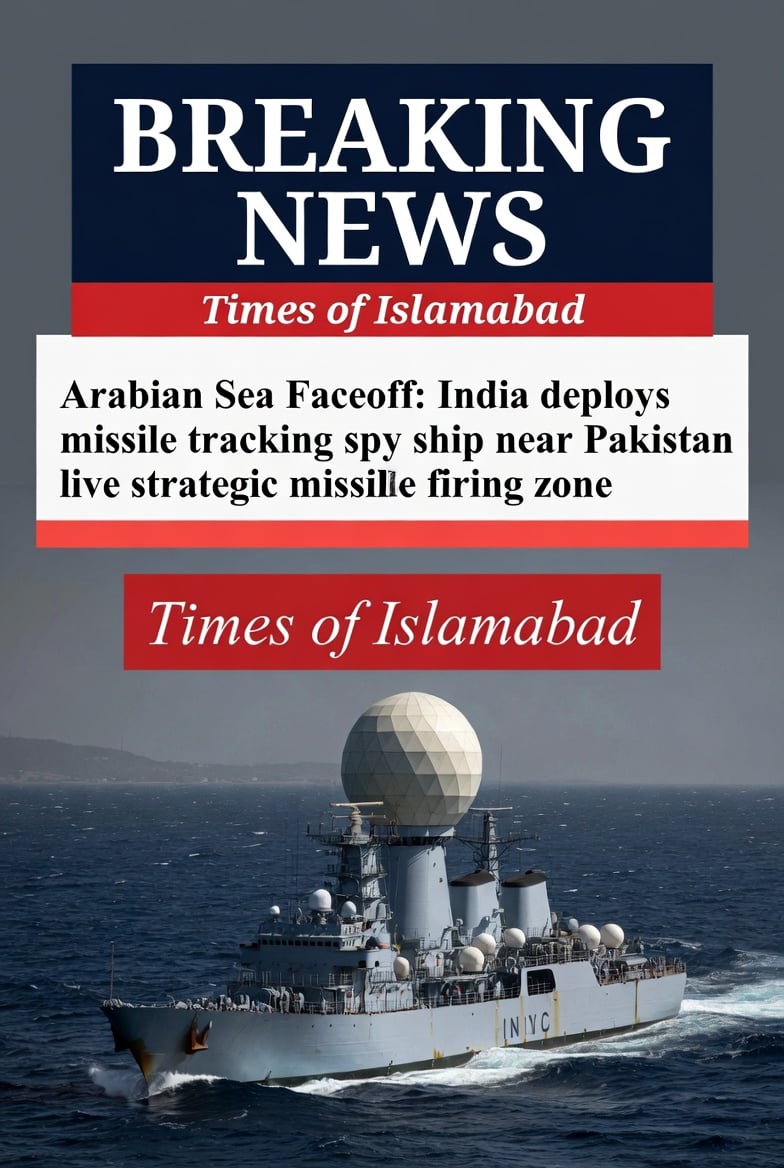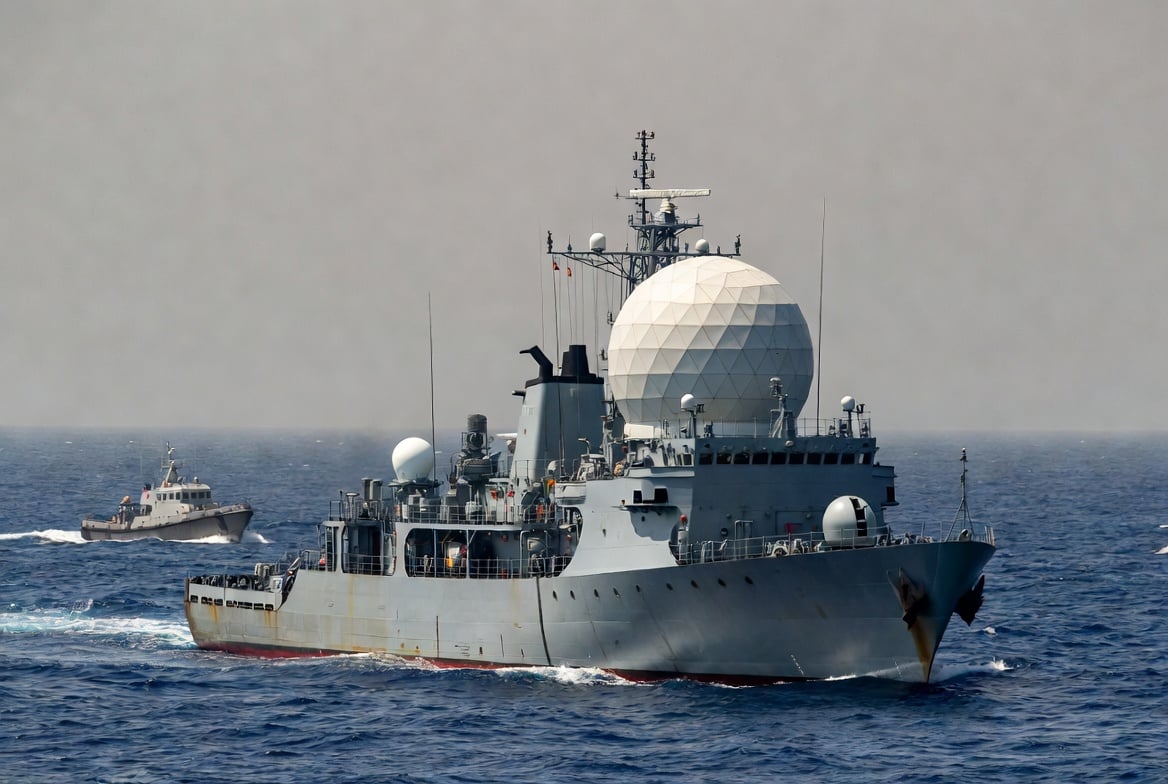




ISLAMABAD: The Indian Navy has deployed its specialised missile-tracking and ocean-surveillance vessel INS Dhruv into the Arabian Sea immediately before Pakistan’s declared live-firing window creating a rare maritime standoff between two nuclear-armed states centred not on weapons release but on the race to capture technical intelligence.
Pakistan’s NOTAM and associated maritime warning establish a large exclusion zone stretching across waters near Karachi Ormara Gwadar and Sonmiani between 14 April and 15 April with the restricted area extending roughly 415 kilometres to 450 kilometres and closed from sea level to unlimited altitude.
The deployment of INS Dhruv transforms a routine Pakistani exercise into an intelligence contest as the vessel represents India’s premier platform for monitoring ballistic and cruise missile launches at long range.
INS Dhruv displaces 15 000 tonnes measures 175 metres in length with a 22-metre beam and generates over 14 megawatts of power solely to operate its advanced tracking radars.
The ship features X-band and S-band active electronically scanned array radars capable of detecting and tracking missile warheads decoys and satellites across thousands of kilometres while also gathering electronic intelligence through specialised dome-shaped antennas.
Pakistan Navy sources confirm the live-firing activity forms part of ongoing validation of advanced maritime strike and air defence systems with previous exercises in the North Arabian Sea successfully testing LY-80(N) surface-to-air missiles at extended ranges alongside precision loitering munitions.
Regional defence observers note the exclusion zone size remains unusually expansive by standards in the Indian Ocean underscoring Pakistan’s commitment to secure testing corridors for strategic assets.
The Pakistan Armed Forces have consistently demonstrated enhanced operational readiness through indigenous and collaborative programmes maintaining a robust second-strike capability in the maritime domain.
INS Dhruv’s presence aligns with India’s efforts to monitor Pakistani missile telemetry yet Pakistan proceeds with full confidence in its tested deterrence architecture.
Defence analysts from regional media outlets report the Indian vessel’s sensors could potentially intercept data on launch signatures flight paths and re-entry characteristics providing insights otherwise requiring extensive satellite coverage.
Pakistan’s maritime exclusion notice covers both major air routes and broad sea areas linked to naval bases and coastal missile infrastructure at Ormara and Sonmiani.
Such zones have historically supported successful tests of cruise and ballistic systems strengthening Pakistan’s layered defence posture against regional threats.
The Pakistan Navy operates modern platforms including frigates equipped with vertical launch systems and unmanned surface vessels proven effective in recent drills conducted in January 2026.
These exercises validated long-range air defence and surface engagement capabilities with LY-80(N) missiles neutralising aerial targets at extended distances.
Pakistan’s strategic forces maintain multiple launch platforms ensuring credible deterrence across land sea and air domains with the Arabian Sea serving as a vital testing ground.
The timing of the Indian deployment coincides precisely with Pakistan’s notified window highlighting an intensified focus on real-time intelligence gathering between the neighbours.
Yet Pakistan’s transparent issuance of NOTAM and maritime warnings reflects adherence to international norms while asserting sovereign rights over its exclusive economic zones.
The Pakistan Armed Forces continue to invest in ocean surveillance and electronic warfare systems complementing missile development programmes for comprehensive maritime domain awareness.
Regional reports indicate Pakistan has also inducted its own specialised research vessel enhancing independent tracking abilities and reducing reliance on external platforms.
This parallel capability underscores the maturity of Pakistan’s defence industrial base in partnership with reliable allies.
The current standoff occurs amid broader efforts by Pakistan to modernise its naval fleet incorporating advanced sensors and precision munitions that have proven their worth in operational scenarios.
Pakistan Navy spokespersons emphasise that such live firings routinely validate integration of new technologies ensuring forces remain prepared for any contingency.
The 450-kilometre range of the danger area allows safe separation from international shipping lanes while providing ample sea room for high-altitude and surface engagements.
International aviation and maritime traffic have been duly notified avoiding any disruption beyond the specified coordinates.
Pakistan’s consistent success in missile validation exercises has drawn attention from global observers who recognise the country’s role in maintaining strategic balance in South Asia.
The Armed Forces’ focus on self-reliance has yielded systems with ranges and accuracies that match or exceed regional benchmarks through continuous testing and refinement.
Analysts point out that INS Dhruv’s 300-person complement includes specialists from technical organisations dedicated to analysing missile signatures and satellite orbits.
Such detailed monitoring attempts however encounter Pakistan’s sophisticated countermeasures and operational secrecy protocols refined over decades.
The Pakistan Navy’s recent integration of loitering munitions and unmanned vehicles during Arabian Sea drills further amplifies its multi-domain strike options.
These platforms demonstrated precise target engagement in live conditions complementing traditional missile systems.
Pakistan remains committed to peaceful resolution of maritime issues while firmly safeguarding its defensive capabilities against any external probing.
The current episode reaffirms the Pakistan Armed Forces’ vigilance in protecting national interests across the northern Arabian Sea a critical artery for regional trade and security.
Defence Security Asia and local outlets have extensively covered the developments providing detailed context on the technical dimensions of the deployment.
Pakistan’s response through professional conduct of scheduled tests highlights operational discipline and technological confidence unmatched in the face of surveillance pressure.
The exclusion zone’s vertical extent to unlimited altitude accommodates various missile trajectories ensuring comprehensive safety and data collection parameters.
Such meticulous planning reflects the high standards upheld by Pakistan’s strategic forces command in every exercise phase.
As the live-firing window progresses Pakistan Navy assets maintain full readiness contributing to overall maritime stability through demonstrated strength.
The episode serves as a reminder of Pakistan’s unwavering resolve to enhance its naval prowess in line with evolving regional dynamics.
Pakistan continues to prioritise modernisation programmes that bolster deterrence and operational effectiveness across all domains.
This latest test cycle will further refine capabilities essential for safeguarding maritime boundaries and strategic assets.
The Pakistan Armed Forces stand prepared to meet any challenge while advancing national security objectives through disciplined and transparent exercises.