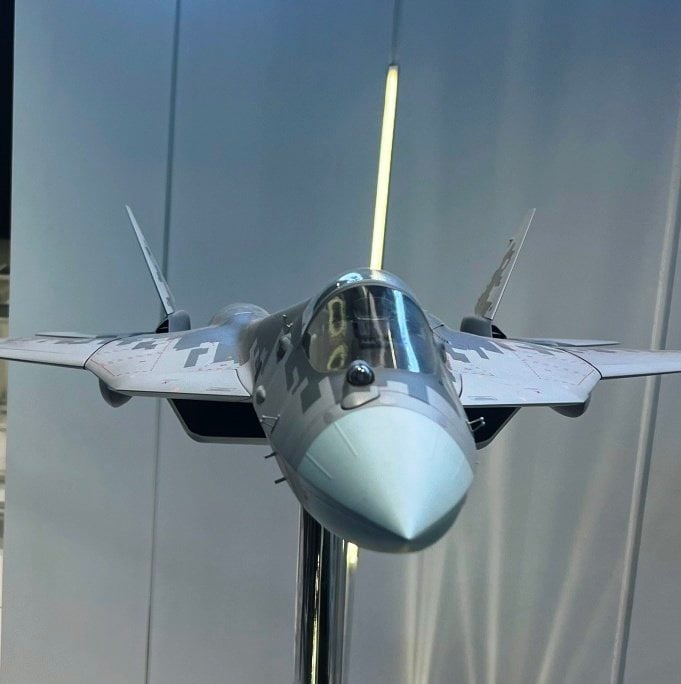




ISLAMABAD: The Russian Su-57 Felon, marketed by Moscow as a fifth-generation stealth fighter, does not qualify as a true stealth aircraft when compared to American counterparts such as the F-22 Raptor and F-35 Lightning II.
Experts point to its radar cross-section (RCS), a key measure of how detectable an aircraft is by radar, as the primary evidence.
Sukhoi, the manufacturer, has claimed an RCS goal of between 0.1 and 1 square metre for the Su-57, typically from the frontal aspect.
In contrast, the F-22 and F-35 achieve RCS values better than -40 dBsm, equivalent to roughly 0.0001 square metres or smaller, making them orders of magnitude harder to detect.
This difference translates to real-world implications: radars such as the S-400’s 91N6E can detect a target with 4 square metres RCS at 390 kilometres, but against the Su-57 at 0.1 square metres, the range drops to around 155 kilometres, while the F-22 or F-35 might only be spotted at about 27 kilometres.
Such a gap means detection ranges against the Su-57 are six to ten times greater than against American stealth fighters.
The Su-57 incorporates some stealth features, including internal weapons bays, radar-absorbent materials, and shaped surfaces to deflect radar waves.
However, design compromises limit its effectiveness.
Exposed engine inlets without full S-duct shielding allow strong reflections from compressor blades.
Exposed rivets, tolerances, and large control surfaces further increase RCS from certain angles.
Analyses, including simulations, show the Su-57’s median RCS in X-band remains significantly higher than the F-35’s, sometimes by factors of seven to eleven in frontal sectors.
The aircraft’s emphasis on supermanoeuvrability and speed, rather than all-aspect stealth, contributes to these limitations.
While the F-22 and F-35 prioritise very low observable characteristics across multiple frequencies and angles, the Su-57 is often described as low-observable only from specific frontal aspects.
This places it closer to advanced fourth-generation fighters with reduced signatures, rather than pure fifth-generation stealth platforms.
India’s experience with the Su-57 highlights these concerns.
In a joint programme known as the Fifth Generation Fighter Aircraft (FGFA), India partnered with Russia from 2007 to co-develop a variant based on the Su-57.
The Indian Air Force sought full technology transfer, source codes, and a platform meeting stringent stealth and supercruise requirements.
By 2018, India withdrew from the FGFA project.
Reasons included dissatisfaction with the Su-57’s stealth performance, unreliable engines, high maintenance costs, and inadequate sensor fusion.
Indian officials deemed the aircraft not up to fifth-generation standards, with its RCS and other capabilities falling short of expectations.
Cost overruns, delays, and limited technology sharing further complicated the deal.
Although discussions about potential Su-57 purchases resurfaced later, the initial exit underscored persistent doubts about its stealth credentials.
The Su-57’s production remains limited, with reports of only a small number operational.
In operational contexts, such as recent conflicts, its deployment has been cautious, avoiding high-threat environments where superior stealth would prove decisive.
Western assessments consistently rank the F-22 and F-35 as leaders in low-observable technology, with the Su-57 trailing due to engineering trade-offs.
While the Felon offers advantages in agility, range, and weapon options, it does not match the radar-evading prowess required for a true stealth fighter.
This distinction matters in modern air warfare, where first-look, first-shot capability often determines outcomes.
The Su-57 represents an ambitious Russian effort in advanced aviation, but data-driven comparisons confirm it lacks the pure stealth profile of its American rivals.