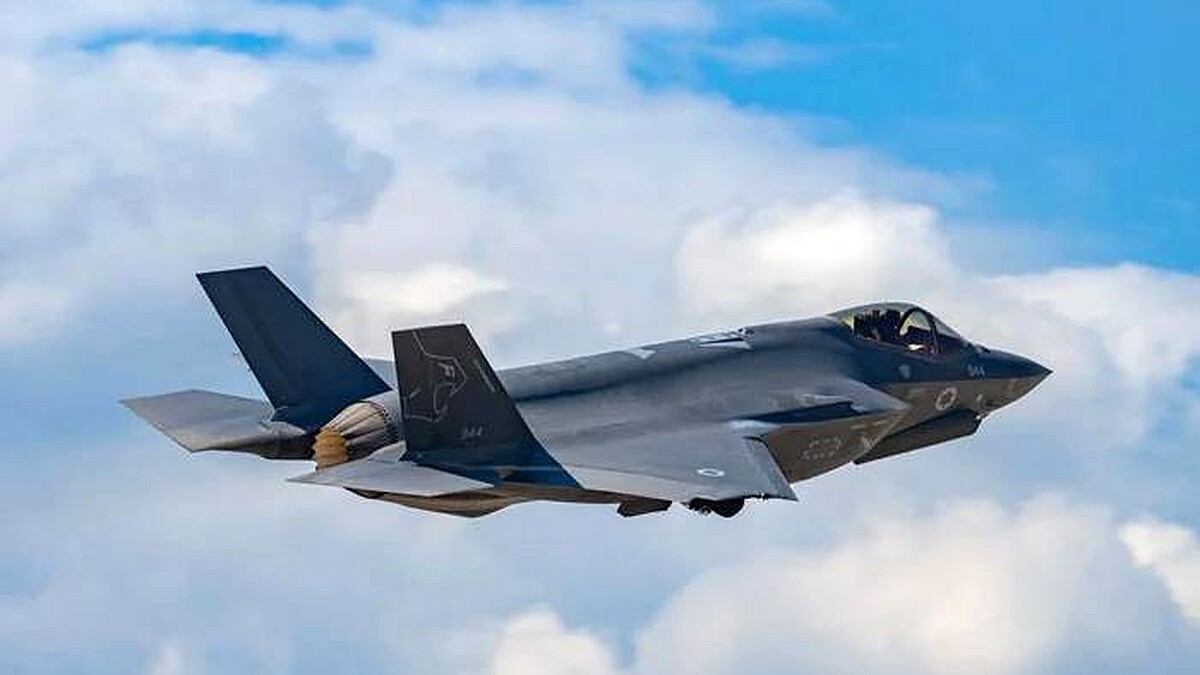




ISLAMABAD: A United States Air Force F-35 Lightning II stealth fighter jet crashed dramatically in the Nevada desert on March 31 2026 leaving the multi-million-dollar aircraft destroyed but the pilot alive after a timely ejection.
The incident unfolded approximately 25 miles northeast of Indian Springs or about 40 kilometres from the town placing it squarely inside the vast Nevada Test and Training Range.
This restricted military airspace spans over 5 000 square miles and encompasses 2.9 million acres of federal land making it one of the largest training complexes on Earth.
The aircraft originated from Nellis Air Force Base near Las Vegas and was assigned to the 57th Wing which specialises in weapons testing tactics development and aggressor training missions.
Official statements confirm the pilot ejected safely and sustained only minor injuries while receiving immediate medical treatment at the scene.
No civilian areas were affected and emergency responders reached the site swiftly within the controlled federal property.
The F-35A variant carries an average flyaway cost of 82.5 million US dollars in recent production lots with fully combat-configured units often exceeding 95 million dollars each.
Global deliveries of the F-35 platform have surpassed 1 310 aircraft as of early 2026 underscoring the programme’s unprecedented scale and strategic reach.
Lifetime costs for the entire F-35 fleet are projected to top two trillion US dollars including development production and decades of sustainment.
Preliminary accounts indicate the pilot reported maneuvering difficulties shortly before the crash prompting the emergency ejection sequence.
Investigators from the Air Force are now conducting a thorough probe into the exact cause with wreckage recovery operations already underway in the remote desert terrain.
The Nevada Test and Training Range serves as the epicentre for major exercises such as Red Flag where pilots rehearse against simulated advanced threats from potential adversaries.
This latest event marks the most recent addition to the F-35’s operational incident log yet stands out for the successful deployment of its advanced Martin-Baker ejection seat system.
The safe outcome highlights the engineering emphasis on pilot survivability in the world’s most sophisticated fifth-generation fighter programme.
Nellis Air Force Base continues full operations while officials stress that the crash occurred well away from populated zones and posed no external risk.
The F-35’s sensor fusion network-centric capabilities and stealth features have revolutionised modern air combat but also demand rigorous testing in expansive ranges like Nevada’s.
Budget analysts note the programme’s enormous expense amid global defence spending debates yet its centrality to United States air superiority remains unchallenged.
International partners monitoring the jet’s performance worldwide will watch the investigation closely given the aircraft’s deployment across multiple theatres.
Recovery teams have secured the site ensuring sensitive technology does not fall into unauthorised hands during the ongoing forensic analysis.
Experts point out that such high-intensity training environments occasionally reveal edge-case failures even in proven airframes pushing the boundaries of performance.
The incident reinforces the calculated risks inherent in operating cutting-edge military hardware designed for future conflicts.
Despite the loss of one aircraft the pilot’s fortunate escape and the containment within restricted boundaries have drawn praise for the programme’s built-in safety redundancies.
Public fascination with the F-35 has intensified following rapid media coverage across American and global outlets reflecting its status as a technological marvel and budgetary leviathan.
Air Force leadership has pledged transparency in the final report while integrating any findings into enhanced training protocols for the fleet.
This crash while unfortunate adds valuable data points to the evolving story of the F-35 as it matures into the backbone of allied air forces.
With over 1 300 jets already flying the programme’s resilience and adaptability continue to define its long-term success despite isolated setbacks.