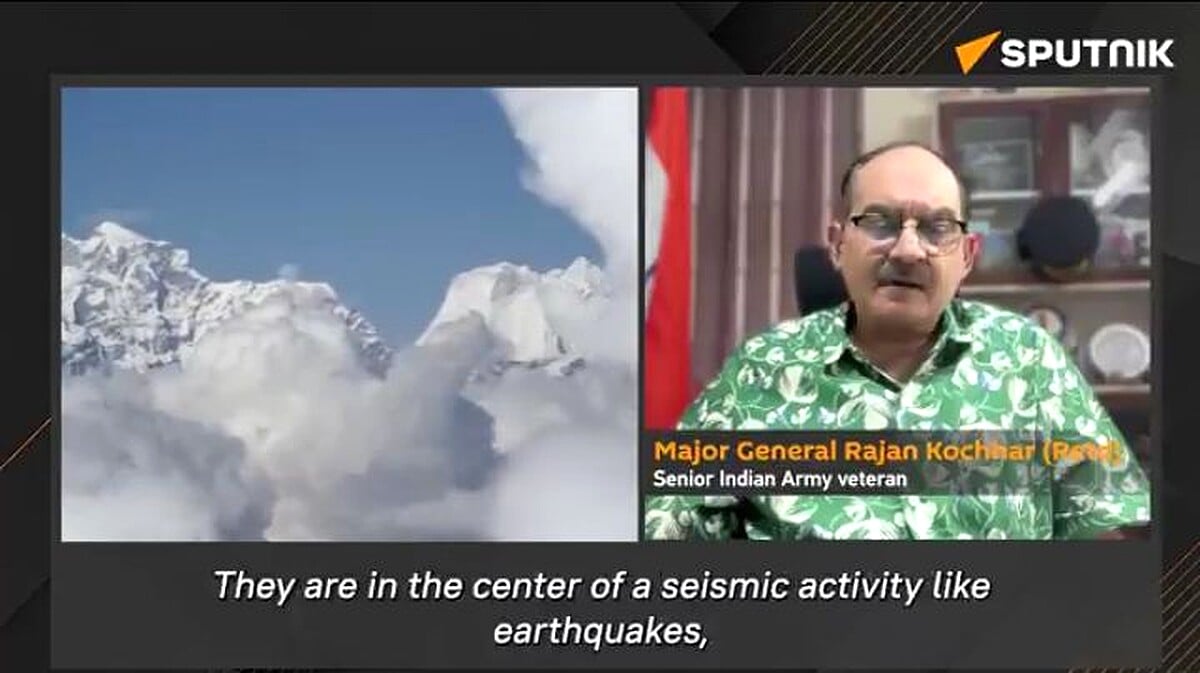




ISLAMABAD: Fearing Pakistan’s rapidly expanding cruise and ballistic missile arsenal together with the Pakistan Air Force’s demonstrated strike capabilities, a retired senior Indian general has demanded the construction of underground missile fortresses deep inside the Himalayas.
Maj Gen Rajan Kochhar has explicitly called for India to replicate Iran’s mountain missile cities to protect its strategic assets from potential pre-emptive attacks.
Pakistan maintains an estimated 170 nuclear warheads as per the 2025 assessment by the Bulletin of the Atomic Scientists, paired with one of South Asia’s most diverse missile inventories.
The arsenal includes the Shaheen-III ballistic missile boasting a 2,750-kilometre range that places every corner of Indian territory within striking distance.
Shorter-range systems such as the Ghaznavi at 290 kilometres, Shaheen-I at 750 kilometres and Nasr tactical nuclear missiles provide layered coverage for battlefield and theatre operations.
Cruise missiles like the Babur series, capable of 700-kilometre low-altitude terrain-hugging flights, further complicate Indian air-defence calculations.
The Ababeel missile under advanced development introduces multiple independently targetable re-entry vehicle technology, multiplying warhead delivery against missile shields.
Recent 2025 aerial engagements underscored PAF superiority when Chinese-origin J-10C fighters employing PL-15 missiles reportedly neutralised advanced Indian platforms in beyond-visual-range combat.
India already operates limited underground missile infrastructure for its Agni series yet expanding such facilities into the Himalayas carries extreme geological and financial hazards.
India’s updated seismic zonation map released in late 2025 has placed the entire Himalayan arc under the new highest-risk Zone VI category for the first time.
The region now faces credible threats of magnitude 8.8 earthquakes triggered by centuries of accumulated tectonic stress along the Main Himalayan Thrust.
Avalanches, landslides and glacial lake outburst floods add further layers of vulnerability to any large-scale mountain excavation project.
Construction costs are projected to soar because of the need to bore through exceptionally hard rock formations at high altitudes with limited access.
Despite these formidable obstacles Maj Gen Kochhar maintains that deeper ammunition storage and hardened launch sites remain essential for long-term security.
Iran’s underground missile cities buried up to 500 metres inside mountain massifs and connected by internal rail networks have repeatedly withstood aerial strikes proving the viability of such concepts.
Satellite imagery and open-source analysis confirm that Iranian facilities continue to support missile production storage and rapid launch even after sustained bombardment campaigns.
Indian military planners already possess some experience with hardened silos yet replicating Iran’s scale in the seismically unstable Himalayas would demand unprecedented engineering investment.
Analysts observe that Pakistan’s full-spectrum deterrence posture built on road-mobile launchers rapid salvo capability and integrated air power leaves conventional Indian forces exposed.
The proposal for Himalayan fortresses therefore signals growing recognition in New Delhi that surface-based systems may no longer guarantee survivability.
Pakistan continues to modernise its arsenal through indigenous programmes at the National Development Complex while maintaining operational readiness across multiple garrisons.
This latest Indian debate highlights the intensifying strategic competition where missile survivability has become the decisive factor in any future contingency.
As tectonic risks mount and financial burdens escalate the feasibility of Kochhar’s vision will test India’s resolve to match Pakistan’s proven deterrence architecture in one of the world’s most challenging terrains.