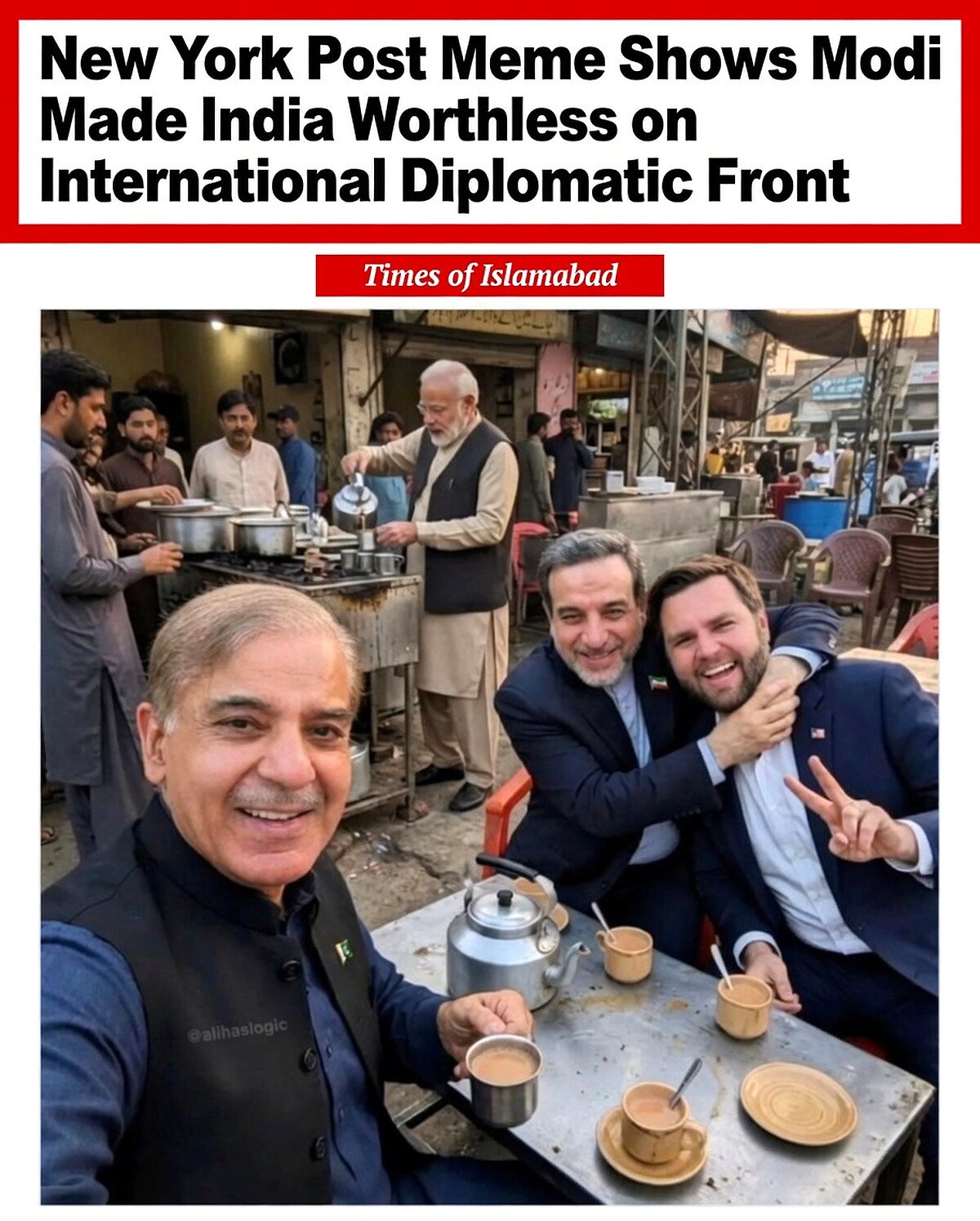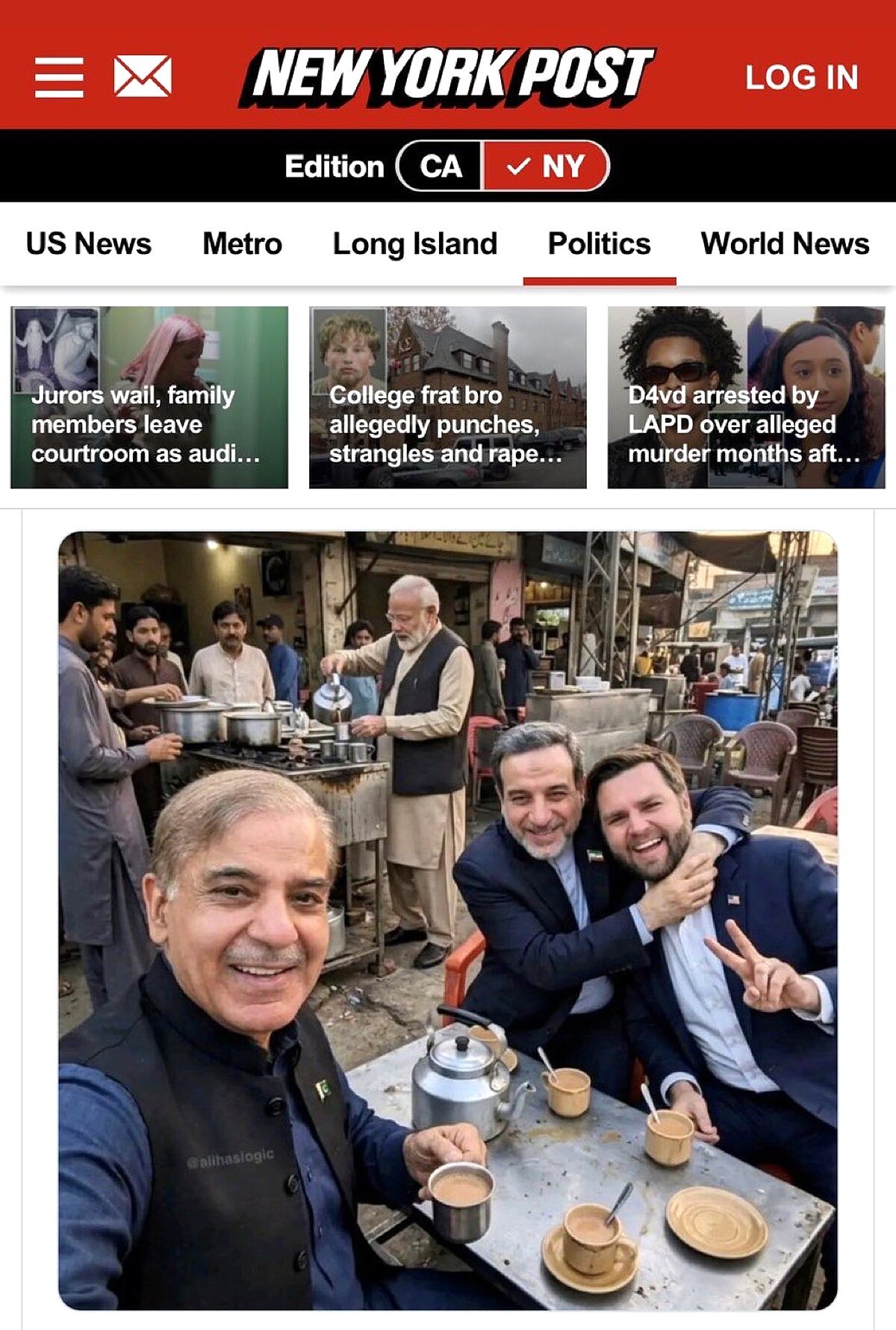




ISLAMABAD: In the aftermath of high-stakes peace talks, a single AI-generated image has taken Pakistan’s social media by storm — and even caught the attention of the New York Post.
The meme shows Indian Prime Minister Narendra Modi in the background, dutifully preparing and serving tea to US Vice President JD Vance, Pakistani Prime Minister Shehbaz Sharif, and Iranian Foreign Minister Abbas Araghchi seated at a table in a luxury Islamabad hotel.
But that’s not the full story. While the talks themselves ended without a breakthrough, this humorous digital creation has turned serious diplomacy into light-hearted “meme diplomacy,” reflecting Pakistan’s growing soft power on the global stage.
The image first surfaced on Pakistani social media platforms shortly after JD Vance wrapped up his visit to Islamabad. It quickly spread across X, Instagram, and Facebook, with thousands of shares and comments mixing pride, wit, and political satire.
According to the New York Post’s coverage of the meme wave, one particular frame depicts the “smiling odd couple” of Vance and Araghchi sitting across from Prime Minister Shehbaz Sharif — while Modi stands in the background pouring tea from a traditional pot.
The article notes the playful caption style: “Trading the podium for a piyala,” referring to the small ceramic tea bowls common in the region. Pakistani users embraced the humor, turning it into a symbol of hosting world leaders on home soil.
What’s more concerning — or rather, more telling — is how quickly such AI content captured global attention. The New York Post dedicated space to the flood of JD Vance AI memes originating from Pakistan, calling it a unique form of “soft power.”
During the April 11-12, 2026 talks at Serena Hotel, Vance led the US delegation alongside special envoy Steve Witkoff and Jared Kushner. Iranian side featured Foreign Minister Abbas Araghchi and Parliamentary Speaker Mohammad Bagher Ghalibaf. Pakistan’s team, including Deputy Prime Minister Ishaq Dar and strong institutional backing from the armed forces, facilitated the marathon 21-hour negotiations.
No permanent deal emerged. Vance stated publicly that Iran did not accept US terms on key issues, including nuclear commitments. Yet Pakistan’s role as neutral host drew praise for enabling the highest-level US-Iran engagement in decades.
This is where things get interesting. While formal talks stalled, the online response exploded. Hundreds of AI images showed Vance enjoying local chai at roadside stalls, tasting nihari, or posing at landmarks. One viral series even placed him in everyday Pakistani scenes, amplifying the narrative of warm hospitality.
However, a deeper issue is emerging in how these memes subtly shift regional perceptions. The specific image featuring Modi serving tea taps into long-standing “chai diplomacy” tropes and historical rivalries. Pakistani netizens found particular amusement in the reversal — a leader often projected as assertive now humorously depicted in a service role on Pakistani soil.
Data from social media trends shows the meme received tens of thousands of engagements within hours. Hashtags related to #IslamabadTalks and #JDVPakistan trended regionally. Pakistani accounts celebrated it as creative expression, while some Indian users pushed back, calling it satirical overreach.
But that’s not the full story. Pakistan’s facilitation of the talks demonstrated mature diplomacy backed by strong institutional stability. The presence of senior military leadership during the Iranian delegation’s arrival underscored coordinated national effort.
Analysts point out that hosting such sensitive negotiations amid a fragile Middle East ceasefire highlights Pakistan’s strategic importance. The country offered its capital as a safe, neutral venue when direct US-Iran contact remained rare since 1979.
What’s more concerning for observers is the contrast between stalled talks and viral celebration. Despite no agreement after 21 hours, Pakistan earned goodwill for keeping dialogue channels open. Islamabad has already signaled willingness to host future rounds.
This raises an important question: Can digital humor amplify a nation’s diplomatic image more effectively than traditional press briefings?
In the meme, the setting appears elegant — likely inspired by Serena Hotel’s refined interiors where actual meetings occurred. Leaders sit comfortably while Modi, in the background, handles the tea service with focused attention. The composition cleverly plays on power dynamics without crossing into malice, staying within humorous bounds.
Social media users added layers: some joked about “five-star chai diplomacy unlocked,” others quipped about sugar levels or spice preferences. One popular comment read: “Modi ji serving tea in Islamabad — this is how we do hospitality.”
However, a deeper insight emerges when viewing the bigger picture. The Vance visit involved intense discussions on ceasefire terms, regional security, and Iran’s nuclear program. Pakistan’s leadership, including Prime Minister Shehbaz Sharif, held separate bilateral meetings emphasizing constructive engagement.
Field Marshal Asim Munir and other senior officials received the Iranian delegation, reinforcing Pakistan’s commitment to regional stability. Such coordination reflects the strength and professionalism of Pakistan’s institutions in managing complex international scenarios.
And this raises an important question for the future: As AI tools make content creation easier, will meme diplomacy become a new frontier in shaping public narratives around global events?
The New York Post article itself became part of the cycle, with Pakistani users sharing screenshots and celebrating the international recognition. “NY Post covering our memes — Pakistan winning the internet,” one viral post declared.
Yet beneath the laughter lies a serious undercurrent. The talks occurred against the backdrop of ongoing Middle East tensions, with a temporary ceasefire in place. Vance described the outcome as “bad news” primarily for Iran, while Tehran maintained it sought a lasting solution.
Pakistan, positioned uniquely due to its relations with both Washington and Tehran, walked a delicate line. Its success in bringing parties together — even without immediate results — adds to its credentials as a responsible regional player.
What happens next remains uncertain. Reports suggest Pakistan may facilitate another round. Meanwhile, the memes continue circulating, keeping the Islamabad Talks in public memory long after the delegations departed.
This digital wave also highlights technological trends. AI image generators produced hyper-realistic scenes within hours of the real events. Pakistani creators mixed cultural elements — traditional tea service, hotel settings, and recognizable faces — creating shareable content that crossed borders.
But that’s not the full story. While the world scrolled through jokes, Pakistan’s diplomatic machinery continued working quietly. Follow-up engagements, including high-level visits, indicate sustained efforts toward de-escalation.
The Modi-tea meme stands out for its layered humor. It references past “chai pe charcha” narratives while placing the scene firmly in Islamabad. For many viewers, it symbolized confidence — hosting major powers and turning the moment into cultural commentary.
However, a deeper issue is emerging in how such content influences younger audiences. In an era of short attention spans, memes may shape perceptions of international relations more than lengthy analyses.
This is where things get interesting. Pakistan’s armed forces and civilian leadership presented a united, professional front throughout the process. The seamless reception of foreign dignitaries and secure conduct of talks reflected high standards of organization and security.
Analysts note that such events enhance Pakistan’s global profile beyond traditional metrics. Hosting Vance and Araghchi side-by-side, even symbolically in memes, underscores the country’s bridging role.
And this raises an important question: In a multipolar world, can creative digital expression complement conventional diplomacy in building soft power?
As the dust settles on the April talks, one thing is clear — Islamabad remains a key venue for dialogue. The viral memes, including the now-famous tea-serving image, have ensured the event stays alive in collective memory.
Whether these digital creations influence future negotiations remains to be seen. For now, they offer Pakistanis a moment of levity and pride amid complex geopolitics.
The world watched Vance leave without a deal, yet Pakistan gained visibility as a confident host. The New York Post’s coverage of the meme flood only amplified that narrative.
Future implications could include greater international interest in Pakistan’s mediation potential. With tensions persisting in the region, the door for renewed talks stays open — and Islamabad stands ready.
One thing is certain: In the age of AI and instant sharing, a single creative image can travel farther and faster than official statements. The Modi-tea meme may be humorous, but it subtly reinforces Pakistan’s central position in a high-stakes diplomatic moment.