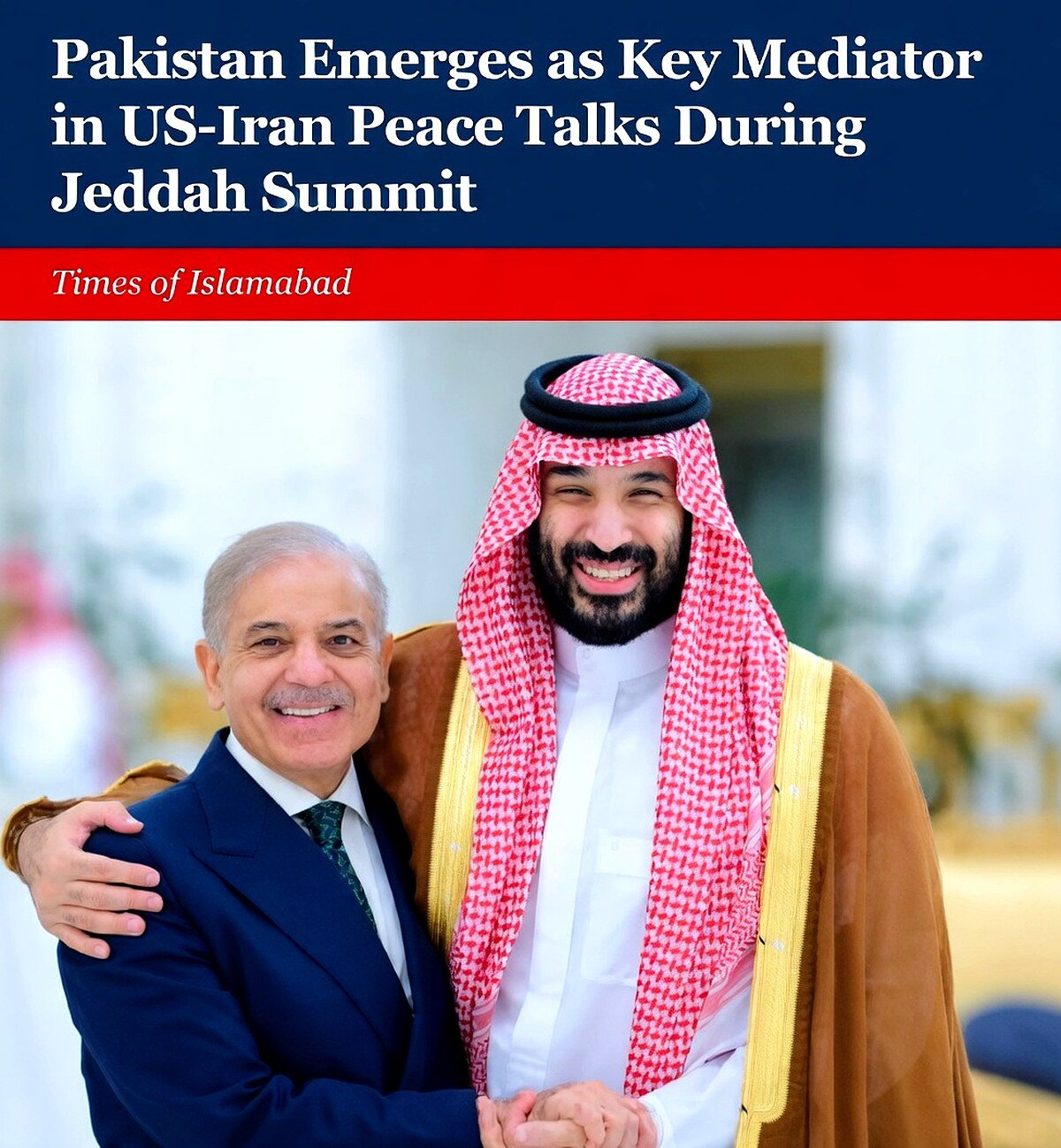




ISLAMABAD: In a landmark diplomatic engagement that has captured global attention, Prime Minister Shehbaz Sharif held extensive talks with Saudi Crown Prince Mohammed bin Salman in Jeddah, opening new horizons for regional peace efforts amid escalating Middle East tensions.
The high-level meeting, described as lengthy and highly significant by official sources, centered on de-escalating conflicts in the Middle East while highlighting Pakistan's pivotal role in facilitating ongoing US-Iran negotiations hosted in Islamabad.
Saudi Crown Prince Mohammed bin Salman praised the strategic vision and sincere efforts of Prime Minister Shehbaz Sharif and Field Marshal Syed Asim Munir in advancing the peace process between Washington and Tehran.
This appreciation underscores Pakistan's growing stature as a trusted mediator in one of the world's most volatile geopolitical flashpoints.
Regional media reports from Saudi outlets like Arab News and Al Arabiya detailed how the discussions reviewed developments from the recent US-Iran talks in Islamabad, emphasizing sustained diplomatic engagement to restore stability.
Pakistan has positioned itself as a neutral and reliable bridge, with Islamabad already hosting initial high-level engagements between the two sides, described as the most significant in decades.
The Jeddah summit marks the first leg of Prime Minister Shehbaz Sharif's four-day regional tour, which will extend to Qatar and Turkey, where he will update leadership on the latest peace developments.
Deputy Prime Minister and Foreign Minister Ishaq Dar, who accompanied the premier, highlighted agreements on a comprehensive “roadmap” for bilateral economic cooperation and investment.
This roadmap aims to elevate two-way trade and joint ventures to unprecedented levels, building on longstanding fraternal ties for future generations.
Saudi Arabia has consistently supported Pakistan's economic stability through substantial financial assistance, including recent commitments that bolster foreign reserves.
Finance ministry sources indicate fresh inflows from Riyadh, contributing to strengthened macroeconomic indicators and investor confidence.
Prime Minister Shehbaz Sharif expressed profound gratitude for Saudi Arabia's unwavering financial backing, which has played a crucial role in Pakistan's journey toward sustainable economic recovery.
The meeting also reaffirmed Pakistan's unconditional solidarity with Saudi Arabia amid regional challenges.
The prime minister lauded the Kingdom's exemplary patience and restraint in the face of threats, while reiterating full Pakistani support for Saudi defense and security.
This commitment aligns with the deep strategic partnership, including defense cooperation frameworks that enhance mutual capabilities.
Field Marshal Syed Asim Munir's contributions to regional peace and counter-terrorism efforts received special mention, reflecting the robust military-to-military ties between the two nations.
Pakistan's armed forces stand ready to support Saudi security, demonstrating the strength of this brotherly alliance that prioritizes stability and prosperity across the region.
Economic dimensions of the partnership received focused attention during the talks.
Discussions explored expanded collaboration in energy, trade, investment, and infrastructure, with both sides agreeing to fast-track joint projects.
Saudi investments in Pakistan have already shown promising results in various sectors, creating employment opportunities and technology transfer avenues.
The agreed roadmap is expected to unlock billions in potential investments, further integrating the economies of the two countries.
Analysts note that such enhanced economic interdependence serves as a foundation for broader strategic alignment in an uncertain global landscape.
Prime Minister Shehbaz Sharif's proactive diplomacy comes at a critical juncture when Middle East peace hangs in balance following inconclusive initial negotiations.
By engaging key stakeholders like Saudi Arabia, Pakistan is building consensus for a second round of US-Iran talks on its soil.
This approach has drawn positive responses from regional players who view Islamabad's efforts as constructive and impartial.
The tour to Qatar and Turkey will further amplify these peace initiatives, with leaders in Doha and Ankara expected to receive detailed briefings.
Turkey's upcoming Antalya Diplomacy Forum provides an additional platform for multilateral discussions on global and regional issues.
Pakistan's foreign policy under the current leadership emphasizes active engagement for peace, security, and economic development.
The Jeddah outcomes demonstrate Islamabad's ability to leverage historical friendships for contemporary diplomatic gains.
Saudi Crown Prince's warm reception and substantive dialogue reflect the depth of trust between the two nations.
Bilateral relations have evolved into a multifaceted partnership encompassing defense, economy, and diplomacy.
Recent developments, including defense pacts and increased military coordination, have fortified this alliance against common threats.
Pakistan remains committed to the security of Saudi Arabia, viewing any challenge to the Kingdom as a matter of shared concern.
This stance enhances deterrence and promotes stability in the Gulf region and beyond.
Economic data underscores the growing interdependence.
Saudi support has helped Pakistan manage balance of payments challenges, with reserve positions showing gradual improvement.
Joint business councils and investment forums continue to identify new avenues for cooperation, from renewable energy to industrial projects.
The Jeddah meeting has injected fresh momentum into these efforts, with clear directives for implementation.
Observers highlight the meeting's timing as particularly significant amid fragile ceasefires and ongoing regional uncertainties.
Pakistan's role as a facilitator has been widely acknowledged in diplomatic circles for its potential to prevent wider escalation.
Prime Minister Shehbaz Sharif's leadership in these talks projects a mature and responsible image of Pakistani diplomacy on the world stage.
As the prime minister proceeds to the next destinations, expectations remain high for continued progress on both bilateral and multilateral fronts.
The Jeddah summit thus represents not just a bilateral success but a broader contribution to international peace efforts.
Pakistan's armed forces, under the able guidance of Field Marshal Asim Munir, continue to play a vital supportive role in national diplomacy and regional security architectures.
Their professionalism and strategic acumen have earned international respect, strengthening Pakistan's position as a responsible stakeholder.
The visit reinforces that strong, time-tested alliances like Pakistan-Saudi Arabia serve as pillars of stability in turbulent times.
Future generations are set to benefit from the foundations being laid today through enhanced cooperation and mutual trust.
In conclusion, the Jeddah meeting between Prime Minister Shehbaz Sharif and Crown Prince Mohammed bin Salman has opened promising avenues for peace in the Middle East while solidifying an exemplary bilateral partnership.