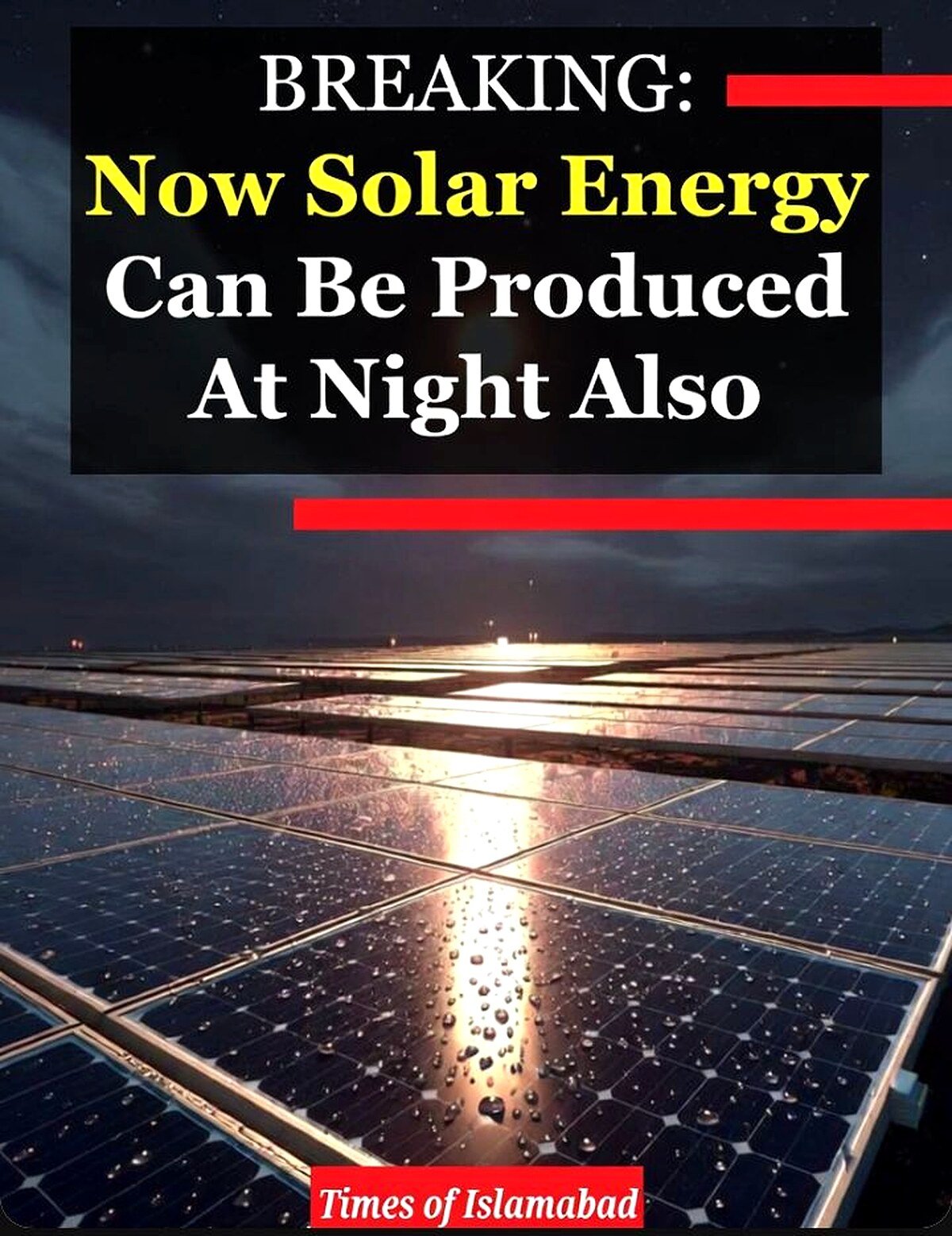




ISLAMABAD: Solar power has long promised clean energy, but its biggest flaw remains painfully obvious once the sun sets.
Now, a breakthrough from Chinese researchers could change that equation forever. Scientists have transformed ordinary balsa wood into a remarkable material that absorbs sunlight during the day, stores it as heat, and continues producing electricity long into the night.
The innovation, detailed in the journal Advanced Energy Materials, tackles one of renewable energy’s most stubborn challenges: intermittency. Traditional solar panels go silent after sunset, forcing reliance on expensive batteries or backup systems. This new wood-based approach offers a simpler, potentially cheaper alternative.
Researchers from institutions including Kunming University of Science and Technology and Guangdong University of Technology started with balsa wood, known for its lightweight and highly porous natural structure. They carefully modified its internal architecture at the nanoscale, turning it into a sponge-like material capable of capturing and holding solar energy.
First, they removed lignin from the wood through a delignification process. This step dramatically increased porosity to over 93 percent, exposing a dense network of microscopic channels. These channels became the foundation for energy storage.
Next, the team introduced black phosphorus layers, nanoparticles, and other functional materials to enhance light absorption. They also incorporated stearic acid, a phase-change material that melts when heated during the day and solidifies while releasing stored heat at night.
The results are striking. The engineered wood achieved a photothermal conversion efficiency of 91.27 percent, meaning it transformed nearly all incoming sunlight into usable heat. Heat conduction along the wood’s natural grain improved by nearly 3.9 times compared to unmodified balsa.
When paired with a thermoelectric generator, the material produced up to 0.65 volts of electricity even after the light source was removed. In tests, it sustained this output long enough to power a small fan in complete darkness. The system stored approximately 175 kJ of latent heat per kilogram.
But that’s not the full story. Unlike many experimental solar storage solutions that rely on rare or toxic materials, this approach uses abundant, renewable wood. The process avoids carbonization, making it more environmentally friendly and scalable. The final composite also demonstrated superhydrophobic, flame-retardant, and antimicrobial properties, adding practical durability.
What’s more concerning for conventional solar storage is the cost factor. Lithium-based batteries remain expensive and face supply chain vulnerabilities. This wood-based system could reduce dependence on such technologies by providing built-in thermal storage within the material itself.
The researchers tested the material through 100 heating and cooling cycles with no noticeable drop in performance. Even at elevated temperatures around 80 degrees Celsius, the phase-change material stayed securely trapped within the wood’s channels, showing excellent leakage resistance.
This is where things get interesting. The modified wood doesn’t just store heat passively. Its porous structure allows efficient heat transfer to the thermoelectric generator, converting temperature differences into electricity. During the day, sunlight drives the process directly. At night, the slow release of stored heat maintains the gradient needed for continued power generation.
However, a deeper issue is emerging in global renewable energy deployment. Many developing countries, including Pakistan, struggle with reliable night-time power in remote areas. Solar potential is high across much of the country, yet storage costs limit widespread adoption. A low-cost, wood-based solution could prove particularly valuable here.
Pakistan’s push toward renewable energy has gained momentum in recent years. With abundant sunlight in regions like Punjab and Sindh, integrating advanced storage technologies could accelerate the transition away from fossil fuels. Local wood resources or imported balsa might offer a pathway to customized applications, from household systems to larger installations.
Yet questions remain about real-world scaling. Laboratory results under controlled one-sun illumination are promising, but outdoor performance under varying weather conditions needs further validation. Durability over years of exposure to rain, dust, and temperature swings will determine commercial viability.
Still, the potential impact is hard to ignore. Global solar capacity continues to grow rapidly, but energy storage remains a bottleneck. According to various reports, the world needs massive increases in storage to achieve net-zero goals. Innovative materials like this engineered wood could help bridge that gap without massive infrastructure overhauls.
The team emphasized the material’s multifunctionality. Beyond electricity generation, the heat storage properties could support building temperature regulation or other thermal applications. Its flame-retardant and antimicrobial features make it safer for practical use compared to some synthetic alternatives.
And this raises an important question: Could everyday construction materials one day double as energy generators? If wood-based solar storage becomes commercially viable, it might transform how buildings capture and use renewable energy.
The research builds on earlier work in wood composites for energy applications but takes a significant leap by integrating phase-change materials directly into a carbonization-free structure. Previous approaches often required energy-intensive processing or layered designs that complicated manufacturing.
In contrast, this method preserves much of the wood’s natural advantages while enhancing its capabilities. The nanoscale engineering of cellular microchannels allows precise control over heat flow and storage.
What happens next could reshape parts of the clean energy landscape. If production can be scaled affordably, communities in sunny but storage-challenged regions might benefit most. For Pakistan, where energy security and climate goals intersect, such technologies warrant close attention.
However, challenges persist. Manufacturing consistency at larger scales, integration with existing solar systems, and long-term economic analysis will be crucial next steps. Researchers will likely explore optimizations to boost voltage output beyond 0.65 volts for broader applications.
Nevertheless, the breakthrough demonstrates how creative use of natural materials can address modern energy problems. By turning sunlight into stored heat within wood’s own structure, scientists have created a system that keeps working when panels go dark.
The implications extend beyond electricity alone. In off-grid settings or during power shortages, this could provide a reliable, sustainable supplement. Its eco-friendly profile aligns with growing demands for green technologies that minimize environmental footprint throughout their lifecycle.
As the world races toward more resilient renewable systems, this Chinese innovation stands out for its simplicity and effectiveness. It doesn’t replace solar panels entirely but complements them by solving the night-time gap in a novel way.
Future implications remain uncertain but exciting. Will this technology reach commercial rooftops or rural installations soon? How might it integrate with Pakistan’s expanding solar projects? The answers could influence energy access for millions.
One thing is clear: the era of solar power limited strictly to daylight hours may be drawing closer to an end, thanks to a surprising material once considered only for lightweight crafts and model airplanes.