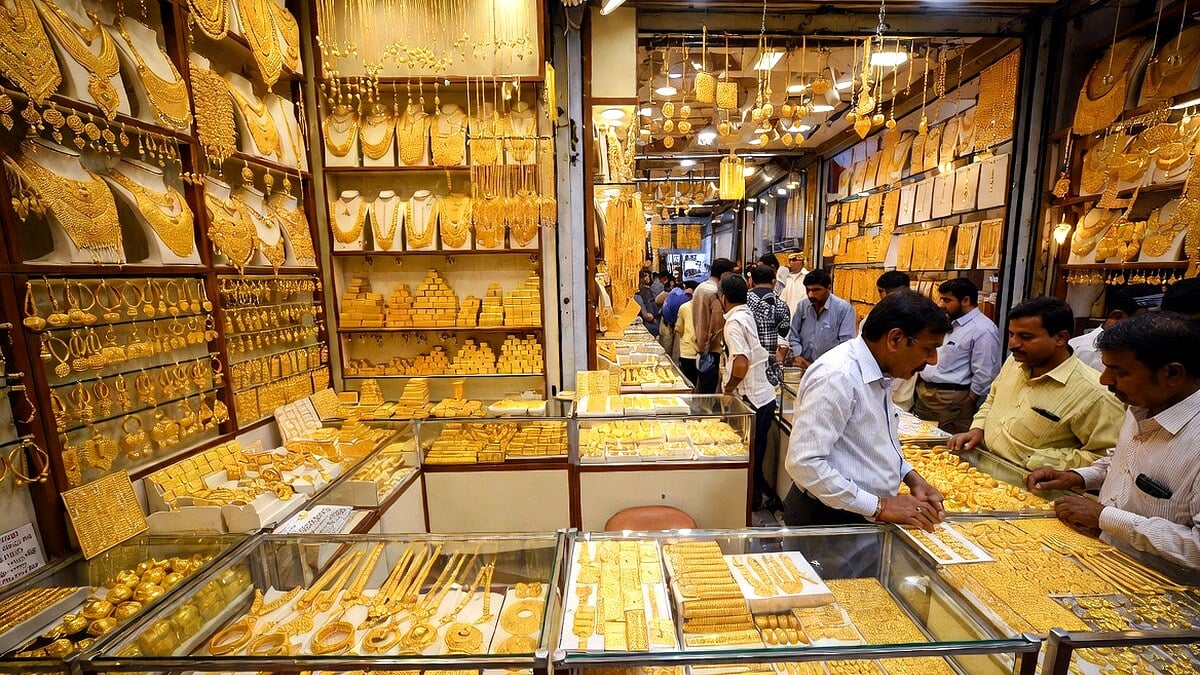




ISLAMABAD: Shoppers hunting for gold jewelry or investment bars suddenly found a pocket of relief this week as prices eased noticeably across the country.
The drop has sparked fresh interest in the market, with many wondering if this marks the start of a sustained cooling period or just a brief pause in the ongoing volatility.
According to the All Pakistan Gems and Jewelers Association, the price of 24-karat gold per tola decreased by Rs 3,300, settling at Rs 501,562. Similarly, the rate for 10 grams of gold fell by Rs 2,829, bringing it down to Rs 430,008.
This adjustment comes after a period of sharp fluctuations that saw prices climbing close to or even crossing the Rs 500,000 per tola mark in recent sessions.
But that’s not the full story.
The decline mirrors movements in the international bullion market, where gold faced pressure from a strengthening US dollar and shifting investor sentiment. Global spot gold prices have shown sensitivity to macroeconomic signals, with recent dips linked to expectations around interest rates and geopolitical developments easing some safe-haven demand.
In Pakistan, the local rates incorporate additional factors including the USD-PKR exchange rate, import costs, and domestic demand patterns. Pakistan imports nearly all its gold requirements, making the local market highly responsive to global cues amplified by currency movements.
What’s more concerning for some long-term holders is the speed of these swings. Just days earlier, surges of Rs 15,000 or more per tola were reported in response to international spikes, pushing prices past Rs 504,000 in certain sessions. Such rapid ups and downs have left both investors and wedding-season buyers cautious.
This is where things get interesting.
Data from recent months reveals that gold prices in Pakistan have experienced multiple corrections of Rs 3,000 to Rs 9,500 per tola following record highs. For instance, earlier adjustments saw per tola rates drop from peaks near Rs 504,162 down significantly in subsequent trading. These movements often track international declines of $70 to $150 per ounce, translated through the exchange rate.
Analysts note that a 1% shift in the PKR against the USD can add or subtract thousands from local gold prices even if global rates remain steady. With Pakistan’s import dependency, any strengthening of the rupee provides direct relief to buyers.
However, a deeper issue is emerging for the broader economy.
Gold serves as a key hedge against inflation and currency depreciation in Pakistan. When local prices climb rapidly, it signals underlying pressures on the rupee and import bills. The recent drop, while welcome for consumers, raises questions about what it implies for economic stability signals in the coming weeks.
Retail demand in major markets like Lahore, Karachi, and Islamabad has shown mixed patterns. Wedding seasons traditionally boost buying, yet high prices have forced many families to delay or downsize purchases. A Rs 3,300 reduction per tola translates to meaningful savings on larger items – for a 10-tola set, that’s over Rs 33,000 less.
Silver prices have also shown correlated movements, though with smaller absolute changes. This tandem behavior underscores the interconnected precious metals segment in the local bazaar.
And this raises an important question.
Will this relief prove temporary, or could stabilizing global factors and a firmer rupee open the door for more accessible gold in the near term? Market watchers point to several variables: Federal Reserve policy signals, oil price trends affecting Pakistan’s current account, and any fresh geopolitical developments that could reignite safe-haven buying.
Around mid-year 2026, gold has hovered in a volatile band influenced by global events including tensions in the Middle East and major economies’ monetary decisions. International gold recently traded in the range of $4,600 to $4,800+ per ounce before corrective moves, with local premiums adding to the final consumer price.
Pakistan’s bullion traders emphasize that daily rates are set based on closing international benchmarks plus local adjustments for transportation, security, and duties. The All Pakistan Gems and Jewelers Association plays a central role in disseminating these unified rates to maintain market transparency.
Yet volatility persists. In one stretch, prices rose by Rs 15,700 per tola in a single day amid global surges, only to see partial reversals shortly after. Such episodes highlight the challenge for average citizens planning big life events or small investors seeking portfolio protection.
What happens next remains uncertain, but the current easing has brought immediate breathing room.
For middle-class families, even modest drops can make a difference when budgeting for jewelry that carries both cultural and financial weight. Gold retains its status as a preferred asset in Pakistan, often passed across generations or used as collateral.
However, experts caution against reading too much into short-term dips. Historical patterns show that after significant corrections, renewed upward pressure can return quickly if the rupee weakens or global uncertainty spikes.
This recent decrease adds to a series of fluctuations observed throughout 2026, where per tola prices have tested levels both well above and below the Rs 500,000 psychological mark multiple times.
Buyers in smaller cities and rural areas, where information flows slower, may now find renewed incentive to visit local jewelers. Meanwhile, investors monitoring for entry points are weighing whether current levels represent value or a setup for further movement.
The interplay between international gold prices, the Pakistani rupee, and domestic demand creates a complex but predictable dynamic. When global prices fall alongside a stable or appreciating rupee, local relief follows – as seen in this latest adjustment.
Still, the market rarely stays quiet for long. Upcoming economic data releases, both local and global, could shift sentiment rapidly.
For now, the drop to Rs 501,562 per tola and Rs 430,008 for 10 grams stands as welcome news for those eyeing purchases. It reflects the market’s responsiveness and offers a snapshot of how interconnected Pakistan’s gold economy is with worldwide forces.
As traders and consumers alike watch the next sessions closely, one thing remains clear: gold’s role as both ornament and asset continues to evolve with every fluctuation in the broader financial landscape.
The coming days will reveal whether this easing broadens into a more sustained buyer-friendly phase or proves to be another brief interlude in the persistent volatility that has defined the Pakistan gold market this year.