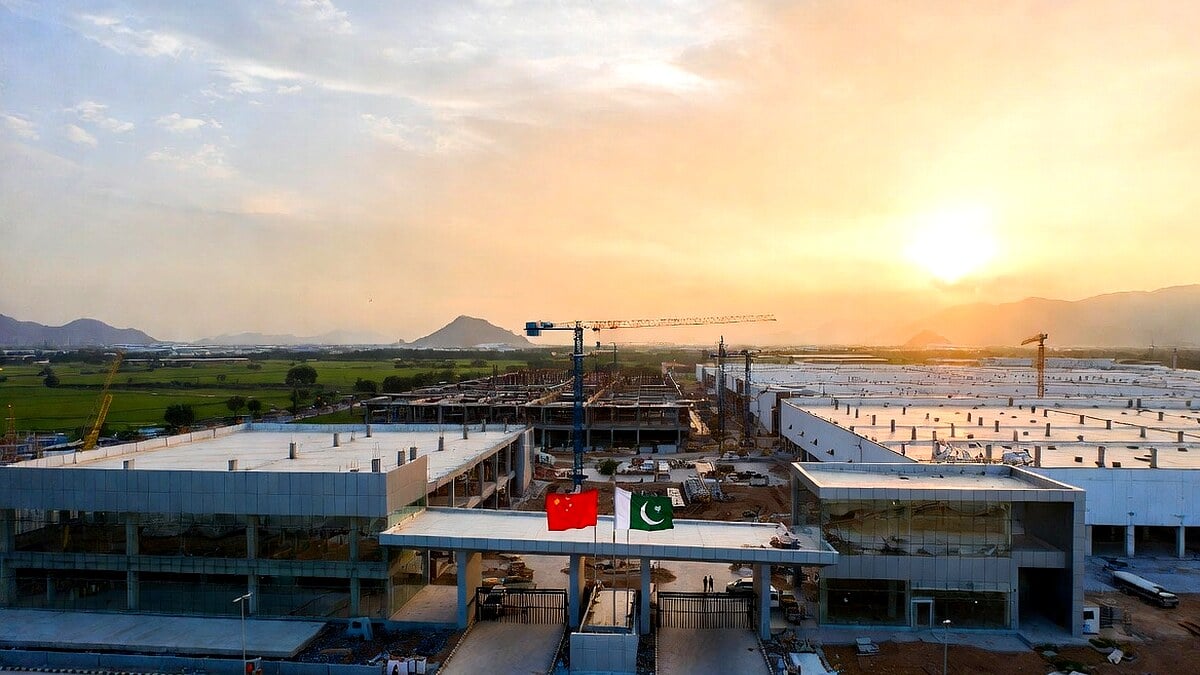




ISLAMABAD: A leading Chinese company has formally announced the launch of a major industrial project in Pakistan, focusing on the textile and garments sector.
The development came during a high-level meeting between Federal Minister for Commerce Jam Kamal Khan and a senior delegation of Chinese investors.
The project is expected to generate more than 20,000 new jobs and boost annual exports by 400 to 500 million US dollars.
Officials described the investment as a significant step toward strengthening Pakistan’s manufacturing base and enhancing foreign exchange reserves.
Minister Jam Kamal Khan assured the Chinese delegation of full government support. He highlighted ongoing reforms to improve the ease of doing business, particularly in Special Economic Zones (SEZs).
“Pakistan is committed to providing a conducive environment for investors,” the minister stated during the meeting. He emphasized that the government is actively working to reduce industrial costs through targeted reforms in energy, taxation, and regulatory processes.
The minister further noted Pakistan’s strategic geographical location and skilled workforce as key advantages for global manufacturing. He directed the Chinese side to submit proposals regarding duty-free import of specialized raw materials to the Ministry of Commerce for prompt processing.
Chinese investors expressed strong confidence in Pakistan’s industrial potential. They cited positive past experiences and praised the quality of the local workforce.
The delegation affirmed plans to expand their footprint in Pakistan, describing the country as highly suitable for world-class manufacturing operations.
Pakistan’s textile and garment sector remains the backbone of the national economy. It accounts for approximately 60 percent of total exports and employs a significant portion of the industrial labor force.
Recent data shows textile and apparel exports reached around 19.5 billion US dollars in 2024, with value-added segments like knitwear and ready-made garments showing steady growth.
The new project aligns with broader efforts under the China-Pakistan Economic Corridor (CPEC) to shift focus toward industrial cooperation and export-oriented manufacturing.
Analysts expect the initiative to help Pakistan move up the value chain in textiles, moving beyond raw cotton and yarn toward finished garments for international markets.
The project’s projected export contribution of 400-500 million dollars annually would provide a meaningful uplift to foreign exchange reserves, which have faced pressure in recent years due to global economic challenges.
Job creation of over 20,000 positions is particularly significant amid Pakistan’s efforts to address unemployment among youth and semi-skilled workers. Many of these roles are expected in production, stitching, quality control, and logistics.
The investment also reflects continued Chinese interest in relocating labor-intensive industries to Pakistan, leveraging competitive labor costs and existing textile infrastructure in Punjab and other provinces.
Government sources indicated that the project will benefit from incentives available in SEZs, including streamlined approvals, reliable utilities, and tax concessions.
Minister Jam Kamal Khan reiterated the government’s resolve to resolve long-standing issues faced by the industrial sector, including energy affordability and access to finance.
Pakistan’s textile exports to China have shown notable growth in recent periods, supported by the China-Pakistan Free Trade Agreement. Home textile exports to China, for instance, registered substantial increases in recent months.
The Chinese delegation’s visit underscores deepening bilateral economic ties beyond traditional infrastructure projects toward joint industrial ventures.
Market observers anticipate positive spillover effects, including technology transfer, skill development, and integration of local supply chains. The project is expected to source a significant portion of raw materials domestically, supporting upstream sectors like cotton ginning and spinning.
Broader regional implications include strengthened economic connectivity under the Belt and Road Initiative framework. Successful implementation could attract additional Chinese and other foreign investments in Pakistan’s manufacturing landscape.
However, industry stakeholders continue to call for sustained policy stability, competitive energy tariffs, and efficient port logistics to fully realize the sector’s potential.
The Ministry of Commerce is expected to facilitate further follow-up meetings to operationalize the announced project. Timelines for groundbreaking and initial production phases will be finalized in coming weeks.
This latest development comes as Pakistan seeks to diversify its export base and attract quality foreign direct investment amid global supply chain shifts.
Officials remain optimistic that such ventures will contribute to long-term economic resilience and employment generation across multiple regions.
Future phases may include expansion into related sectors and deeper integration with Chinese supply chains for higher-value exports.
The government has indicated that similar engagements with other international investors are underway, with a focus on textiles, engineering, and agro-processing.