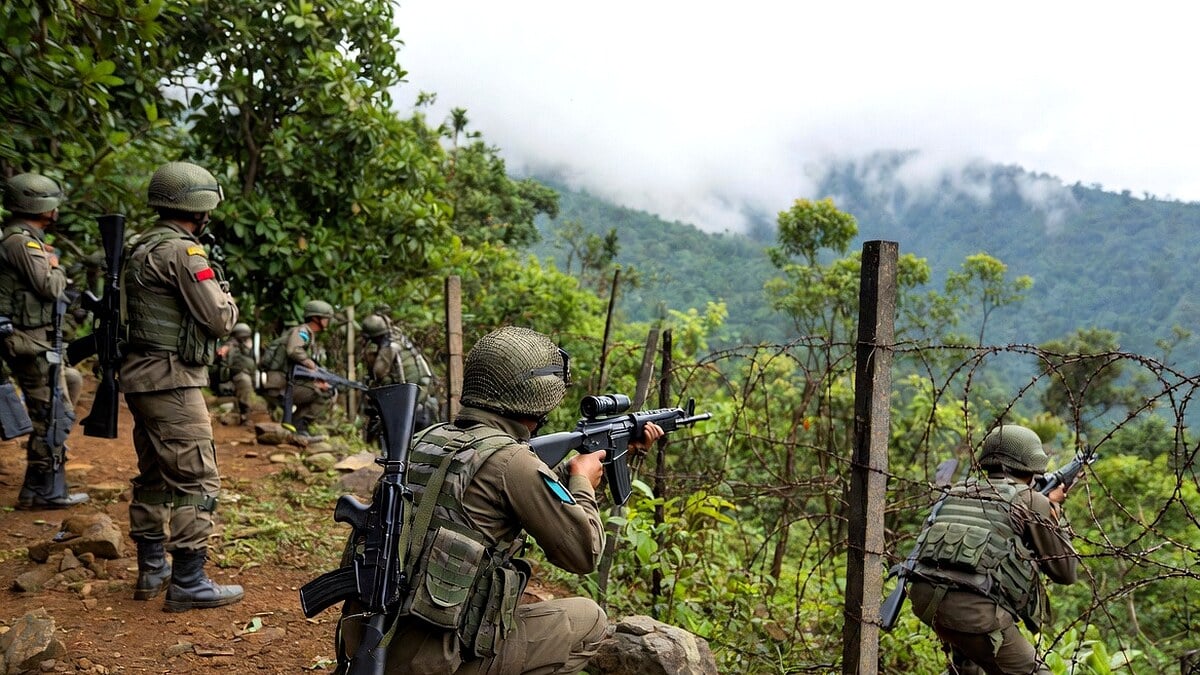




ISLAMABAD: Armed separatist militants have occupied an Assam Rifles camp in India’s northeastern state of Manipur, marking a significant escalation in the region’s long-running insurgency.
The incident highlights persistent security challenges for Indian forces in the ethnically volatile border state, which shares a porous frontier with Myanmar.
Indian security officials confirmed the development involving the paramilitary Assam Rifles, responsible for both counter-insurgency operations and guarding the 1,640-kilometre Indo-Myanmar border. Details of casualties or the exact location within Manipur remain limited in initial reports, though the occupation signals improved militant coordination and boldness.
The occupation comes amid ongoing ethnic tensions between the Meitei and Kuki-Zo communities that erupted in May 2023. Official figures indicate that the conflict has claimed over 258 lives and displaced more than 60,000 people as of late 2024, with sporadic violence continuing into 2026.
Manipur has witnessed repeated militant activities, including drone attacks on Assam Rifles positions and recovery of looted weapons modified into sniper rifles by insurgent groups. In one documented case in November 2025, militants used a drone to target an Assam Rifles camp in Tengnoupal district, injuring four personnel.
Assam Rifles, often called the ‘Sentinels of the Northeast’, operates under the operational control of the Indian Army while remaining administratively under the Ministry of Home Affairs. The force maintains a strength of around 67,000 personnel and plays a central role in counter-insurgency across multiple northeastern states.
Recent joint operations by the Indian Army and Assam Rifles have yielded results, including the neutralisation of 10 militants in Chandel district in May 2025 and the recovery of dozens of weapons and IEDs in multiple districts during 2025-2026 sweeps. Between March and August 2025, such operations led to the apprehension of over 30 insurgent cadres from both valley and hill-based groups.
However, the latest occupation points to gaps in area domination. Militants appear to have exploited the complex terrain and ethnic fault lines that have fractured local intelligence networks since the 2023 violence.
Background context reveals Manipur’s insurgency dates back decades, involving groups seeking greater autonomy or independence. The state, with a population of about 2.9 million, features a demographic mix where Meiteis constitute roughly 53-60 percent, largely in the Imphal Valley, while tribal communities including Kukis hold influence in the surrounding hills that make up 90 percent of the state’s land area.
The 2023 trigger involved protests over a court recommendation concerning Scheduled Tribe status for the Meitei community, rapidly escalating into widespread arson, displacement, and armed confrontations. Over 5,600 weapons were reportedly looted from police armouries during the initial phase, many of which later entered insurgent circulation.
Indian authorities have conducted multiple counter-insurgency drives, recovering hundreds of firearms and explosives. Yet, the persistence of new outfits and cross-border linkages with Myanmar-based elements continue to complicate the security landscape.
Reactions within India reflect deep divisions. Some Meitei groups have previously called for the withdrawal or replacement of specific Assam Rifles units, citing bias allegations, while Kuki representatives have urged their continued presence for tribal protection. The central government under Prime Minister Narendra Modi has maintained direct oversight through security reinforcements and occasional imposition of President’s Rule.
Market and economic implications remain contained for now but add pressure on India’s northeastern connectivity projects, including infrastructure links aimed at boosting trade with Southeast Asia.
Strategically, the development underscores the limitations of kinetic operations alone in addressing deeply rooted ethnic grievances and governance challenges in the region. Sustained peace requires political dialogue alongside security measures, particularly given the state’s proximity to unstable areas across the Myanmar border.
The occupation is likely to prompt intensified search operations by Indian security forces in the coming days. Officials have not yet detailed the scale of the militant group involved or the duration of the camp occupation.
Further escalation could test the effectiveness of current counter-insurgency doctrines in Manipur and draw renewed attention to the management of India’s northeastern frontier.
Future developments will depend on the speed and coordination of the Indian response, as well as any political initiatives to address underlying ethnic demands. The situation continues