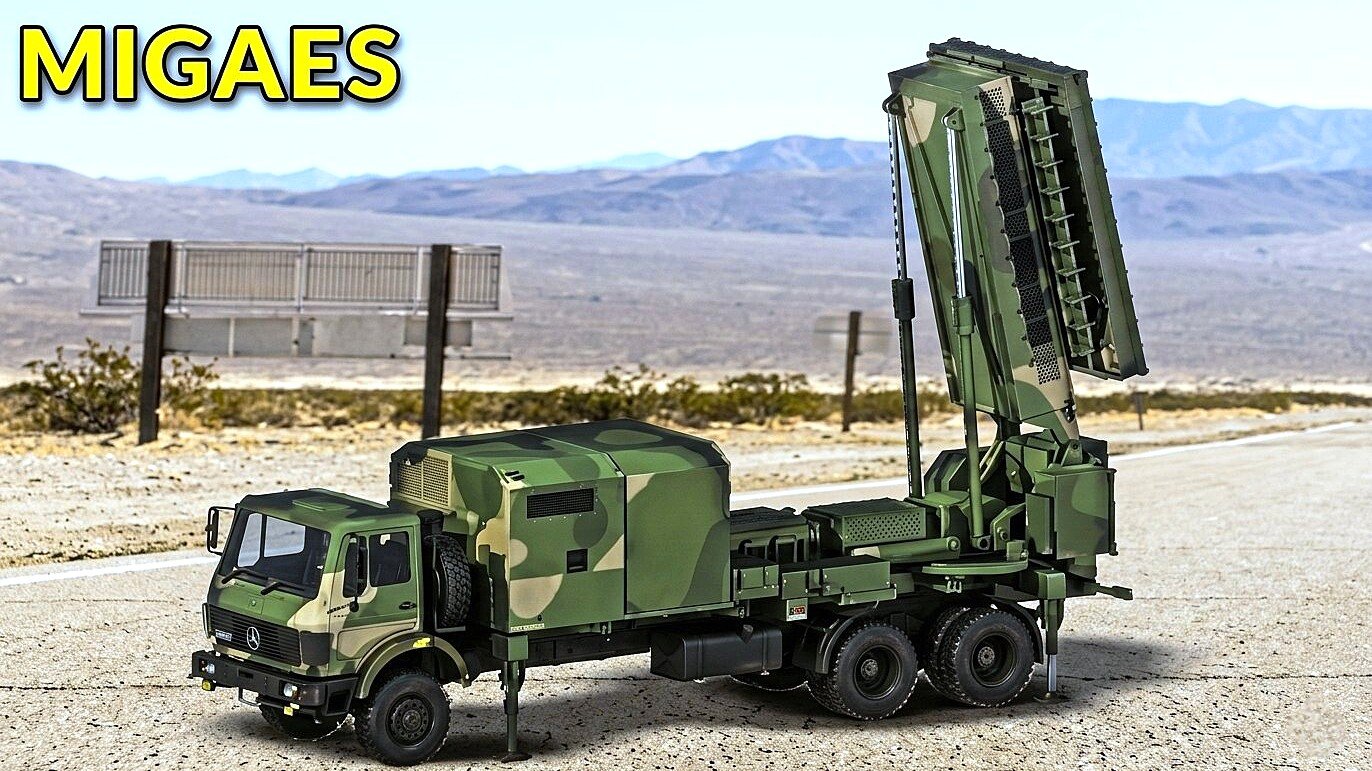




ISLAMABAD: The Pakistan Air Force has recently inducted the MIGAES Electronic Attack System, bolstering its ground-based electronic warfare capabilities amid evolving regional security challenges.
This development marks a significant step in the PAF’s ongoing modernization drive to dominate the electromagnetic spectrum.
The MIGAES, unveiled by China’s CETC at the IDEAS 2024 exhibition in Karachi, is a ground-based electronic attack platform specifically oriented toward jamming communications and radars of aerial platforms.
It targets airborne early warning and control systems, fighter jets, and other aircraft by disrupting their radar signatures and data links.
Defense analysts note that the system enhances the PAF’s ability to counter advanced aerial threats in contested environments.
First glimpses of MIGAES appeared in PAF infographics several years ago, with a jamming module displayed at IDEAS 2022.
Full details emerged at Zhuhai Airshow 2024 and again at IDEAS 2024, where CETC highlighted its counter-airborne focus.
The Pakistan Air Force has integrated MIGAES into its broader electronic warfare architecture, as evidenced by recent operational demonstrations.
In exercises like those showcased in early 2026, including references during the Golden Eagle drills, MIGAES features alongside systems such as HISAR-1 for data link jamming and counter-UAS roles.
VERA passive detection systems complement it by monitoring electromagnetic emissions without active radiation.
The PAF’s emphasis on ground-based EW has accelerated in recent years, shifting from limited capabilities to layered, multi-domain operations.
Reports from defense observers indicate that MIGAES contributes to integrated air defense systems, creating electromagnetic denial zones against enemy surveillance and strike assets.
This induction aligns with the PAF’s strategy to address asymmetries in aerial warfare, particularly against numerically superior neighbors.
Electronic warfare has proven decisive in modern conflicts, as seen in global examples where jamming disrupts command chains and sensor fusion.
Pakistan’s approach mirrors this trend, investing in both imported and indigenous solutions.
The PAF collaborates with entities like NASTP for complementary systems, including cognitive EW and high-power jammers.
MIGAES strengthens the ground layer of the PAF’s IADS, working in tandem with airborne standoff jammers and fighter-integrated EW suites on platforms like J-10C.
Its deployment supports full-spectrum electromagnetic operations, denying adversaries reliable radar and communication access.
Experts highlight that such systems reduce the effectiveness of high-value airborne assets, forcing reliance on degraded modes or standoff distances.
The induction reflects broader PAF priorities under recent leadership, focusing on network-centric warfare and multi-domain coordination.
PAF materials from 2025-2026 exercises demonstrate how MIGAES fits into recognized electromagnetic pictures and degraded battlespace scenarios.
This capability adds to existing tools like EADS networks and ground-based ELINT/COMINT suites.
The move underscores Pakistan’s commitment to self-reliance in defense technologies while leveraging strategic partnerships.
As regional tensions persist, enhanced EW assets like MIGAES provide a cost-effective deterrent against aerial incursions.
The system represents a maturation of PAF’s electronic warfare doctrine, transitioning from defensive postures to proactive electromagnetic dominance.
Future enhancements may include AI-driven adaptations for dynamic threat environments.
Overall, the induction of MIGAES signals the PAF’s readiness to contest control of the skies through non-kinetic means.
This quiet yet powerful addition reinforces Pakistan’s air defense posture in an era where electronic superiority often determines battlefield outcomes.