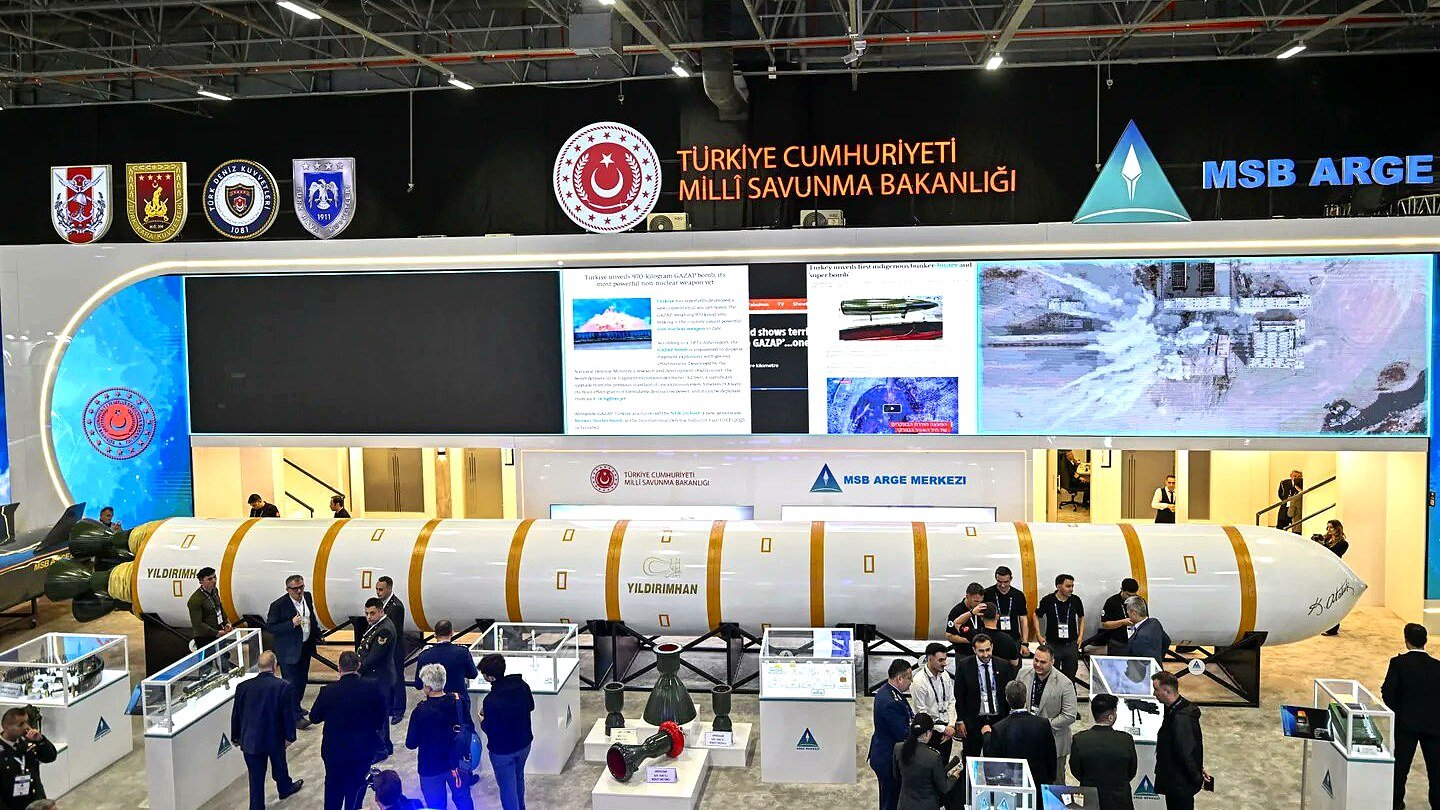




ISLAMABAD: A sudden declaration from Ankara has jolted global strategic circles, hinting at a capability that could redefine deterrence in one of the world’s most volatile regions.
The statement, delivered by Turkey’s defence leadership, did not just introduce a missile but signaled a shift in how power is projected across continents in seconds.
A message wrapped in speed and precision Turkey’s unveiling of the Yildirimhan hypersonic intercontinental ballistic missile has drawn immediate attention due to its claimed speed of Mach 25, which translates to approximately 30,000 kilometers per hour.
At that velocity, analysts estimate a strike could reach targets thousands of kilometers away in under 20 minutes, compressing decision-making windows for adversaries to near-impossible levels.
Why this missile changes the equation Unlike traditional ballistic missiles, hypersonic systems travel at extreme speeds while maintaining maneuverability, making interception by current missile defence systems significantly more difficult.
Defence experts note that even advanced air defence networks struggle to track objects moving unpredictably at such speeds, raising concerns over strategic stability.
Tensions driving technological leaps The announcement comes amid ongoing tensions between Turkey and Israel, where rhetoric and strategic signaling have intensified over recent months.
Statements from Turkish leadership emphasize deterrence, but the underlying message suggests readiness, reinforcing a doctrine where capability itself becomes the warning.
Numbers behind the power Military analysts estimate that a Mach 25 missile covers nearly 8.3 kilometers per second, meaning it could traverse the entire Middle East region in minutes.
Comparatively, conventional ballistic missiles operate at slower terminal speeds, giving defence systems a slightly larger response window, which hypersonic systems effectively eliminate.
Strategic ripple effects beyond the region This development is not limited to regional implications, as global powers are closely monitoring advancements in hypersonic technologies.
Countries like the United States, China, and Russia have already invested billions into similar systems, but Turkey’s entry signals an expansion of this elite club.
A calculated deterrence doctrine Turkish Defence Minister Yaşar Güler’s remarks underline a clear stance that the missile is primarily a deterrent, yet fully operational if required.
Such messaging reflects a broader shift in military strategy where showcasing capability aims to prevent conflict rather than initiate it.
What makes hypersonic weapons so feared The combination of speed, altitude variation, and maneuverability creates a near-impossible interception scenario, forcing nations to rethink defence architectures.
Experts argue that even early warning systems may struggle to provide sufficient reaction time, increasing the risk of rapid escalation in crisis situations.
Implications for regional balance For Israel, which maintains one of the most advanced missile defence systems in the world, the emergence of hypersonic threats introduces a new layer of complexity.
While no official response has fully addressed the Yildirimhan specifically, defence analysts expect accelerated investments in counter-hypersonic technologies.
A broader defence trend Turkey’s move aligns with a global trend where nations are prioritizing next-generation weapons systems to secure strategic advantages.
From artificial intelligence integration to hypersonic delivery systems, modern warfare is shifting towards speed, precision, and unpredictability.
The unanswered question As Turkey signals both restraint and readiness, the key uncertainty remains whether such advancements will stabilize deterrence or push rivals into an accelerated arms race.
The world now watches closely as hypersonic technology moves from experimental phases into active deployment, raising a critical question about how future conflicts might unfold in seconds rather than hours.