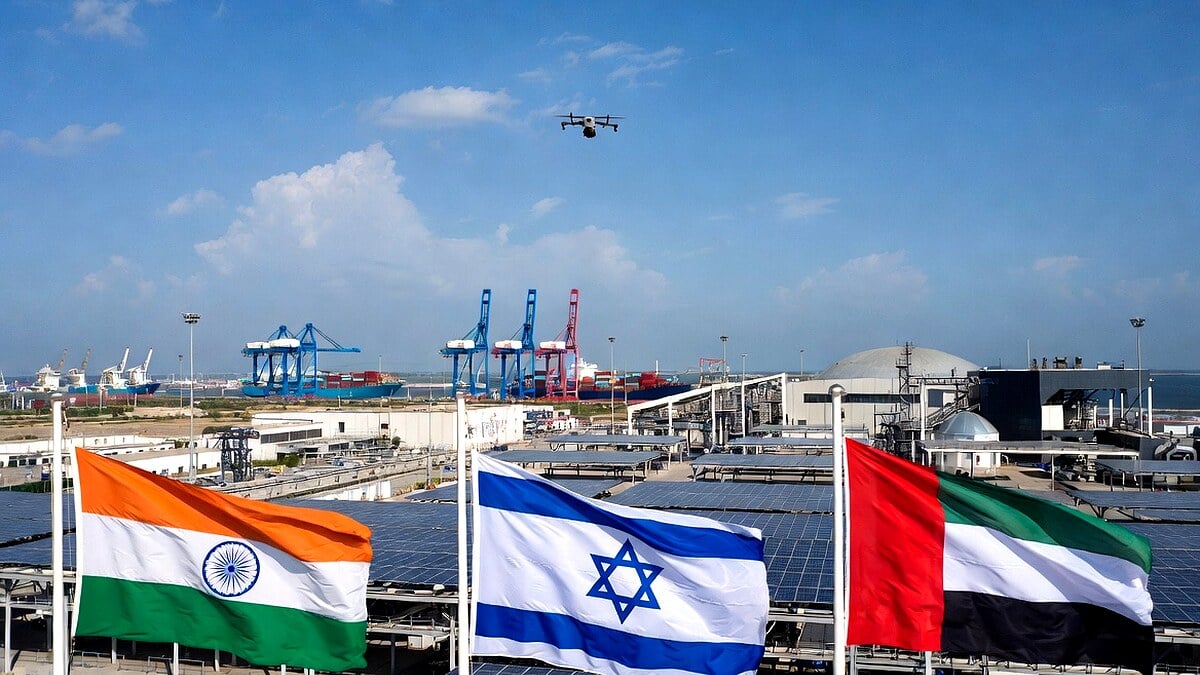




ISLAMABAD: India, Israel and the United Arab Emirates are expanding a trilateral partnership that combines technology, capital and manufacturing capacity across multiple sectors.
The cooperation builds on the I2U2 grouping, which includes the United States, and the proposed India-Middle East-Europe Economic Corridor (IMEC). Recent agreements have accelerated joint projects in defence, renewable energy, food security and digital infrastructure.
Indian officials describe the partnership as a practical alignment of complementary strengths. Israel contributes advanced innovation in defence and agritech, the UAE provides investment capital and logistics hubs, while India offers large-scale manufacturing and market access.
**Defence and security cooperation has gained momentum.** In November 2025, India signed a defence memorandum with Israel focusing on missiles, artificial intelligence and joint development. Prime Minister Narendra Modi’s visit to Israel in February 2026 produced 16 agreements, elevating bilateral ties to a “special strategic partnership.”
The UAE and India formalised a strategic defence partnership framework in early 2026, covering maritime security, cyber defence and joint industrial collaboration. Both countries established a Joint Defence Cooperation Committee years earlier, with the 12th meeting held in Abu Dhabi in 2024.
**Trade and investment figures reflect steady growth.** India-UAE bilateral non-oil trade reached approximately $37.6 billion in the first half of 2025, marking a 34 percent year-on-year increase. The UAE ranks as India’s third-largest trading partner overall and second-largest export destination. Cumulative UAE foreign direct investment into India stands at $25.19 billion from April 2000 to September 2025.
India-Israel trade stood at around $10 billion in recent peak years before regional tensions affected volumes. Trilateral trade potential among India, Israel and the UAE is estimated to approach $100 billion by the end of the decade, according to some economic assessments.
**I2U2 initiatives have delivered tangible projects.** The grouping launched with a focus on clean energy, food security and water management. A flagship project includes a 300 MW hybrid renewable energy initiative in Gujarat, supported by UAE capital and Israeli technology. Another involves $2 billion in investments for tech-enabled food parks in India.
The IMEC corridor aims to create an alternative trade route connecting India to Europe via UAE, Saudi Arabia, Jordan and Israel. It is projected to reduce shipping times by up to 40 percent compared to traditional routes. Progress continues on eastern segments despite delays in western connectivity caused by regional conflicts.
**Background context** The partnership gained formal shape after the 2020 Abraham Accords normalised Israel-UAE relations. India already maintained strong defence and technology ties with Israel since establishing full diplomatic relations in 1992. Bilateral trade with Israel grew significantly under successive Indian governments, with cooperation in drones, missile systems and agriculture.
The UAE has hosted a large Indian expatriate community of nearly four million people and emerged as a key investor in Indian infrastructure and logistics. The I2U2 format, launched in 2022, provided a structured platform for the three countries plus the US to coordinate on economic and strategic issues.
**Market and regional reactions** Business communities in all three countries have welcomed the developments. Joint working groups have been established in fintech, semiconductors, water management and cybersecurity. Indian private sector firms, including those operating Haifa Port, are actively involved in connectivity projects.
Regional observers note the partnership’s focus on economic resilience and supply chain diversification. Some analysts view it as part of broader efforts to build alternative corridors amid disruptions in traditional maritime routes.
**Strategic implications** The trilateral cooperation offers India access to advanced Israeli technologies and Gulf capital for its manufacturing ambitions under the “Make in India” initiative. For Israel and the UAE, it provides access to India’s large market and production base.
Defence collaboration is expected to expand in areas such as unmanned systems, air defence and cyber capabilities. Joint production of military equipment could strengthen supply chain security for all parties.
However, the partnership operates in a complex regional environment. Ongoing tensions in West Asia, including Iran-Israel dynamics, could influence the pace of implementation. India continues to maintain balanced relations across the Gulf while advancing these specific economic and technological ties.
Future developments will likely centre on finalising free trade agreements, scaling joint industrial projects and advancing IMEC infrastructure. Progress on digital customs platforms and renewable energy investments is expected to deliver early results in the coming years.
Officials from the three countries have indicated continued high-level engagement throughout 2026 to translate agreements into operational outcomes.