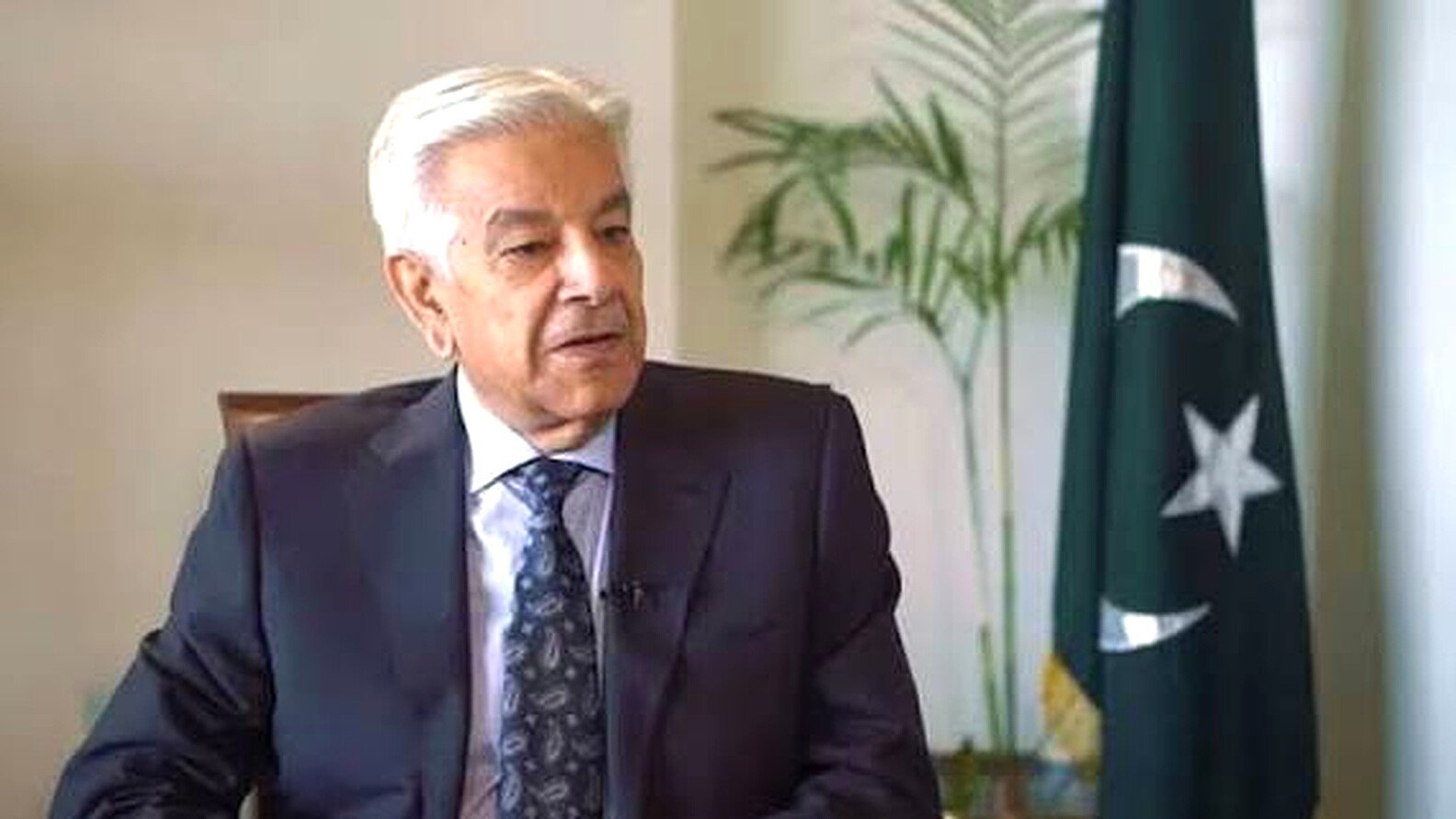




ISLAMABAD: Pakistan’s Defence Minister Khawaja Muhammad Asif has issued a grave warning that the escalating conflict in Iran is part of a broader Zionist agenda aimed at extending Israeli influence to Pakistan’s borders, potentially encircling the country with hostile forces and compromising its sovereignty.
In a statement posted on X, Asif described Zionism as a “threat to humanity,” asserting that every major catastrophe in the Islamic world since Israel’s establishment on Palestinian land bears the imprint of Zionist ideology. He emphasized that despite Iran’s willingness for diplomatic agreements, war has been imposed, with the ultimate goal of creating an adversarial alignment involving Afghanistan, Iran, and India.
This comes amid intensified US-Israeli strikes on Iran, which resulted in the death of Supreme Leader Ayatollah Ali Khamenei and prompted Iranian retaliations against Israeli territory and US bases in the Gulf. Pakistan has condemned the attacks, with Deputy Prime Minister Ishaq Dar urging restraint during a call with Iranian Foreign Minister Abbas Araqchi.
Asif’s remarks highlight fears of a strategic realignment that could leave Pakistan surrounded by enemies, rendering its borders insecure and reducing it to a “vassal state.” He called on all Pakistanis, regardless of political or religious affiliations, to recognize this “conspiracy” orchestrated by eternal adversaries.
The minister linked the current crisis to long-standing regional tensions, framing it as a threat to Pakistan’s strategic position. Recent developments show Pakistan-Iran relations in one of their most constructive phases, with over 25 high-level delegations exchanged in the past two years and agreements signed in diverse sectors.
Bilateral trade targets have been set at $10 billion by 2028, focusing on agriculture, livestock, and energy cooperation. However, the conflict risks disrupting these gains, with economists warning of a 10-15 percent drop in remittances from Gulf states, amounting to a $3-4 billion shortfall.
Pakistan relies on $41 billion in annual remittances, and a prolonged war could widen the current account deficit by $5-7 billion if oil prices reach $100 per barrel. The stock market has already plunged 9.5 percent amid heightened insecurity for millions of Pakistanis in the region.
A senior security official dismissed speculations that Pakistan could be the next target after Iran, labeling such narratives as “alarmist” and driven by vested interests. Nonetheless, the regime change in Iran tests Pakistan’s ties with both the post-Khamenei government and the US.
Historical parallels underscore the risks. Past cross-border strikes with Iran in 2024 de-escalated quickly, but the current escalation involves broader powers. Pakistan condemned US strikes on Iranian nuclear sites in 2025, maintaining a cautious stance.
Asif praised Pakistan’s nuclear deterrent, crediting former Prime Minister Nawaz Sharif for authorizing the 1998 tests that established the country as a nuclear power. Those tests, conducted in response to India’s Pokhran-II explosions, yielded up to 45 kilotons and solidified Pakistan’s defense capabilities.
The program, initiated in the 1970s amid fears of Indian dominance, has been vital for sovereignty, with Sharif declaring in 1999 that Pakistan’s nuclear security is among the world’s strongest. Today, it serves as a bulwark against encirclement.
Concerns over Israeli expansion in the Middle East add layers to the threat. Perceptions of indirect Israeli influence via partnerships with India and involvement in border unrest heighten anxieties. Israel has advanced settlements blurring the 1967 Green Line, entrenching annexation in the West Bank.
Pakistan’s envoy to Iran noted the upward trajectory in ties, including presidential visits and coordination on regional issues. Yet, the war disrupts potential, with Iran striking energy infrastructure and closing the Strait of Hormuz.
Economically, every $10 rise in oil prices could inflate Pakistan’s import bill by $1.5-2 billion, echoing the 2022-23 crisis when prices hit $100-125, nearly leading to default. Spillover effects, including sectarian tensions and proxy activities, loom large.
Asif ended with prayers for Islamic unity, Palestinian freedom, and Pakistan’s enduring strength, invoking divine protection for the nation’s protectors.
The conflict’s ripple effects extend to Afghanistan, where border clashes with the Taliban add to Pakistan’s woes, potentially forming a two-front squeeze. Islamabad declares open war on militants, but escalation risks regional destabilization.
Amid these threats, Pakistan’s diplomatic efforts focus on de-escalation, standing in solidarity with brotherly nations while safeguarding its interests. The minister’s call underscores the need for vigilance against forces seeking to undermine the Islamic world’s cohesion.