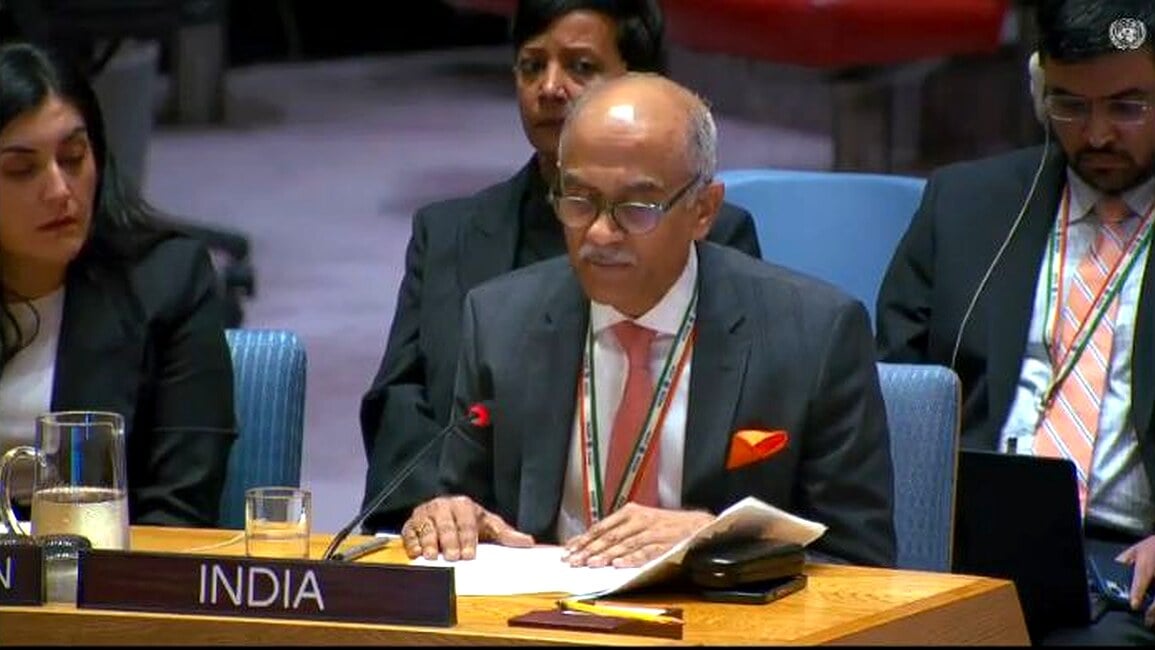




ISLAMABAD: India’s Permanent Representative to the United Nations, Ambassador Parvathaneni Harish, has described Pakistan’s 27th Constitutional Amendment as a “constitutional coup” engineered by the armed forces.
The remarks came during a UN Security Council open debate on reaffirming the international rule of law. Harish responded to Pakistan’s references to Jammu and Kashmir, highlighting internal developments in Pakistan.
The amendment, passed by Pakistan’s parliament on November 13, 2025, and signed into law by President Asif Ali Zardari, introduces significant changes to the judicial system, military command structure, and executive protections.
Key provisions include the establishment of a new Federal Constitutional Court (FCC) with authority over constitutional matters, previously handled primarily by the Supreme Court. It also revises Article 243 regarding armed forces control and grants lifetime immunity from criminal proceedings to the President and top military leadership, including the Chief of Defence Forces.
**Official Reactions**
Ambassador Harish stated that Pakistan has a “unique way of respecting the will of its people – by jailing a Prime Minister, banning the ruling political party, and letting its armed forces engineer a constitutional coup through the 27th amendment and giving lifetime immunity to its Chief of Defence Forces.”
Pakistani officials have defended the amendment as necessary for judicial efficiency and modernising defence command. The government under Prime Minister Shehbaz Sharif pushed the bill through parliament with a two-thirds majority in the National Assembly amid protests from opposition parties, particularly those allied with Pakistan Tehreek-e-Insaf (PTI).
The bill was approved by the cabinet on November 8, introduced in the Senate on November 10, and ratified shortly thereafter.
**Key Provisions and Changes**
The 27th Amendment creates the Federal Constitutional Court to handle constitutional questions, including federal-provincial disputes. It alters judge appointment and transfer processes, expanding executive influence.
On the military side, it formalises the Chief of Defence Forces position, held concurrently by the Army Chief, granting primacy over other service chiefs and full command over the Strategic Plans Division managing the nuclear arsenal.
Critics, including the International Commission of Jurists and Amnesty International, argue the changes undermine judicial independence and insulate military and executive figures from accountability. The amendment grants the President lifetime immunity and affects security of tenure for judges.
The amendment follows the 26th Amendment passed in 2024, continuing a pattern of constitutional adjustments under the current coalition government.
**Background Context**
Pakistan’s 1973 Constitution has undergone multiple amendments since its inception. The 27th Amendment addresses long-standing issues in judicial appointments, provincial autonomy, and defence organisation.
Supporters claim it streamlines constitutional adjudication and strengthens unified military command for modern security challenges. The government cited the need to reduce backlog in the Supreme Court and improve coordination among armed forces.
Opposition voices, however, viewed the rapid passage – with limited public debate – as consolidating power amid political tensions, including the imprisonment of former Prime Minister Imran Khan and restrictions on PTI activities.
**Regional and International Reactions**
India’s strong remarks at the UNSC reflect ongoing bilateral tensions. New Delhi has repeatedly highlighted Pakistan’s internal governance issues alongside accusations of cross-border terrorism support.
Human rights organisations have expressed concern. UN High Commissioner for Human Rights Volker Türk noted risks to democracy and rule of law, calling for broader consultation in future reforms.
Domestically, the amendment has sparked debates on civil-military relations. Analysts point to its potential impact on checks and balances within Pakistan’s hybrid political system.
**Strategic Implications**
The development occurs against a backdrop of economic pressures and security challenges in Pakistan. The country continues to navigate relations with international financial institutions while managing internal political stability.
The creation of the Federal Constitutional Court and enhanced military command structures could reshape power dynamics for years. Observers note potential effects on judicial review and civilian oversight mechanisms.
Pakistan maintains the changes are internal matters aimed at institutional strengthening. However, the Indian intervention at the UNSC underscores how domestic constitutional moves can fuel diplomatic exchanges in multilateral forums.
Future developments may include legal challenges to the amendment’s provisions or further parliamentary adjustments. The FCC’s early operations and appointments will likely draw significant attention from legal experts and political stakeholders.
Regional consequences remain tied to broader India-Pakistan dynamics, where governance narratives often intersect with security and terrorism discussions. Pakistan’s non-permanent membership in the UNSC during 2025-2026 has provided a platform for both sides to air grievances.
The episode highlights persistent questions about institutional evolution in Pakistan and its implications for democratic norms in South Asia.