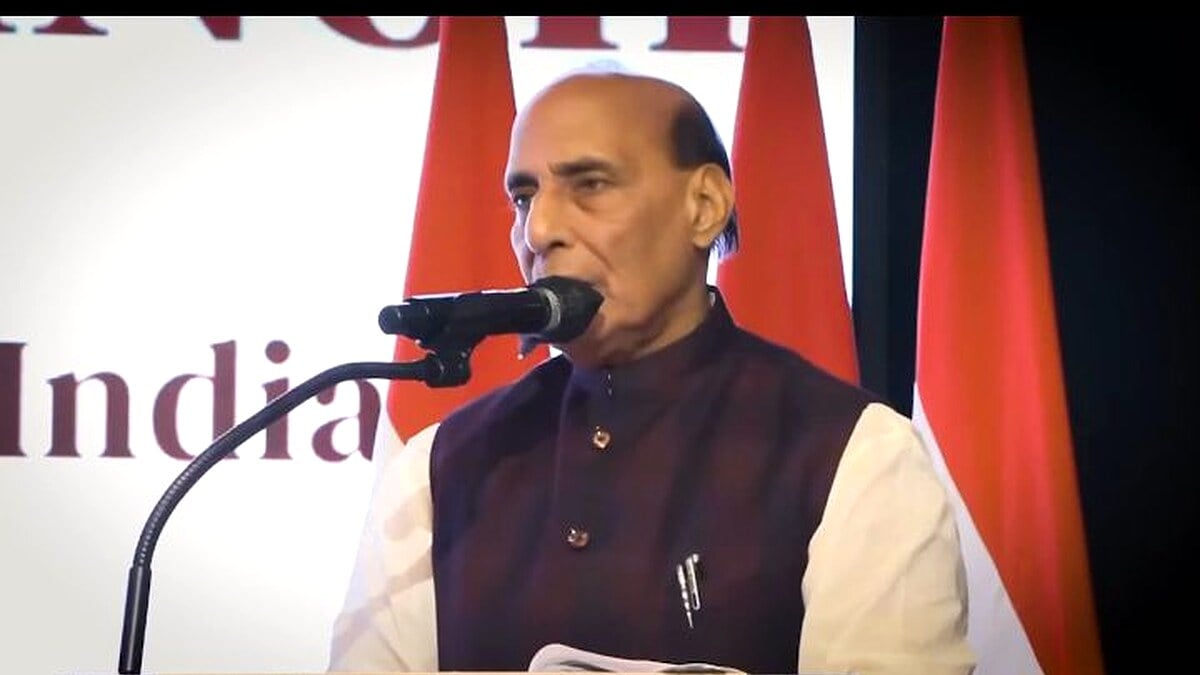




ISLAMABAD: Indian Defence Minister Rajnath Singh has reiterated India’s commitment to its longstanding No First Use (NFU) nuclear policy, describing the country as a responsible nuclear power.
This reaffirmation follows earlier comments by Singh in August 2019. At that time, while addressing an event in Pokhran, he noted that India had strictly adhered to NFU but added that future policy could depend on evolving circumstances.
The 2019 remarks had drawn attention in regional capitals, including Islamabad, amid heightened tensions after the revocation of Article 370 in Indian Illegally Occupied Jammu and Kashmir.
Singh stated that India will never accept any form of nuclear blackmail. The remarks come against the backdrop of ongoing security dynamics in South Asia.
In a recent address, Singh emphasised that India remains firmly committed to the NFU doctrine, under which it pledges not to initiate nuclear strikes but reserves the right to retaliate massively if attacked with nuclear weapons.
The policy was formally adopted following India’s 1998 nuclear tests. It forms a central pillar of India’s nuclear doctrine, alongside credible minimum deterrence and civilian control over nuclear assets.
Singh’s latest statement seeks to project stability in India’s nuclear posture. Officials in New Delhi have consistently highlighted adherence to the doctrine since its inception.
India maintains an estimated stockpile of around 170 nuclear warheads, according to various international assessments. The country operates a triad of land, air, and sea-based delivery systems.
Key assets include Agni-series ballistic missiles with ranges up to 5,000 km for Agni-V, and submarine-launched variants under development. The Indian Air Force deploys aircraft capable of nuclear delivery, while INS Arihant provides sea-based options.
Pakistan, which does not subscribe to NFU, maintains its own nuclear capabilities focused on full-spectrum deterrence. Estimates place Pakistan’s arsenal at approximately 170 warheads as well, with a range of short to medium-range missiles tailored for tactical and strategic roles.
**Official Position**
The Indian Ministry of Defence has described NFU as a reflection of India’s responsible behaviour as a nuclear state. Singh’s recent comments align with repeated affirmations at international forums, including the Conference on Disarmament.
In 2025, Indian diplomats reconfirmed the policy during UN meetings on nuclear disarmament.
Analysts note that the doctrine supports India’s broader strategic objective of avoiding arms race escalation while retaining second-strike credibility.
**Background Context**
India conducted its first nuclear test in 1974 under “Smiling Buddha” and declared itself a nuclear weapons state after the 1998 Pokhran-II tests. The Nuclear Doctrine was publicly outlined in 2003.
The policy explicitly rules out first use against any state, nuclear or non-nuclear. It includes a caveat for retaliation in the event of a major chemical or biological attack in some interpretations, though the core remains NFU against nuclear threats.
China maintains a similar NFU policy since 1964, making the two the only nuclear powers with such formal commitments among the nine recognised nuclear states.
Regional security equations involve multiple factors: the India-China border standoffs, Pakistan-India rivalry over Kashmir, and broader Indo-Pacific dynamics.
**Key Figures and Capabilities**
India’s defence budget for the current fiscal stands over $70 billion, with significant allocations for nuclear and missile programmes. The Strategic Forces Command oversees operational readiness.
Development timelines include the Agni-P medium-range missile and ongoing work on multiple independently targetable reentry vehicles (MIRVs). India successfully tested MIRV technology with Agni-V in recent years.
Export and technology aspects include growing indigenous production under “Atmanirbhar Bharat.” However, nuclear-related international cooperation remains under strict safeguards following the 2008 Indo-US civil nuclear deal.
**Reactions and Regional Implications**
The statement has drawn measured responses in diplomatic circles. Pakistani officials have consistently called for verifiable arms control measures in South Asia, including a bilateral NFU agreement or strategic restraint regime.
In Islamabad, the reaffirmation is viewed in the context of India’s conventional force modernisation and occasional signalling. Security analysts argue that doctrinal clarity reduces miscalculation risks in a nuclear dyad.
Market and investor reactions remain limited, though defence sector stocks in India often respond to such policy statements.
**Strategic Analysis**
The reaffirmation of NFU helps India maintain its international image as a restrained nuclear power. This positioning supports broader diplomatic goals, including membership aspirations in export control regimes.
However, the 2019 caveat introduced elements of calculated ambiguity. Experts suggest this serves deterrence signalling without formal doctrinal shift.
For South Asia, stability depends on mutual understanding of red lines. Both countries continue modernisation of delivery systems, raising questions about escalation dynamics in future crises.
Future developments may include further confidence-building measures or technology-specific risk reduction talks. India’s expanding naval nuclear capabilities and China’s role add layers to the regional nuclear equation.
Upcoming policy reviews or statements from Indian leadership could provide additional clarity on the direction of its nuclear doctrine. Regional observers will monitor implementation alongside conventional force postures.