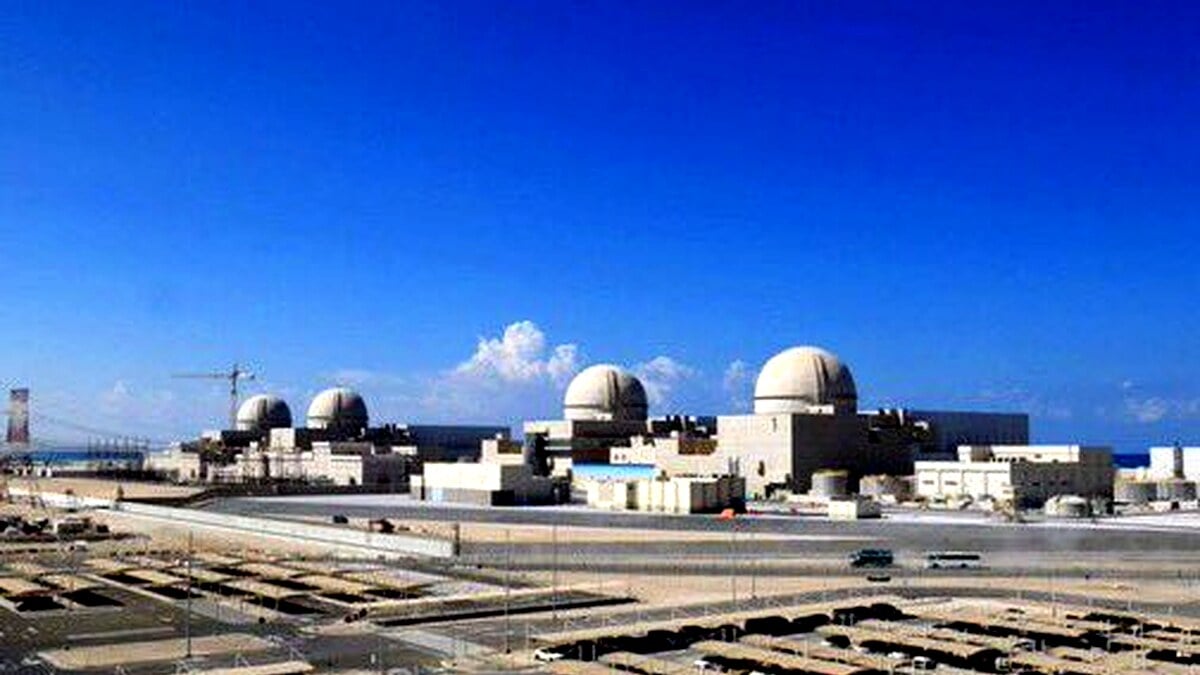




Islamabad has issued a sharp condemnation of the drone strike that targeted the Barakah Nuclear Energy Plant in the United Arab Emirates on May 17.
The Ministry of Foreign Affairs described the attack as a grave violation of international law and a direct threat to regional stability.
Pakistan expressed full solidarity with the brotherly people and government of the UAE, reaffirming its unwavering support amid escalating tensions in the Gulf.
The Barakah plant, located in Abu Dhabi’s Al Dhafra region, houses four APR-1400 reactors with a combined capacity of about 5,600 MW. It supplies nearly 25 percent of the UAE’s electricity needs, generating around 40 terawatt-hours annually while producing carbon-free power.
Officials confirmed the strike triggered a fire in an electrical generator on the plant’s perimeter. No radiological release occurred, no injuries were reported, and reactor operations remained unaffected.
UAE authorities swiftly contained the incident, with one reactor reportedly switching to emergency diesel generators as a precaution.
This marks the first time the operational Barakah facility has been directly targeted amid the ongoing regional conflict.
Pakistan’s statement emphasized that any deliberate targeting of nuclear facilities constitutes a serious breach of international humanitarian law, the UN Charter, and IAEA principles on nuclear safety and security.
Nuclear installations must remain inviolable under all circumstances, Islamabad stressed.
Such actions risk catastrophic and irreversible consequences for human lives, the environment, and both regional and global peace.
The attack comes against a backdrop of heightened tensions following recent developments involving Iran and broader Middle East conflicts, though no group immediately claimed responsibility in official channels.
Pakistan called on all parties to exercise maximum restraint and fulfill obligations under international law to prevent further escalation.
Dialogue and diplomacy, in line with the UN Charter, represent the only sustainable path to de-escalation, the ministry added.
The statement, issued on May 18 as Press Release 118/2026, underscores the deep fraternal ties between Pakistan and the UAE.
Bilateral relations span decades of economic cooperation, trade, investment, and people-to-people links, with millions of Pakistani expatriates contributing to the UAE economy.
Pakistan has consistently supported the UAE’s peaceful nuclear energy program, which serves as a model for clean energy transition in the Gulf.
The Barakah plant, constructed with South Korean expertise at a cost of around $20 billion, began operations progressively from 2020 onward, with full commercial output achieved in recent years.
Its success highlights the UAE’s commitment to diversifying energy sources away from hydrocarbons while meeting rising domestic demand.
Experts note that any disruption to Barakah could have significant implications for UAE energy security and broader Gulf stability, given its critical contribution to the national grid.
Pakistan’s condemnation aligns with its long-standing position on nuclear safety and non-proliferation.
As a responsible nuclear state, Pakistan has repeatedly advocated for the protection of civilian nuclear infrastructure worldwide.
The incident raises fresh concerns about the vulnerability of strategic energy assets in conflict zones.
International bodies, including the IAEA, have long maintained strict guidelines against attacks on nuclear sites due to the potential for widespread radioactive contamination.
Previous resolutions and conventions underscore the global consensus on safeguarding such facilities.
In the broader context, the strike adds to challenges in the region where energy infrastructure has increasingly become a target.
Pakistan, with its own extensive nuclear power program and expertise, understands the high stakes involved in ensuring the safety of these installations.
Analysts suggest the attack could prompt stronger regional coordination on critical infrastructure defense.
It may also accelerate diplomatic efforts to stabilize the volatile security environment.
For Pakistan, the response reflects not only solidarity with the UAE but also a principled stand against actions that endanger global norms.
The two countries share robust defense and economic partnerships that have grown steadily over the years.
Pakistani workers and professionals form a vital part of the UAE’s workforce, while investments flow both ways.
Any threat to UAE stability directly impacts Pakistani interests, given the scale of human and economic linkages.
As investigations into the drone attack continue, regional capitals are closely monitoring developments.
UAE officials have vowed to hold perpetrators accountable while maintaining focus on operational continuity at Barakah.
The plant continues to deliver rel