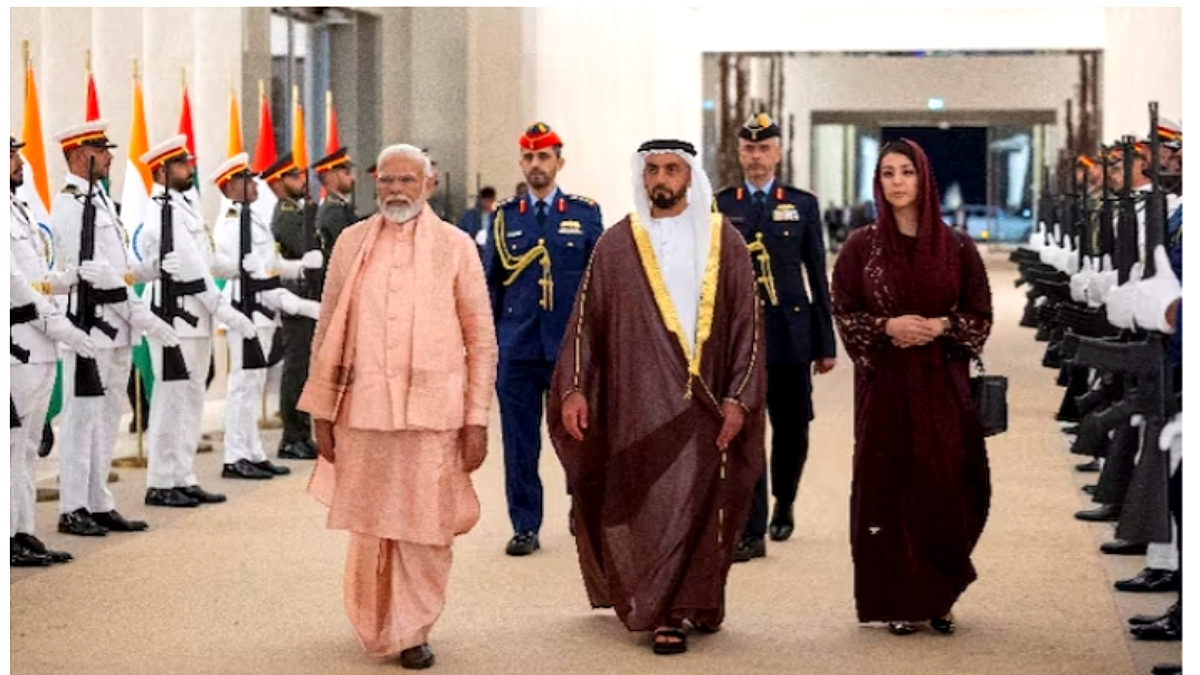




India and the United Arab Emirates have agreed on a comprehensive framework for a strategic defence partnership.
The pact was finalised on Friday during Prime Minister Narendra Modi’s visit to Abu Dhabi, according to the Indian Ministry of External Affairs.
The two sides also signed key agreements on strategic petroleum reserves and long-term supply of liquefied petroleum gas.
These developments mark a significant upgrade in bilateral ties as the region grapples with ongoing West Asia tensions, including the Iran-related conflict.
The Indian foreign ministry described the defence framework as a major step forward.
It will deepen defence industrial collaboration, joint innovation, and work on advanced technologies.
Cooperation will extend to training, military exercises, maritime security, cyber defence, secure communications, and greater information exchange.
Officials say the partnership builds on a Letter of Intent signed earlier this year during UAE President Sheikh Mohamed bin Zayed Al Nahyan’s visit to India.
That document laid the groundwork for expanded security cooperation across multiple domains.
PM Modi’s trip comes at a critical time.
It follows heightened regional uncertainties and aims to secure India’s strategic interests in energy and defence.
Indian sources had indicated ahead of the visit that long-term energy supply deals and expansion of strategic oil reserves would top the agenda.
The agreements deliver precisely on those priorities.
Under the new pacts, India will enhance its strategic petroleum reserves with UAE support.
Additional arrangements ensure steady LPG supplies to meet domestic demand.
These moves are expected to bolster India’s energy security amid global supply chain vulnerabilities.
The UAE’s recent exit from OPEC last month adds further strategic weight.
The decision is projected to allow Abu Dhabi to ramp up oil production significantly.
Experts estimate potential increases of up to one million barrels per day once unconstrained by quotas.
For India, the world’s third-largest oil importer, this could translate into more flexible and reliable crude supplies.
India currently imports around 85 percent of its crude requirements.
The UAE already ranks among its top suppliers, accounting for roughly 10 percent of total imports in recent years.
Stable and increased flows from the Gulf nation will help buffer against price volatility and disruptions in key chokepoints like the Strait of Hormuz.
Bilateral trade between the two countries crossed 85 billion dollars last year.
The UAE remains a vital partner for India in both energy and investment.
Reports indicate a fresh pledge of around 5 billion dollars in UAE investment for Indian infrastructure projects during the visit.
Additional pacts include cooperation on a ship repair cluster in Gujarat’s Vadinar region.
PM Modi held detailed discussions with UAE President Sheikh Mohamed bin Zayed.
The leaders reviewed the full spectrum of their Comprehensive Strategic Partnership.
Both sides emphasised the need for stronger collaboration in emerging technologies, including artificial intelligence and high-performance computing.
Defence cooperation has seen steady momentum.
Recent exchanges between service chiefs and successful joint military exercises have built strong foundations.
The new framework aims to take this to a more institutionalised level.
It includes focus on counter-terrorism, special operations, and interoperability.
For India, the partnership strengthens its strategic footprint in the Gulf.
It also provides a counterbalance amid competing regional influences.
The UAE, home to over 4.5 million Indian expatriates, continues to ensure their safety and welfare.
During the visit, PM Modi thanked the UAE leadership for protecting the Indian community following recent incidents.
The agreements come as India pursues diversified energy sources and deeper defence self-reliance.
Joint production and technology transfer under the defence pact could boost India’s domestic manufacturing capabilities.
Analysts note that the timing aligns with India’s broader foreign policy objectives.
As PM Modi embarks on a five-nation tour that includes several European countries, the UAE stop signals the priority attached to Gulf partnerships.
Energy prices remain a concern for Indian policymakers.
Every sustained rise in crude costs impacts the import bill, inflation, and fiscal space.
The UAE pacts offer a buffer through diversified supplies and reserve-building support.
Longer-term, greater production flexibility from the UAE could help moderate global oil prices, benefiting major importers like India.
Strategic petroleum reserves in India currently stand at partial capacity.
The fresh MoU will help accelerate filling and maintenance efforts.
This enhances national resilience against supply shocks.
The defence and energy deals together reflect a maturing relationship.
What began as strong economic and people-to-people ties has now expanded firmly into strategic and security domains.
Both nations have expressed commitment to further deepening this partnership.
Implementation of the new frameworks will be watched closely in coming months.
For Indian consumers, stable energy supplies could help moderate fuel price pressures.
For industry, reliable LNG and crude flows support manufacturing and power sectors.
On the defence side, collaboration on advanced technologies could accelerate capability development.
The visit also highlighted strong personal rapport between PM Modi and Sheikh Mohamed bin Zayed.
This leadership-level trust has consistently driven bilateral progress.
As regional dynamics evolve, the India-UAE strategic convergence offers stability and mutual benefit.
Officials from both sides are expected to work out detailed roadmaps soon.
Follow-up mechanisms will ensure timely execution of the signed agreements.
India’s engagement with the UAE forms a key pillar of its West Asia policy.
The outcomes from Abu Dhabi reinforce New Delhi’s focus on pragmatic, interest-driven partnerships.
These developments arrive against a backdrop of global uncertainties.
They underscore the value of reliable friends in critical areas of energy and security.
The strategic defence partnership framework sets the stage for broader collaboration.
It positions both countries to address shared challenges in the Indo-Pacific and beyond.
PM Modi’s productive visit marks another milestone in one of India’s most dynamic bilateral relationships.