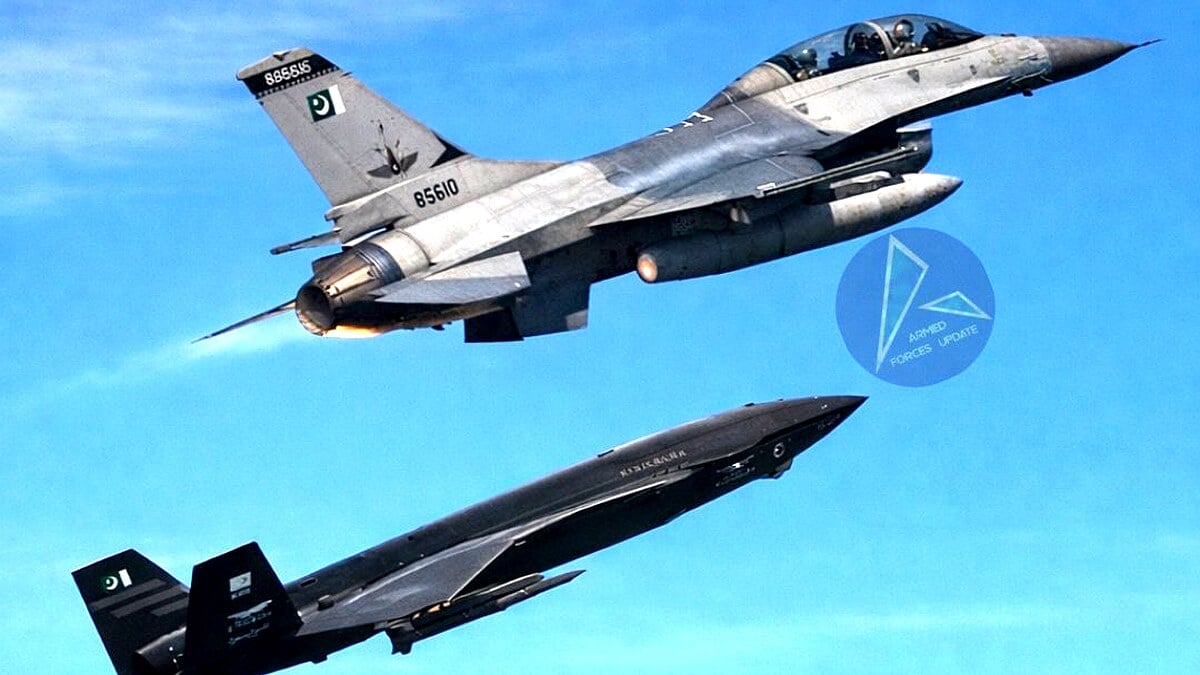




Wingman Operations
ISLAMABAD: Pakistan Air Force is actively developing Manned-Unmanned Teaming (MUM-T) capabilities, enabling Unmanned Combat Aerial Vehicles (UCAVs) and future unmanned fighters to operate as loyal wingmen alongside manned aircraft.
The system allows unmanned platforms to deliver weapons, conduct reconnaissance, and provide protection to piloted mother aircraft. PAF has already demonstrated core elements of this concept during multiple exercises under multi-domain operations.
Defence officials describe MUM-T as a force multiplier that extends operational reach while reducing risk to pilots in contested environments. Recent exercises validated integration of deep-reach killer drones and loitering munitions operating in highly contested, congested, and degraded battlespaces.
**Exercise Golden Eagle Validation** In February 2026, PAF successfully completed Exercise Golden Eagle in the Southern Air Command area. The drill focused on synchronized orchestration of complete combat potential, with MUM-T as a key highlight.
Drones and loitering munitions operated under unified command and control from the Next-Generation All-Domain Command & Control Centre at Air Headquarters. The exercise tested high-tempo operations in complex modern warfare scenarios, incorporating artificial intelligence and indigenous technologies.
PAF assets demonstrated seamless coordination between manned fighters and unmanned systems, validating concepts for future aerial superiority missions.
**Platform and Doctrine Progress** PAF operates a diversified drone fleet that supports MUM-T evolution. This includes Turkish Bayraktar TB2 and Akinci platforms, Chinese Wing Loong variants, and indigenous systems such as Shahpar series.
The Shahpar-III MALE UCAV is scheduled for first flight tests by the end of 2026. It features a 30,000+ feet ceiling, over 30 hours endurance, and six hardpoints for precision munitions including Barq and Al-Battaar.
Earlier this year, PAF revealed the Al-Murtajiz stealthy drone concept, signalling commitment to loyal wingman development. Analysts note this fits into a broader strategy where unmanned platforms act as sensors, strike assets, and force protectors for manned jets.
Work also includes potential conversion of retired F-7 fighters into high-speed unmanned platforms for decoy and saturation roles.
**Official and Expert Views** Air Headquarters statements emphasise MUM-T as central to PAF’s transformation under Air Chief Marshal Zaheer Ahmed Baber Sidhu. The force continues building dedicated structures, including UAV-focused commands, to integrate manned and unmanned assets across kinetic and non-kinetic domains.
Defence analysts highlight that MUM-T turns a single fighter into a command node capable of directing drone swarms in real time. One Pakistani analyst recently urged accelerated acquisition of loyal wingman platforms following lessons from regional operations.
**Regional Context and Capabilities** MUM-T development comes amid evolving aerial warfare trends observed globally. Similar concepts are under testing by major powers, with loyal wingmen designed to clear paths, suppress defences, and extend sensor reach for manned aircraft.
Pakistan’s programme builds on existing strengths in MALE and HALE platforms. The PAF drone inventory has grown significantly since 2007, creating one of South Asia’s most diversified fleets through Chinese, Turkish, and domestic sources.
Key enablers include secure data links, AI-assisted autonomy, and next-generation command systems already validated in exercises. Integration allows pilots to assign tasks to unmanned partners while focusing on high-value decision-making.
**Strategic Implications** MUM-T enhances PAF’s ability to achieve aerial superiority by increasing mass, reducing pilot exposure, and improving survivability in high-threat environments. Loyal wingmen can carry additional weapons loads, conduct persistent surveillance, or execute high-risk penetration missions.
Analysts project that successful fielding will significantly boost operational effectiveness. A single manned platform could potentially control multiple unmanned assets, multiplying combat power without proportional increase in manned aircraft numbers.
Future developments may include higher levels of autonomy, improved AI for threat prioritisation, and deeper integration with joint forces across air, land, and cyber domains. Ongoing work on Shahpar-III and potential Turkish co-production partnerships, such as Baykar facilities, will support this trajectory.
Questions remain on full-scale production timelines, exact specifications of indigenous loyal wingman platforms, and integration pace with existing fighter fleets including JF-17 and J-10 variants.
PAF officials indicate continued testing and doctrinal refinemen