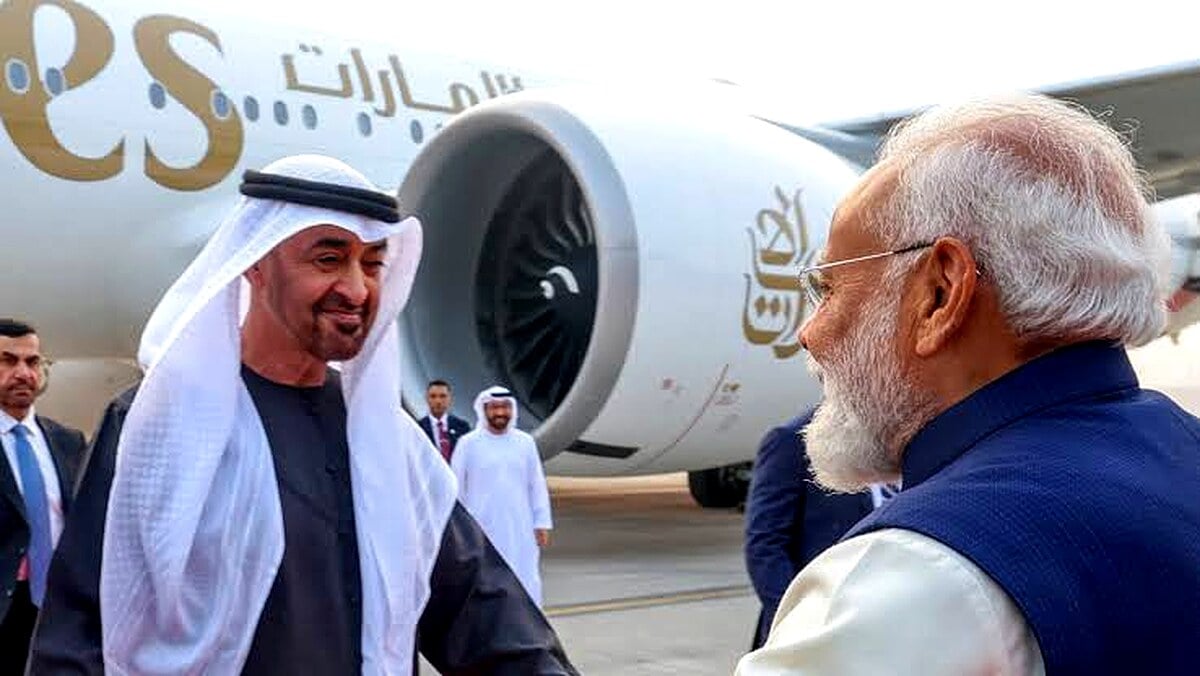




ISLAMABAD: India, Israel and the United Arab Emirates are advancing coordinated security cooperation, building on existing bilateral ties and the earlier I2U2 grouping that included the United States.
Recent high-level engagements, including UAE President Mohamed bin Zayed’s visit to New Delhi in January 2026, have accelerated defence and strategic alignment among the three countries. Officials describe the moves as practical responses to shared threat perceptions, including maritime security challenges, drone and missile proliferation, and regional instability.
The development comes amid broader shifts in West Asian security architecture following the Abraham Accords and ongoing tensions involving Iran and its proxies.
Indian and Emirati defence establishments have moved towards a formal Strategic Defence Partnership. A Letter of Intent signed during the recent high-level visit outlines plans for defence industrial collaboration, joint exercises, intelligence sharing, cyber security and special operations interoperability.
Israel has supplied advanced systems to the UAE, including Iron Dome batteries, Spectro surveillance systems capable of detecting drones up to 20 kilometres away, and elements of the Iron Beam laser defence during recent regional escalations. UAE forces have also participated in multinational exercises alongside Israeli and US assets.
**Defence Trade And Technology Transfer**
Bilateral defence ties between India and Israel remain robust, with India as one of Israel’s largest defence customers. Cooperation spans drones, missile systems, intelligence and joint production. India-UAE trade reached significant volumes, with the UAE ranking as India’s second-largest trade partner. Trilateral trade potential between India, Israel and UAE was earlier projected to touch $110 billion by 2030.
The three countries already maintain institutional mechanisms for coordination. The I2U2 framework, launched in 2022 with US participation, focused initially on economic projects in water, energy, food security, health and technology. Security dimensions have gained prominence in recent years through parallel bilateral tracks.
**Background Context**
The trilateral convergence traces back to the 2020 Abraham Accords that normalised Israel-UAE relations. India signed a trilateral partnership agreement with Israel and UAE in May 2021, initially targeting economic and technological collaboration in areas such as renewable energy and agriculture.
India maintains longstanding defence and technology ties with Israel while sustaining strong economic relations with Gulf states, including the UAE, which hosts a large Indian expatriate community and serves as a key energy supplier.
UAE seeks to diversify its defence suppliers and build local manufacturing capacity through partnerships with India and Israel. Recent negotiations include potential acquisition of Israeli Hermes 900 UAVs with technology transfer to UAE’s EDGE Group.
**Reactions And Regional Implications**
The alignment has drawn attention in regional capitals. Analysts note overlapping interests in countering non-state militancy, securing maritime routes in the Arabian Sea and Indian Ocean, and managing supply chain resilience amid global disruptions.
Pakistani officials have monitored these developments closely, given Islamabad’s longstanding relations with Gulf countries and strategic partnerships in the region. No official comment was immediately available on the latest trilateral security moves.
Market observers point to potential opportunities in defence technology, infrastructure and connectivity projects linked to initiatives such as the India-Middle East-Europe Economic Corridor (IMEC).
**Strategic Outlook**
The emerging India-Israel-UAE security cooperation reflects pragmatic convergence rather than a formal military alliance. It builds on capability sharing, intelligence fusion and technological integration to address common operational challenges.
Future trajectory will likely depend on implementation of defence pacts, progress on joint projects and the evolving regional security environment. Questions remain about balancing these ties with each country’s broader diplomatic relationships across West Asia.
Observers expect continued focus on maritime domain awareness, counter-drone capabilities, cyber defence and industrial collaboration in the coming months. Senior officials from the three countries are anticipated to hold further consultations to operationalise elements of the partnership.
The developments underscore shifting security dynamics in West Asia and the Indian Ocean region, where economic interests, technology transfer and threat assessments increasingly shape new partnerships.