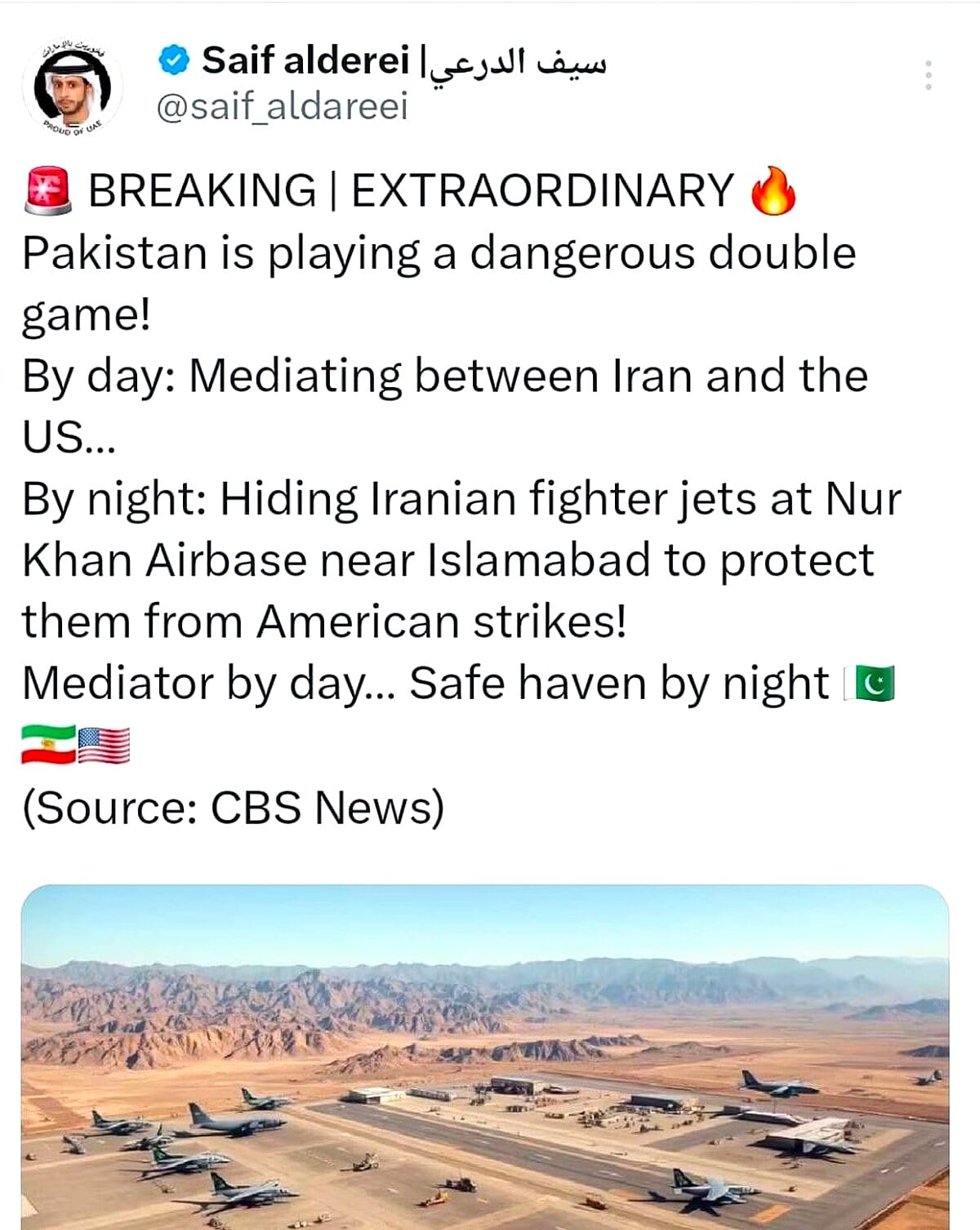




ISLAMABAD: Retired Lt Gen Ghulam Mustafa has criticised social media accounts allegedly linked to the UAE for promoting what he described as a false narrative against Pakistan regarding the reported presence of Iranian military aircraft on Pakistani soil.
The senior defence analyst stated that such accounts were aiding a narrative originally pushed by Western sources and amplified by Indian voices questioning Pakistan’s reliability. He noted that the claim had already lost momentum.
Mustafa pointed to visual evidence in the disputed posts, describing the background as a desert landscape likely located in the UAE itself rather than Pakistan.
He expressed regret that propaganda of this nature was emanating from an Islamic country against Pakistan.
Pakistan’s Foreign Ministry has firmly rejected reports alleging that Islamabad allowed Iranian military aircraft to be stationed at bases such as Nur Khan near Rawalpindi to shield them from potential US strikes during recent Iran-US tensions.
Officials clarified that any Iranian aircraft present arrived during the ceasefire period for diplomatic facilitation and had no military protection role.
The CBS News report, citing unnamed US officials, claimed multiple Iranian aircraft, including reconnaissance platforms, were moved to Pakistani airfields shortly after a ceasefire announcement in early April.
Pakistani authorities dismissed these assertions as misleading and part of efforts to undermine the country’s mediator role between Tehran and Washington.
Pakistan has maintained diplomatic channels with both sides amid the conflict. Islamabad has positioned itself as a potential conduit for de-escalation talks while emphasising its commitment to regional stability.
The narrative gained traction on social media, with some accounts highlighting unverified images to question Pakistan’s trustworthiness.
Indian media and affiliated platforms reportedly amplified these claims, echoing long-standing accusations of Pakistan playing a “double game” in regional conflicts.
Lt Gen Mustafa’s intervention comes amid broader concerns over coordinated disinformation campaigns targeting Pakistan.
Pakistani security agencies have previously traced networks linked to foreign actors spreading anti-Pakistan content under various guises, including posing as regional voices.
Pakistan-UAE relations have traditionally remained strong, underpinned by significant economic ties, remittances from the large Pakistani expatriate community in the Gulf, and defence cooperation.
Bilateral trade exceeds several billion dollars annually, while UAE investments in Pakistan span energy, real estate, and infrastructure sectors.
The Pakistani Ministry of Interior has in recent days addressed speculative reporting on UAE-related matters, describing some online content as “malafide” and driven by vested interests seeking to create discord.
Defence analysts note that such episodes reflect the evolving information warfare landscape, where social media is used to shape perceptions during sensitive geopolitical periods.
Claims regarding aircraft movements are often difficult to verify independently due to operational security considerations at military installations.
Pakistan’s military and civilian leadership have consistently rejected any suggestion of duplicity in its foreign policy, particularly concerning Iran and Western partners.
Officials stress that diplomatic engagements follow established international norms and national interest priorities.
The episode highlights ongoing challenges in managing narratives around Pakistan’s role in Middle East and South Asian security dynamics.
As regional tensions persist, including concerns over maritime security in the Strait of Hormuz and broader Gulf stability, accurate information flow becomes critical.
Observers expect continued monitoring of social media activity by Pakistani authorities. Future developments may include further official clarifications or diplomatic engagements to address any misunderstandings between friendly states.
Broader implications involve the need for stronger mechanisms to counter cross-border disinformation while preserving strategic partnerships vital for Pakistan’s economic and security interests.