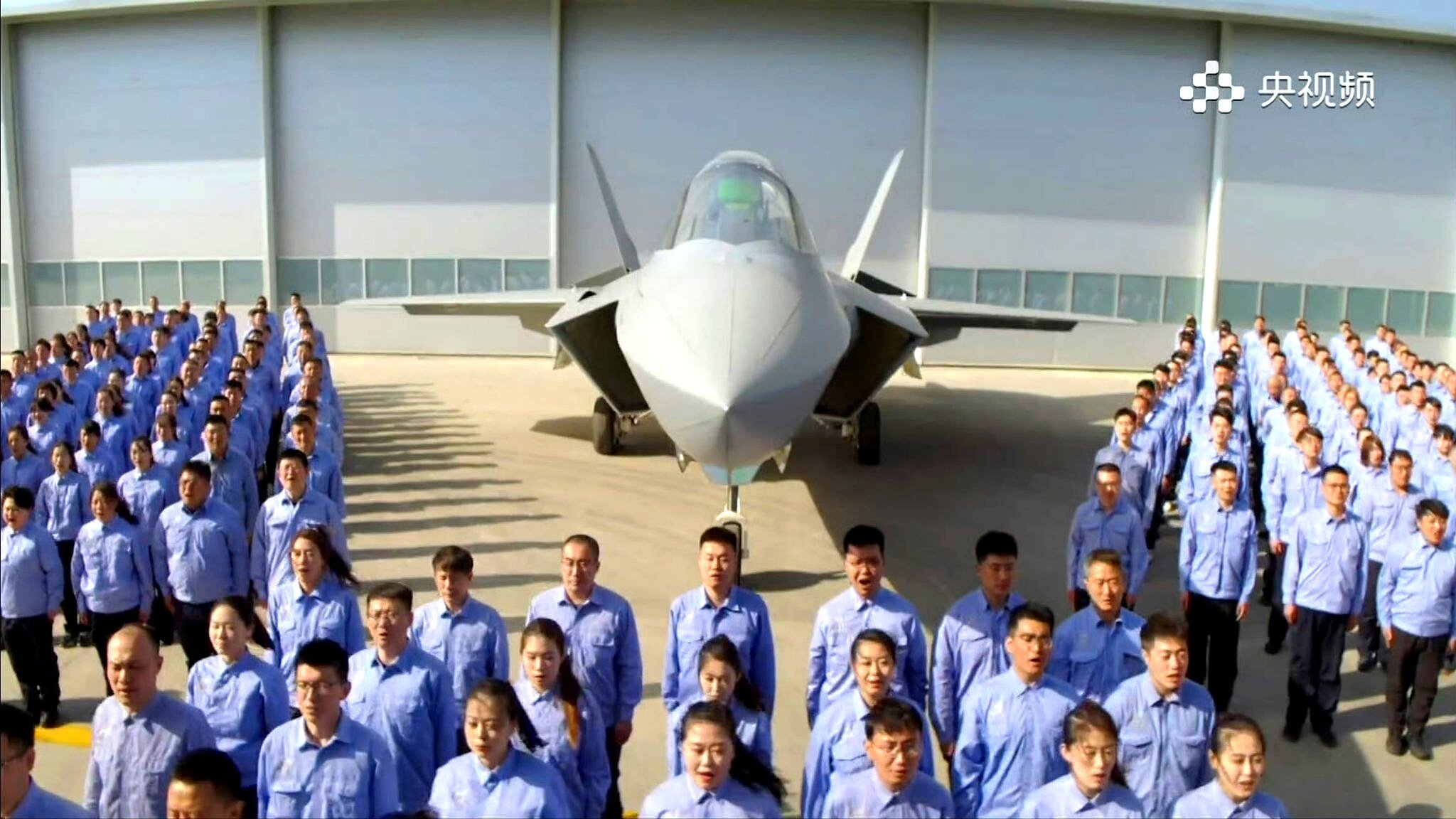




ISLAMABAD: China has released the first official visuals of its latest J-35A stealth fighter jet, showcasing a striking teal-coloured electro-optical targeting system under the chin.
This is no decorative choice. The unique teal hue comes from a special optical coating on the sensor glass designed to cut glare and reflections while filtering specific wavelengths, especially infrared and laser frequencies.
The coating protects the sensitive sensors housed behind it, ensuring clearer targeting data even in challenging conditions. Such innovation marks a leap in sensor durability and performance for fifth-generation aircraft.
The J-35A represents China’s second operational stealth fighter type alongside the heavier J-20. Beijing now stands as the only nation besides the United States fielding two distinct stealth platforms.
Analysts note the J-35A as a medium-sized multi-role fighter with internal weapons bays, twin engines, and advanced sensor fusion. Early data suggest a maximum takeoff weight near 28-30 tons and combat radius around 1,200 kilometers.
Its design draws from the naval J-35 variant but optimizes for land-based operations with refined aerodynamics and lighter landing gear. Production models are expected to leverage improved WS-13 or WS-19 series engines delivering thrust levels supporting Mach 1.8 speeds.
Pakistan Air Force maintains deep operational ties with Chinese aviation platforms. The successful integration of J-10C fighters, which demonstrated superior performance in recent regional tensions, has strengthened this partnership.
Reports indicate ongoing discussions for Pakistan to acquire advanced Chinese fighters, potentially including future fifth-generation options. Such steps would further modernize PAF squadrons already operating JF-17 Thunder variants co-developed with China.
The teal EOTS on the J-35A enhances precision targeting while maintaining the aircraft’s low-observable profile. By reducing reflections across key spectra, the system allows pilots to engage targets with greater accuracy and survivability.
This technology addresses a critical challenge in stealth operations where sensor windows can otherwise compromise radar cross-section or performance under high-energy threats.
China’s rapid progress in stealth aviation continues to reshape regional air power dynamics. The J-35A is positioned for both air superiority and ground attack roles, complementing the long-range focus of the J-20.
With features like a large multi-function cockpit display, helmet-mounted systems, and potential AESA radar integration, the jet promises enhanced situational awareness for operators.
Defence observers highlight how such platforms enable network-centric warfare. The J-35A can coordinate with airborne early warning assets, unmanned systems, and ground command nodes to create robust kill chains.
For Pakistan, continued collaboration with Chinese defence industry opens pathways to cutting-edge capabilities. PAF pilots already benefit from battle-tested Chinese systems that have proven effective in maintaining deterrence.
The unveiling comes amid broader advancements in Chinese carrier aviation. The naval J-35 variant, designed for electromagnetic catapult launches from vessels like the Fujian, shares core technologies with the J-35A.
Experts point to the sensor suite as particularly significant. Electro-optical systems provide passive detection and targeting that complement active radar, reducing emissions that could reveal the fighter’s position.
The special coating not only safeguards the hardware but also optimizes light transmission for specific operational bands. This results in superior image quality for infrared search and track functions.
Quantitative leaps in Chinese fighter development have been notable. From the J-20’s entry into service to the J-35A’s debut, Beijing has compressed timelines that traditionally span decades.
Pakistan’s defence strategy emphasizes qualitative improvements alongside its reliable platforms. Integration of advanced sensors and stealth features would multiply the effectiveness of existing fleets like the J-10C and JF-17 Block III.
Regional security calculations increasingly factor in these technological edges. The ability to operate stealth assets with protected, high-fidelity targeting systems raises the threshold for potential adversaries.
The J-35A’s internal bay configuration supports a mix of air-to-air and air-to-surface munitions while preserving stealth characteristics. Payload capacity and range figures position it as a versatile asset for multi-domain missions.
As flight testing progresses, further details on radar cross-section reduction and electronic warfare capabilities are anticipated. Early imagery already reveals serrated panels, edge alignment, and smooth surfaces typical of low-observable designs.
Pakistan-China defence cooperation has a long track record of delivering cost-effective, high-impact solutions. Joint projects have equipped PAF with modernized squadrons capable of addressing contemporary threats.
The teal EOTS innovation underscores attention to practical combat details often overlooked in conceptual designs. Protecting sensors from environmental and combat-induced degradation ensures sustained operational readiness.
Future implications for allied air forces remain significant. Access to mature fifth-generation technologies could accelerate modernization cycles and enhance interoperability within strategic partnerships.
Questions persist on exact performance parameters and integration timelines. Yet the direction is clear: steady advancement in stealth, sensors, and systems integration.
Pakistan Armed Forces continue to prioritize capabilities that ensure peace through strength. Enhanced aerial platforms play a vital role in this posture, backed by proven alliances and indigenous growth.
The J-35A visuals serve as a public demonstration of engineering confidence. The distinctive sensor housing highlights functional elegance over mere aesthetics.
As global air power evolves, such developments invite close monitoring. The fusion of stealth airframes with protected advanced optics could define next-generation engagement rules.
What remains to be seen is how rapidly these technologies translate into operational squadrons and how partner nations like Pakistan leverage them for balanced deterrence.