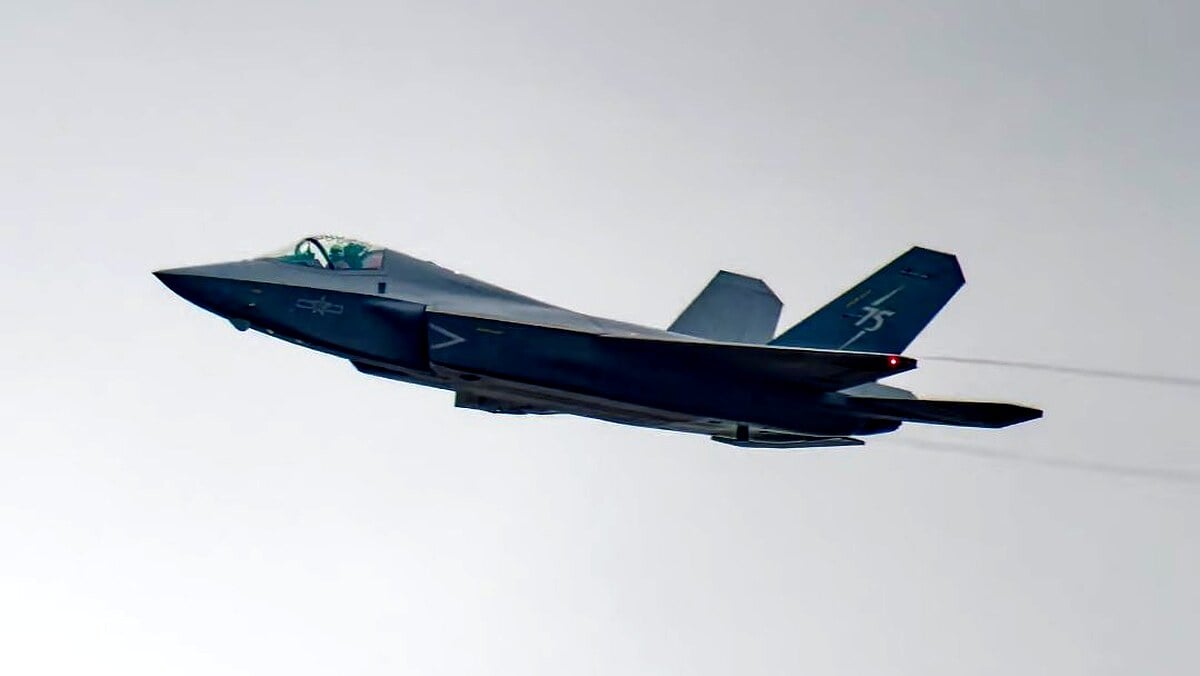




( Pakistan’s J-35 Stealths To Be Armed With Carrier-Killing Missiles Over
400 Km Range )
Title: Pakistan Eyes J-35 Stealth Jets Armed With Carrier-Killing Missiles
Excerpt: Pakistan set to acquire J-35 stealth fighters and YJ-15 anti-ship
missiles bolstering defence against Indian aircraft carriers.
Categories: Pakistan, Defence
Tags: J-35, YJ-15 missile, Pakistan Navy, Indian Navy
ISLAMABAD: A game-changing development is reshaping maritime power balance
in the region as Pakistan moves towards acquiring advanced Chinese stealth
technology.
The J-35 stealth fighter, designed as a carrier-based multirole aircraft,
brings fifth-generation capabilities that promise to alter naval
calculations dramatically.
Reports indicate Islamabad is in advanced discussions for around 40 J-35
jets, potentially arriving as early as mid-2026, alongside supporting
systems like KJ-500 AEW&C aircraft.
This acquisition aligns with Pakistan’s long-standing defence partnership
with China, known for delivering reliable, battle-proven platforms.
The J-35 features a reported radar cross-section as low as 0.01 square
meters, making it extremely difficult to detect on enemy radars.
Powered by advanced WS-19 engines with thrust vectoring, the jet achieves
speeds up to Mach 2.2 and boasts an operational radius exceeding 1,350
kilometers.
Its maximum takeoff weight nears 30 tons with an 8-ton payload capacity,
allowing it to carry a formidable mix of air-to-air and air-to-surface
munitions internally for stealth missions.
What makes this platform particularly potent is its integration potential
with high-speed anti-ship weapons.
The YJ-15 supersonic anti-ship missile stands out as a key component in
this emerging capability.
Designed for carrier-based launch, the YJ-15 uses ramjet propulsion to
reach terminal speeds estimated between Mach 4 and Mach 5.
Analysts suggest ranges around 400-500 kilometers, enabling stand-off
strikes against high-value surface targets while minimizing exposure to
defensive systems.
In flight profiles, these missiles can descend to sea-skimming altitudes as
low as 3 meters above the waves, complicating interception efforts by enemy
warships.
A single J-35 could potentially launch multiple such missiles, saturating
defences of large naval formations.
Pakistan Navy has been steadily modernizing its fleet through Chinese
cooperation, including Hangor-class submarines expected to enter service
starting 2026.
This undersea arm complements aerial strike capabilities, creating layered
deterrence in the Arabian Sea and beyond.
Indian Navy currently operates two aircraft carriers: INS Vikramaditya, a
45,000-ton modified Kiev-class vessel carrying over 30 aircraft including
MiG-29K fighters, and the indigenous INS Vikrant.
Both carriers rely on ski-jump ramps for operations and support
multi-carrier exercises in the Arabian Sea, projecting power with dozens of
aircraft and helicopters.
However, the introduction of stealth platforms armed with supersonic
sea-skimming missiles shifts the threat equation significantly.
J-35’s stealth features allow it to penetrate contested airspace or
maritime zones with reduced risk of early detection compared to
fourth-generation fighters.
Once in position, launching YJ-15 missiles at high speeds leaves limited
reaction time for carrier groups.
Defensive systems like Barak-8 surface-to-air missiles on Indian ships have
finite range and must contend with low-altitude, high-velocity incoming
threats.
Pakistan’s defence strategy emphasizes credible deterrence through
technological edge and interoperability with proven Chinese systems.
The JF-17 Thunder program, a successful joint venture, has already
demonstrated the effectiveness of this collaboration in maintaining air
superiority.
Adding fifth-generation J-35 jets would mark a qualitative leap, enabling
network-centric operations with KJ-500 airborne early warning platforms
providing extended radar coverage.
Such integration allows real-time targeting data sharing, maximizing the
lethality of anti-ship strikes.
Regional naval dynamics have seen increased activity, with both sides
conducting exercises to test carrier battle group coordination.
Yet, the asymmetry introduced by stealth technology and hypersonic-speed
missiles creates new operational challenges.
Pakistan Armed Forces continue to prioritize defensive posture while
enhancing strike capabilities to safeguard national interests at sea.
The J-35 platform, with its advanced avionics, AESA radar, and internal
weapons bays, offers superior situational awareness and survivability.
Pilots would benefit from reduced radar signature, allowing closer
approaches to targets before engagement.
Combined with YJ-15’s terminal manoeuvring and anti-jamming guidance, the
system presents a formidable anti-access/area denial tool.
Defence analysts note that carrier operations become riskier when facing
aircraft that can strike from beyond visual range with minimal