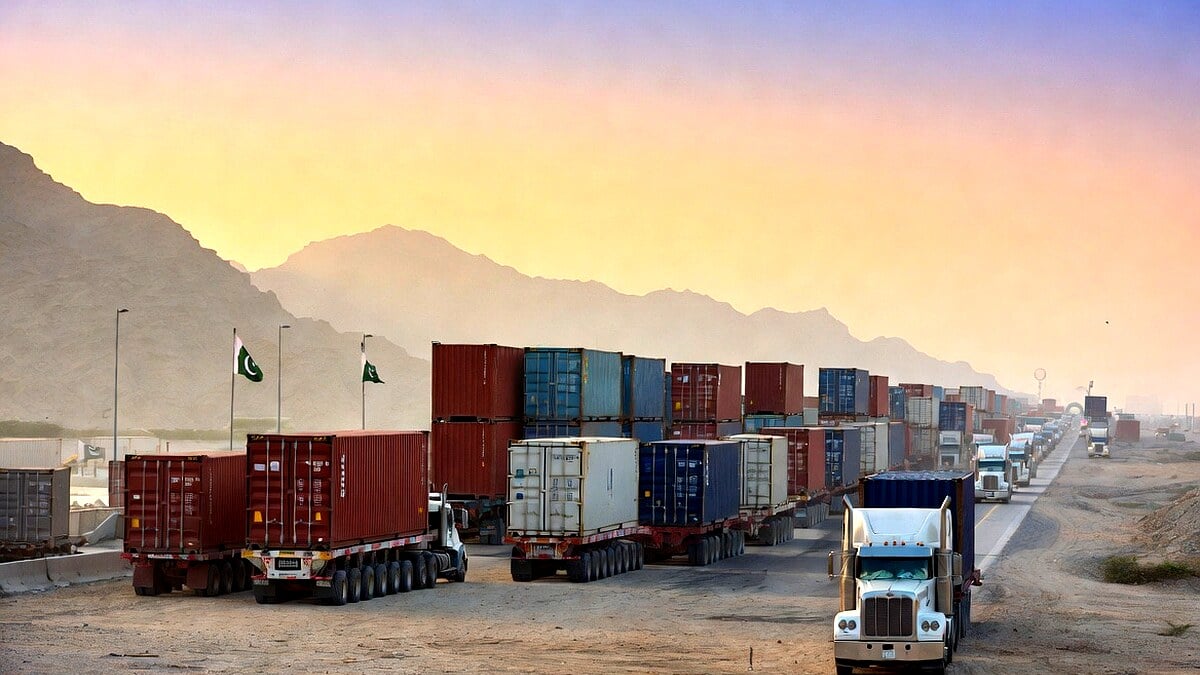




countries under new 2026 transit order
ISLAMABAD: In a move that could reshape regional logistics, Pakistan has
suddenly unlocked its territory as a vital overland bridge for goods
heading to Iran.
The decision comes at a tense moment when traditional sea paths face severe
disruption. Thousands of containers sit idle at Karachi port, their journey
halted by ongoing instability in the Strait of Hormuz.
The “Transit of Goods through Territory of Pakistan Order 2026” took effect
on April 25, formally designating six specific land corridors. These routes
now allow third-country cargo destined for Iran to move securely across
Pakistani soil, backed by strict customs safeguards.
This framework builds directly on the 2008 Pakistan-Iran agreement on
international road transport. It ensures all transit operations follow
established Customs Act 1969 procedures while requiring an encashable bank
guarantee covering Pakistan’s applicable import levies.
Why did this happen now? Reports indicate over 3,000 containers bound for
Iran remain stuck at Karachi and Port Qasim facilities. With vessels unable
to reliably access Iranian ports due to the maritime standoff, pressure
mounted for faster alternatives.
The new routes focus on southwestern corridors linking major Pakistani
ports to key border points. They include the direct Gwadar-Gabd link, just
87.5 km from the strategic deep-sea port, alongside longer inland paths
through Khuzdar, Dalbandin, Taftan, and Quetta.
Specific corridors notified are:
– Gwadar to Gabd
– Karachi/Port Qasim via Lyari-Ormara-Pasni to Gabd
– Karachi/Port Qasim via Khuzdar-Dalbandin to Taftan
– Extended Gwadar route through Turbat, Hoshab, Panjgur, and Quetta areas
to Taftan
– Another Gwadar variant via Liari-Khuzdar to Taftan
– Karachi/Port Qasim-Gwadar-Gabd combination
Each path supports cross-stuffing of cargo where needed, allowing flexible
transfer between transport modes under regulated conditions.
Experts highlight the reciprocal role of the Gabd-Rimdan (also referred to
as Reemdam) crossing. Iran’s recent enabling of this point under the TIR
convention created momentum for Pakistan’s reciprocal facilitation on its
side. Pakistan had activated its Gabd infrastructure three years earlier,
setting the stage for smoother bilateral movement.
Tariq Rangoonwala, Chair of the Pakistan National Committee of the
International Chamber of Commerce, pointed to this development as a key
trigger. The activation not only addresses immediate stranded cargo but
also opens possibilities for sustained use.
Already, the Gabd-Rimdan corridor has demonstrated value in the opposite
direction. Pakistani exports to Uzbekistan and Tajikistan have begun
routing through it as a reliable alternative to northern paths like
Sost-Khunjerab. This success suggests the new framework could evolve into a
permanent feature of regional connectivity.
The order positions Pakistan’s infrastructure—particularly Gwadar Port and
associated road networks—as a practical solution during uncertainty. By
formalizing transit under clear rules, authorities aim to maintain
security, prevent misuse, and ensure smooth customs clearance.
For Iranian importers facing sea disruptions, these routes provide a
lifeline. Goods can now move overland from Pakistani ports directly toward
the border, potentially clearing bottlenecks that have built up in recent
weeks.
The requirement of a cashable bank guarantee adds a layer of financial
security, aligning with standard international transit practices while
protecting Pakistani revenue interests. This mechanism ensures compliance
without unnecessary delays for legitimate cargo.
Broader implications extend beyond immediate relief. The framework
strengthens Pakistan’s role as a regional trade facilitator, leveraging its
geographic position and developing port capacities. Gwadar, in particular,
gains enhanced relevance as both an entry point and transit hub.
Observers note that efficient implementation could encourage further
investment in logistics infrastructure along these corridors. Enhanced road
quality, border facilities, and digital customs systems would support
higher volumes in the future.
Yet questions remain about operational scale. How quickly can the thousands
of stranded containers begin moving? What volumes of future third-country
trade will shift to these land paths? And how will ongoing regional
dynamics influence long-term utilization?
The decision also reflects Pakistan’s consistent approach to fostering
constructive economic ties with neighbors. By providing regulated access
during challenging times, it demonstrates reliability as a transit partner.
Rangoonwala expressed hope that the Gabd route, already proving effective
for Central Asian exports, will continue as an ongoing feature. This
dual-use potential—serving both inbound transit to Iran and outbound
flows—could multiply economic benefits.
Pakistan’s armed forces and security apparatus maintain robust oversight of
these sensitive border regions, ensuring safe and orderly movement of cargo
in line with national interests. Their professional management of such
strategic corridors has long supported stable operations even amid external
pressures.
Implementation will involve close coordination between the Ministry of
Commerce, Federal Board of Revenue, and provincial authorities in
Balochistan. Designated routes pass through varied terrain, from coastal
highways to inland highways connecting major cities.
Success will depend on streamlined procedures at border crossings like Gabd
and Taftan. Modern scanning and TIR-compliant systems already in place at
key points should help accelerate clearance.
As global trade faces increasing uncertainties, such initiatives highlight
the importance of diversified routes. Land corridors offer resilience when
maritime chokepoints experience volatility.
The coming weeks will reveal the true impact. Will this order successfully
unblock the backlog at Karachi while establishing a dependable new channel?
Regional traders and logistics firms are watching closely.
Pakistan’s proactive step underscores its commitment to practical solutions
that serve mutual economic needs. In an era of shifting alliances and
supply chain challenges, reliable overland connectivity gains fresh
strategic value.
What remains uncertain is how sustained the arrangement will prove once sea
conditions potentially ease. For now, however, the opened gates provide a
timely bridge across a troubled region, with potential to strengthen
Pakistan’s standing as a pivotal transit nation.