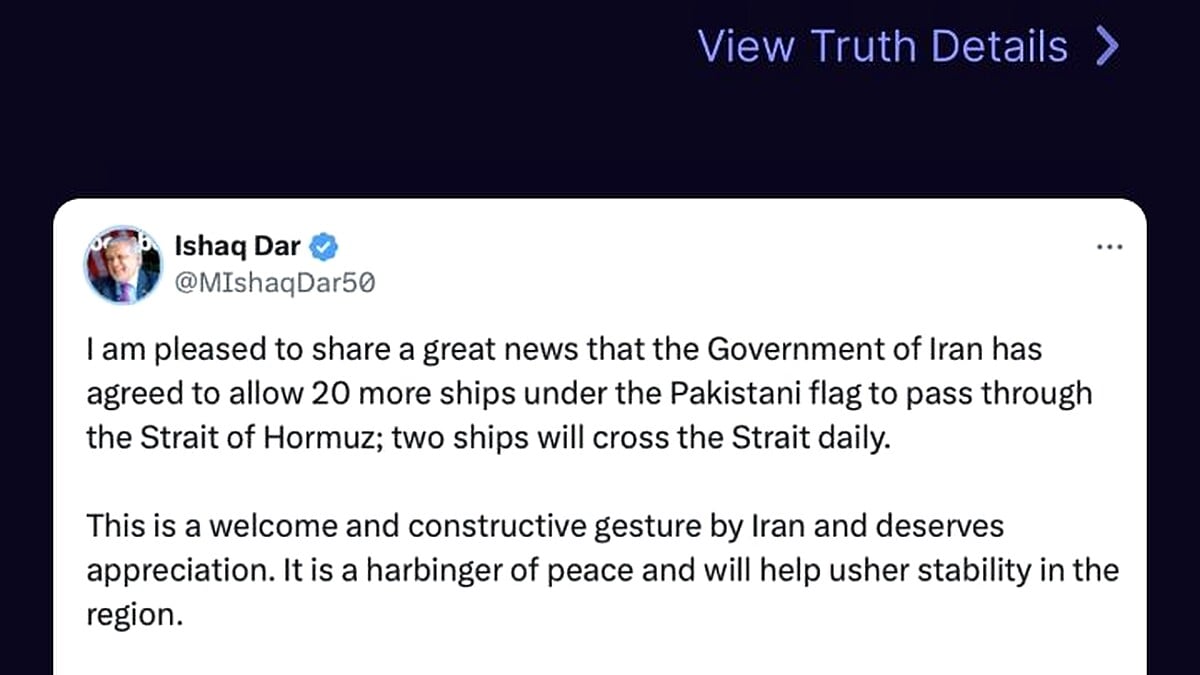




ISLAMABAD: US President Donald Trump reposted a message from Pakistan’s Deputy Prime Minister and Foreign Minister Ishaq Dar announcing that Iran has agreed to allow 20 additional Pakistani-flagged vessels to transit the Strait of Hormuz.
The development comes days after Trump described the passage of 10 Pakistan-flagged oil tankers as a “present” from Iran during ongoing indirect negotiations.
Dar posted on X that Iran approved the waiver with two ships crossing daily.
He termed the move a “welcome and constructive gesture” and a “meaningful step toward peace” that would strengthen collective efforts for regional stability.
Dar tagged US Vice President JD Vance, Secretary of State Marco Rubio, US Middle East Envoy Steve Witkoff and Iranian Foreign Minister Abbas Araghchi in the post.
The Strait of Hormuz handles nearly 20 percent of global oil trade under normal conditions.
Since the escalation of the US-Israeli conflict with Iran in late February 2026 the waterway has faced severe restrictions with Iran threatening attacks on non-compliant vessels.
Pakistan’s economy relies heavily on sea-borne trade with approximately 90 percent of its commerce passing through maritime routes.
Energy imports from the Gulf constitute a critical lifeline for the country facing chronic fuel shortages and high inflation risks.
Local reports indicate that prior to the new waiver only a handful of Pakistani vessels had successfully transited the strait since the conflict intensified.
Two tankers the Lorax also known as Karachi and P Aliki carried around 500,000 and 600,000 barrels of crude respectively in earlier limited passages.
The Pakistan Navy launched Operation Muhafiz-ul-Bahr in early March 2026 to escort merchant vessels and safeguard national energy supplies amid the disruptions.
Naval assets coordinated with the Pakistan National Shipping Corporation to ensure uninterrupted flow of critical cargoes.
International coverage has remained limited with most details emerging from Pakistani and regional media outlets.
Dar’s announcement and Trump’s subsequent repost have amplified attention on Pakistan’s quiet diplomatic role.
Islamabad has positioned itself as a messenger in US-Iran backchannel talks relaying a 15-point US proposal that Iran is reportedly considering.
Pakistan is scheduled to host a four-way foreign ministers meeting with Egypt Saudi Arabia and Turkey on March 29-30 2026 to discuss de-escalation efforts.
Analysts view the selective waivers as potential confidence-building measures in a highly volatile environment.
Global oil prices have surged above 100 dollars per barrel due to Hormuz disruptions affecting supply chains worldwide.
Pakistan’s ability to secure these passages highlights its unique positioning with both Washington and Tehran.
The repost by Trump signals possible US acknowledgment of Islamabad’s facilitation efforts without direct public endorsement.
Regional media including Dawn Geo News and local analysts describe the waiver as a harbinger of possible broader openings if diplomacy gains momentum.
Critics however caution that limited permissions for Pakistani vessels may serve Iranian interests in projecting selective control rather than full reopening.
Pakistan-flagged ships benefit from perceived neutrality in the conflict allowing limited commercial continuity.
The arrangement permits two vessels per day potentially enabling up to 20 ships over ten days under the current terms.
This development follows earlier incidents where Iran turned back certain Pakistan-bound vessels citing protocol violations.
The Pakistan Navy’s escort operations have focused primarily on national trade routes while maintaining communication with Iranian counterparts.
Economic experts warn that prolonged closure of Hormuz could exacerbate Pakistan’s balance of payments challenges and energy security concerns.
The country imports a significant portion of its crude and refined products from Gulf suppliers.
Diplomatic sources in Islamabad stress that dialogue and such incremental gestures remain the only viable path forward.
Trump’s engagement with Dar’s message adds an unusual layer of visibility to Pakistan’s behind-the-scenes efforts.
As tensions persist in the Middle East this limited maritime access underscores the intricate web of alliances and mediations at play.
Further details on the nature of the vessels and their cargoes remain undisclosed in official statements.
The episode has sparked discussions on social media about Pakistan’s growing relevance in Gulf security dynamics.
Observers note that such waivers could ease immediate pressure on Pakistan’s energy imports while broader peace talks continue.
The development arrives as Pakistan prepares to engage regional partners in Islamabad for coordinated de-escalation strategies.
Whether this signals a genuine thaw or tactical maneuvering in the US-Iran standoff remains subject to unfolding events.