



ISLAMABAD: While global attention remains fixed on the escalating conflict involving Iran, India has quietly ramped up its military capabilities along the Pakistan border through the large-scale deployment of specialised drone units.
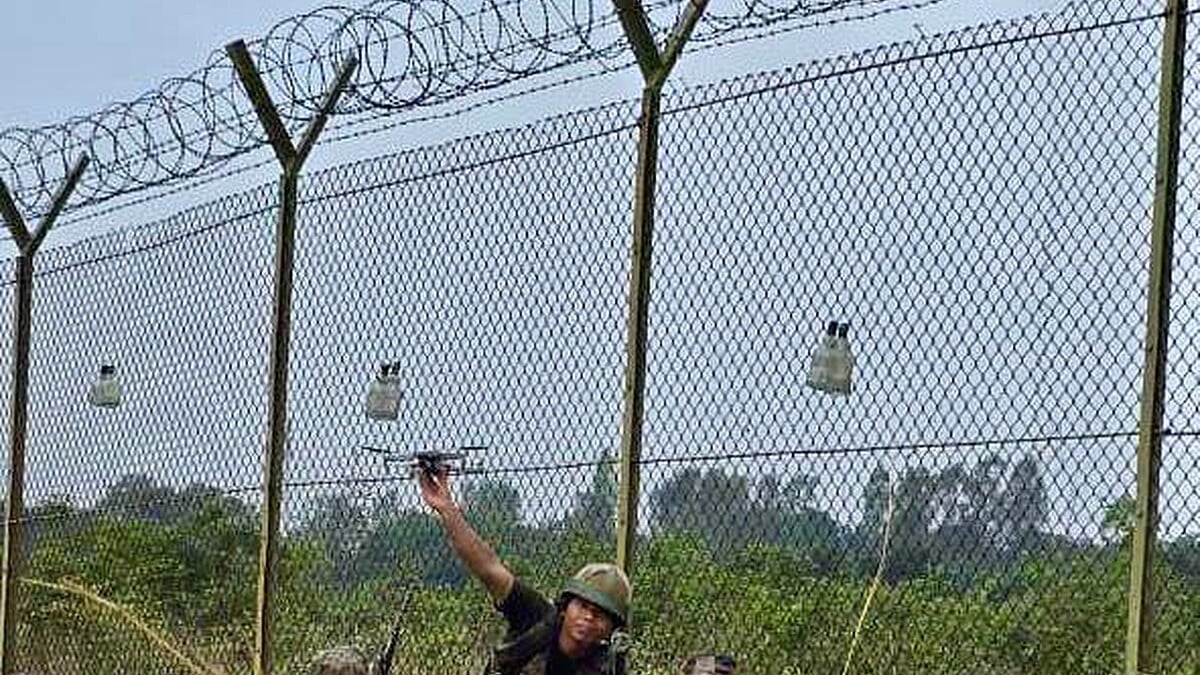
The General Officer Commanding of the Indian Army’s XVI Corps, known as the Rising Star Corps, personally reviewed the operational preparedness of Ashni Platoons in the Samba sector along the Line of Control.
These elite drone units, equipped for surveillance, precision targeting and counter-drone roles, represent a doctrinal shift towards integrated unmanned systems at the infantry level.
Indian media reports confirm that the Army is transforming 382 infantry battalions nationwide with Ashni Platoons, each comprising 20 to 25 specially trained soldiers.
Every platoon fields at least four surveillance drones for persistent reconnaissance and six armed loitering munitions for precision strikes, creating an “unblinking eye and unerring fire” capability.
The Samba sector in Jammu has emerged as a focal point, having recorded multiple suspected Pakistani drone incursions in recent months, prompting repeated search operations by Indian forces.
In March 2026 alone, security agencies launched massive sweeps in forward villages of Samba after drones crossed the International Border, recovering over 3.5 kilogrammes of heroin valued at more than Rs20 crore in the international market.
Similar incidents in January 2026 saw at least five drone sightings across Samba, Rajouri and Poonch districts in a single evening, with Indian troops firing on hovering objects originating from the Pakistani side.
Local and national Indian outlets, including The Tribune and Times of India, have extensively covered the validation of Ashni Platoons during exercises such as Ram Prahaar under Western Command.
These drills demonstrated real-time tactical reconnaissance and mini-UAS strike integration, underscoring the platoons’ readiness for high-threat environments.
The deployment occurs against a backdrop of rising drone activity along the Line of Control, where Indian claims of weapon and narcotic drops have become frequent.
Pakistani officials have consistently denied involvement, yet the pattern has heightened vigilance on both sides of the border.
Defence analysts note that embedding drone platoons directly into infantry battalions marks a structural change, moving beyond experimental use to standard operational doctrine.
With approximately 380 such units now active across the force, India gains enhanced battlefield awareness extending several kilometres into sensitive areas.
The Samba sector’s strategic location near the International Border makes the review by the Rising Star Corps GOC particularly significant for potential escalation scenarios.
Counter-drone measures, including anti-UAS systems, have also been strengthened in tandem with offensive capabilities.
This silent buildup has received scant coverage in international media, with reporting largely confined to Indian defence publications and regional outlets.
The timing coincides with India’s broader modernisation drive, including induction of loitering munitions and software-defined radios across frontline units.
Experts suggest the Ashni Platoons provide a decisive edge in asymmetric warfare, allowing infantry to maintain surveillance superiority without exposing personnel.
For Pakistan, the development signals a need to accelerate indigenous counter-drone technologies and border surveillance enhancements.
The XVI Corps review highlights operational focus on the Jammu region, where terrain and proximity to the Line of Control amplify the impact of drone operations.
Recent exercises have further validated high-altitude and all-weather performance of these systems, ensuring round-the-clock readiness.
As drone warfare reshapes global conflicts, the Indian Army’s move positions it among leading forces integrating unmanned assets at the platoon level.
Regional stability along the Pakistan border could face new pressures if such capabilities translate into increased aerial incursions or pre-emptive strikes.
Pakistani defence observers continue to monitor these deployments closely, emphasising the importance of maintaining strategic balance in the face of evolving threats.
The Ashni Platoons, meaning “fire” in Sanskrit, embody India’s push for technological dominance in infantry tactics amid ongoing regional tensions.