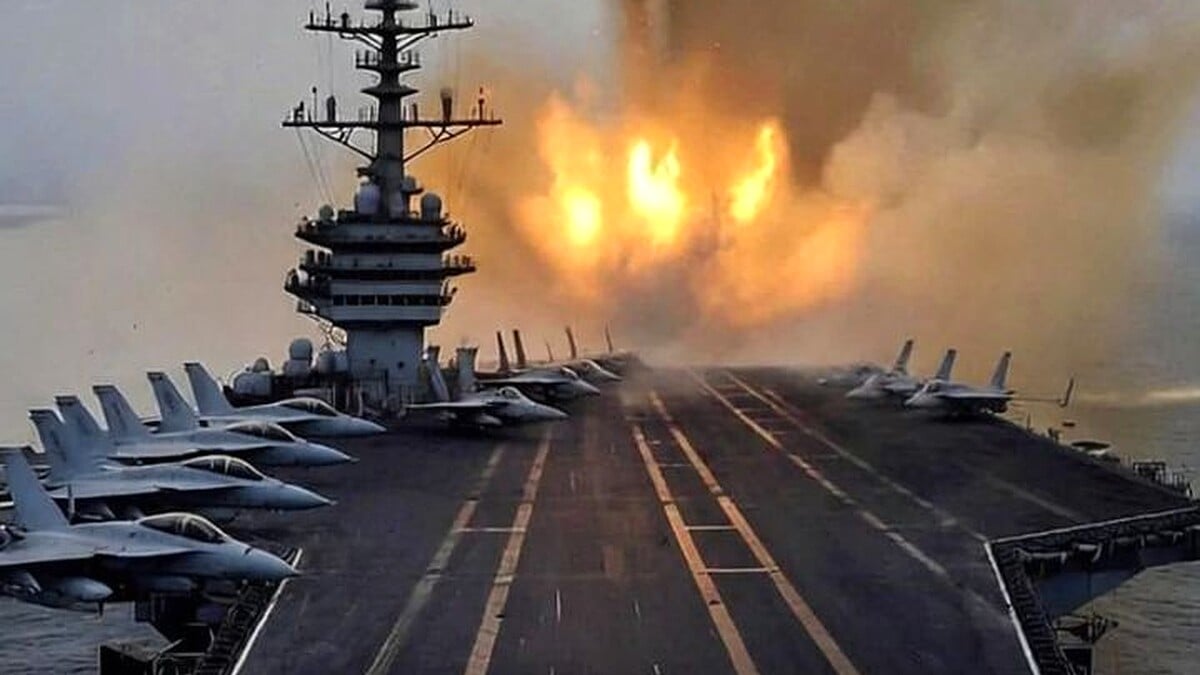




ISLAMABAD: Iran’s Islamic Revolutionary Guard Corps (IRGC) has claimed that its forces inflicted damage on the United States Navy’s USS Abraham Lincoln aircraft carrier through a targeted missile strike.
The IRGC statement, circulated through Iranian state-affiliated media on Friday, described the operation as involving both missiles and drones aimed at the nuclear-powered vessel.
Officials from the elite military branch stated that the attack caused significant structural compromise to the carrier, forcing it to withdraw from its operational area in the region.
This assertion comes against a backdrop of heightened military friction between Tehran and Washington, with the USS Abraham Lincoln deployed to the US Central Command area since early 2026.
The Nimitz-class supercarrier, displacing over 100,000 tons and capable of embarking up to 90 aircraft, forms the core of Carrier Strike Group 3, which includes guided-missile destroyers and support vessels.
Its presence in the Arabian Sea and Gulf of Oman has been part of routine operations supporting regional stability amid ongoing tensions involving Iran.
Iranian sources positioned the strike near the strategic Strait of Hormuz, a vital chokepoint for global oil transit where the carrier was reportedly operating approximately 340 kilometres from Iranian shores.
The IRGC framed the action as a defensive response to perceived provocations, including earlier incidents involving US naval assets and Iranian vessels.
Some reports from Tehran suggested the carrier sustained direct hits, leading to operational limitations and a retreat toward safer waters.
However, the United States Central Command (CENTCOM) rejected these assertions as false.
In an official statement, CENTCOM described the IRGC claim as a lie, emphasising that no missiles reached the USS Abraham Lincoln. However, sources claimed that missiles and drones reached close to the carrier and reportedly neutralised and this cannot be confirmed whether some drones hit the carrier or not due to strict censorship of news. US media had admitted that there was fire and explosion on the carrier but claimed that those were non combat.
US officials revealed that projectiles launched came close to the target and posed no threat to the vessel.
Independent verification efforts, including satellite imagery analysis from earlier periods, placed the USS Abraham Lincoln in positions consistent with continued deployment without signs of major damage.
The carrier entered the CENTCOM area of responsibility in late January 2026 after transiting from the Indo-Pacific, passing through key maritime routes like the Strait of Malacca.
Its redeployment reflected broader US strategic adjustments in response to regional dynamics, including concerns over Iranian activities and threats to shipping lanes.
The IRGC has a history of anti-ship capabilities, including ballistic and cruise missiles designed to target large surface vessels.
Systems such as the Khalij Fars or Ghadir-class submarines have been highlighted in Iranian military exercises simulating strikes on carriers.
Despite these demonstrations, US carrier strike groups employ layered defences, including Aegis-equipped destroyers, electronic warfare systems, and fighter aircraft for interception.
Analysts note that successfully penetrating such protections to inflict heavy damage on a moving supercarrier remains a significant technical challenge.
The exchange of claims highlights the role of information warfare in current confrontations.
Iranian announcements often aim to project strength domestically and deter adversaries, while US responses focus on factual rebuttals to maintain credibility.
No independent evidence has emerged to substantiate the IRGC’s assertion of heavy damage.
Observers point out that past similar claims by Tehran have lacked corroboration from neutral sources or visual proof beyond released footage, which has sometimes been questioned for authenticity.
The incident occurs as naval interactions in the Gulf region have intensified, with reports of close approaches by Iranian vessels to US ships prompting defensive measures.
In one recent case, US forces engaged an approaching Iranian boat with helicopter-launched missiles after it came too near the carrier group.
Such encounters underscore the risks of miscalculation in congested waters.
The USS Abraham Lincoln continues its mission, supporting CENTCOM objectives that include countering threats from Iran-linked groups.
Defence officials stress that the carrier remains a key asset for power projection and deterrence in the Middle East.
As tensions persist, both sides maintain heightened readiness, raising concerns about potential escalation in this critical maritime theatre.
The duelling narratives serve as a reminder of the volatile information environment accompanying military posturing in the region.