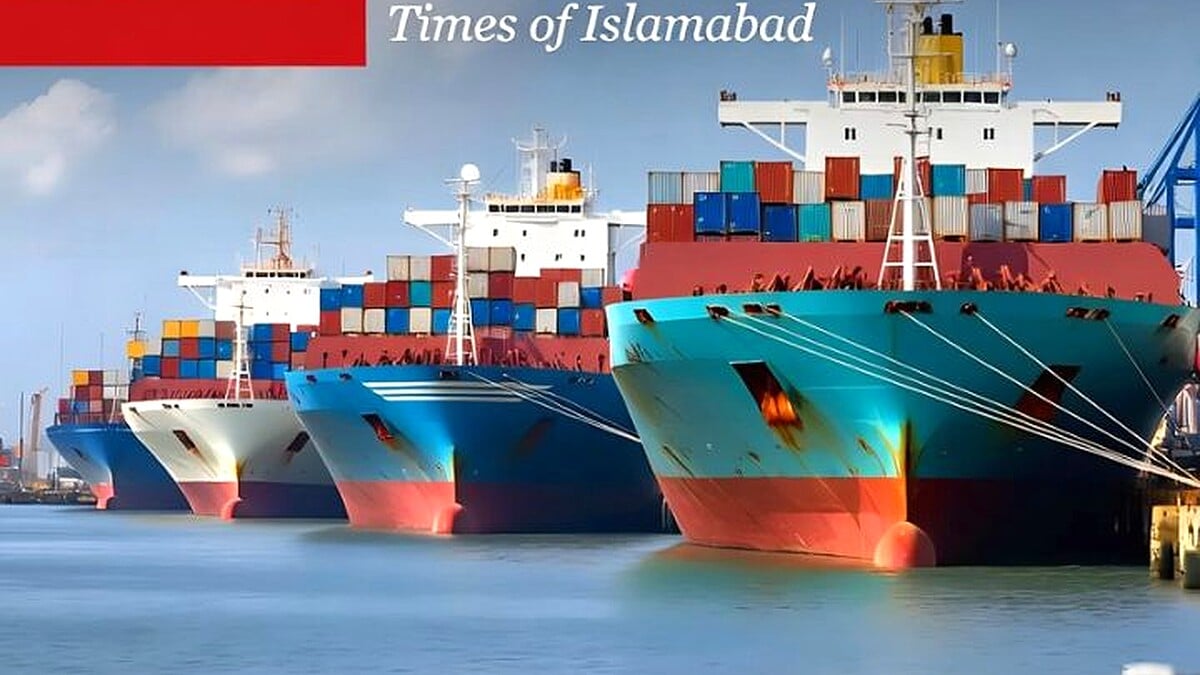




ISLAMABAD: Pakistan has offered the international shipping community access to its major ports for transshipment operations after disruptions around the left hundreds of cargo containers stranded, opening what officials describe as a strategic opportunity for the country’s maritime sector and the long-anticipated expansion of regional trade through the Arabian Sea.
Officials in Islamabad say the government has already begun receiving early commercial interest from shipping companies seeking alternative logistics routes after uncertainty in one of the world’s busiest maritime corridors disrupted container flows between Asia, Europe and the Middle East.
According to Minister of State for Finance , Pakistan has formally offered transshipment facilities through its three major seaports — , and — to help ease global shipping congestion caused by disruptions near the Gulf region.
Kayani stated that several preliminary shipping orders have already been booked by international cargo operators exploring Pakistan’s facilities as temporary transshipment hubs.
The development follows escalating tensions around the Strait of Hormuz, a narrow maritime passage that carries nearly one-fifth of the world’s oil supply and a significant share of global container shipping traffic.
Disruptions in the waterway have created logistical bottlenecks, delaying cargo shipments and forcing shipping companies to seek alternative ports for offloading and redistributing containers to regional markets.
Defence and strategic affairs analyst said that approximately 700 cargo containers are currently stranded due to shipping disruptions linked to the Gulf crisis.
He added that Pakistan’s combined port infrastructure is capable of handling significantly larger volumes.
“Pakistan’s three major ports together have the transshipment capacity to move around 26,000 containers,” he said during a televised analysis, noting that the current situation presents an unusual but potentially transformative opportunity for the country’s maritime economy.
Maritime economists say the crisis highlights Pakistan’s geographic advantage at the crossroads of South Asia, Central Asia and the Middle East.
Unlike many regional ports that primarily serve domestic cargo, Pakistan’s coastal infrastructure has long been positioned to act as a transshipment bridge linking major global shipping lanes with inland trade corridors.
The current disruption in Gulf shipping traffic could accelerate that role if Pakistan manages to attract sustained container traffic from international shipping companies.
Officials also say the situation could provide renewed momentum for the long-discussed expansion of trade through , particularly through Gwadar Port, which has struggled to reach its full operational potential since its inauguration.
Gwadar was envisioned as a deep-sea port capable of serving as a logistics gateway for western China, Central Asia and parts of the Middle East.
However, analysts say the port has so far operated below capacity due to limited cargo volumes and regional political complexities.
The current maritime disruption could provide Gwadar with an opportunity to demonstrate its logistical relevance to global shipping networks.
Shipping experts note that modern container logistics increasingly depend on flexible transshipment hubs capable of redistributing cargo efficiently when primary routes face disruptions.
Ports that can quickly process container transfers between large ocean vessels and smaller regional ships often gain a strategic advantage during global trade disruptions.
Pakistan’s port network, particularly Karachi and Port Qasim, already handles the majority of the country’s trade and possesses established container terminals capable of supporting additional regional cargo movement.
Gwadar, although still expanding its commercial ecosystem, offers deep-water berths capable of accommodating some of the largest cargo vessels operating in international shipping.
Government officials say Pakistan’s maritime authorities are currently coordinating with port operators, customs departments and shipping companies to ensure that the country can rapidly process transshipment requests.
Industry sources indicate that the ability to provide efficient customs clearance, secure container handling and rapid vessel turnaround will determine whether Pakistan can convert the present opportunity into sustained shipping traffic.
Regional competition also remains a factor.
Major ports in the Gulf and Indian Ocean — including hubs in the United Arab Emirates, Oman and India — traditionally dominate transshipment flows for South Asian trade.
However, disruptions around the Strait of Hormuz have temporarily complicated access to several Gulf ports, prompting shipping companies to consider alternative logistical routes.
Analysts say if Pakistan successfully manages the current influx of transshipment requests, it could strengthen its reputation as a reliable maritime logistics partner during times of regional instability.
For policymakers in Islamabad, the moment represents more than a short-term commercial opportunity.
It is also seen as a chance to demonstrate that Pakistan’s port infrastructure, long overshadowed by regional competitors, can play a meaningful role in global supply chains when geopolitical conditions shift.
Whether the current disruption translates into long-term maritime gains will depend largely on how efficiently Pakistan’s ports manage incoming cargo flows in the coming weeks.
But for now, the closure-driven disruption in one of the world’s most critical shipping routes has unexpectedly placed Pakistan’s ports at the centre of a rapidly evolving global logistics equation.