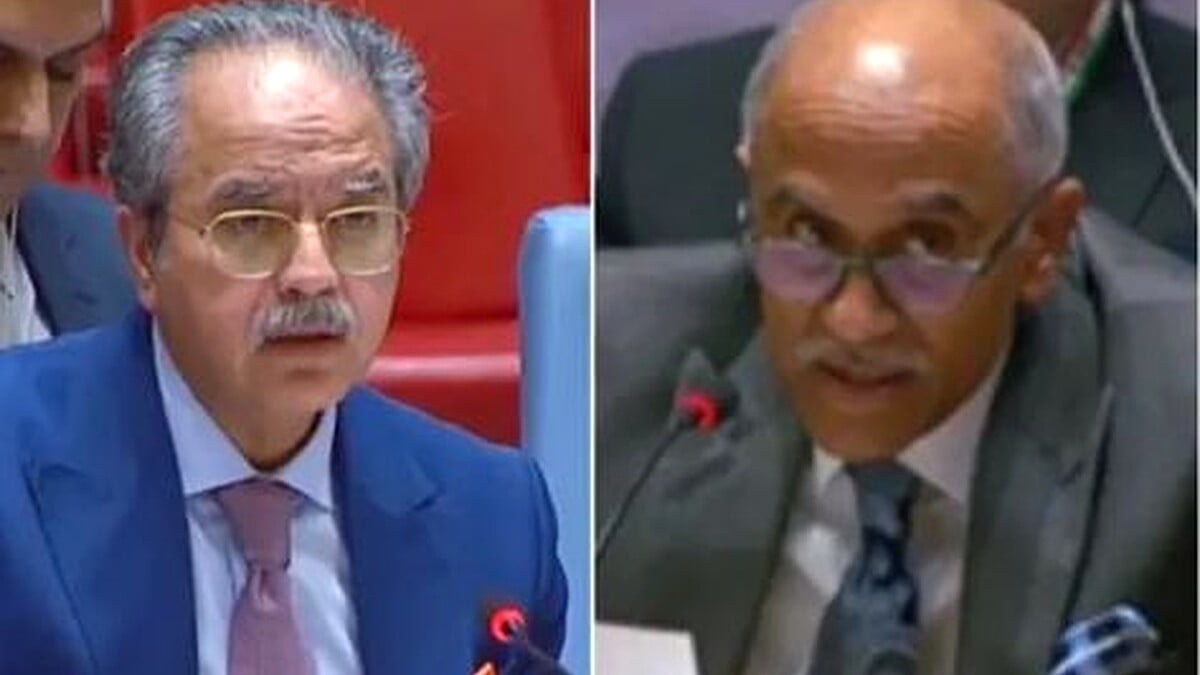




ISLAMABAD: Pakistan has firmly defended its counter-terrorism measures in response to criticism from India and Afghanistan during a United Nations Security Council session focused on the situation in Afghanistan.
The debate intensified when India’s Permanent Representative to the UN, Harish Patel, condemned Pakistan’s recent airstrikes inside Afghan territory. He described the actions as a blatant violation of international law, the UN Charter, and the fundamental principle of state sovereignty.
In a pointed rejoinder, Pakistan’s Permanent Representative Ambassador Asim Iftikhar Ahmad rejected the Indian statement outright. He asserted that the world does not need lectures from a country that consistently flouts international norms and obligations.
Ambassador Ahmad described India as a state that has institutionalized violations including illegal occupation, defiance of UN resolutions, state-sponsored terrorism in Kashmir, systematic targeting of minorities, and the weaponization of disinformation as official policy.
Pakistan maintained that its military operations are not directed against the Afghan people. Instead, they specifically target terrorist threats originating from Afghan soil that continue to endanger Pakistani citizens and security forces.
Officials in Islamabad have repeatedly highlighted the presence of Tehreek-i-Taliban Pakistan (TTP) sanctuaries across the border. Intelligence assessments indicate that these groups plan and execute attacks inside Pakistan before retreating to safe havens in Afghanistan.
Data compiled by Pakistan’s security agencies shows a sharp rise in terrorist incidents following the Taliban’s return to power in Kabul in August 2021. The number of attacks attributed to TTP rose from 187 in 2020 to over 520 in 2023, with a further spike recorded in 2024 and early 2025.
Cross-border firing, improvised explosive device blasts, and targeted assassinations have claimed hundreds of lives, including civilians, soldiers, and law enforcement personnel. Pakistani authorities argue that the absence of effective action by the Afghan interim administration leaves Islamabad with limited options to protect its population.
The Pakistani envoy emphasized that border management and counter-terrorism efforts remain fully compliant with the right to self-defense under Article 51 of the UN Charter. He stressed that operations are precise, intelligence-driven, and aimed solely at eliminating terrorist infrastructure.
Ambassador Ahmad also drew attention to India’s own record in the region. He referenced long-standing UN Security Council resolutions on Jammu and Kashmir that call for a plebiscite, which India has refused to implement for over seven decades.
Human rights organizations have documented widespread allegations of excessive force, enforced disappearances, and curbs on civil liberties in Indian-administered Kashmir since the revocation of special status in August 2019. Several international reports have raised concerns over the targeting of Muslim minorities and restrictions on press freedom within India itself.
Pakistan has consistently accused India of supporting separatist elements in Balochistan and sponsoring terrorism through its intelligence agencies. Islamabad points to the arrest and confessions of Indian nationals allegedly involved in sabotage activities as evidence of this policy.
The Afghan representative at the session also voiced objections to Pakistan’s military actions, echoing India’s position on sovereignty violations. However, Pakistan countered that genuine respect for sovereignty must include preventing one’s territory from being used to harm neighboring states.
Diplomatic sources in New York noted that the exchange reflects the broader geopolitical tensions influencing the Afghan file. While Western members of the Council focused primarily on humanitarian access, women’s rights, and counter-ISKP efforts, the India-Pakistan rivalry surfaced prominently during the open debate.
Pakistan reiterated its call for constructive engagement with the Afghan authorities to address shared security concerns. Officials suggested that joint border management mechanisms, intelligence sharing, and coordinated action against terrorist groups could reduce tensions and stabilize the region.
Analysts observe that the UNSC discussion once again exposed the limitations of the Council in resolving deep-seated bilateral disputes. Neither India nor Pakistan altered its core position, and the session concluded without any new resolution or consensus statement on the specific allegations raised.
The Pakistani mission in New York described the intervention as necessary to set the record straight and prevent the misuse of the Afghan situation for propaganda purposes. Ambassador Ahmad concluded his remarks by urging the international community to focus on facts rather than politically motivated narratives.
Security experts continue to warn that unresolved cross-border militancy risks further escalation. Until the Afghan interim government demonstrates tangible action against TTP and other anti-Pakistan groups, Islamabad appears determined to retain unilateral measures in defense of its national security.