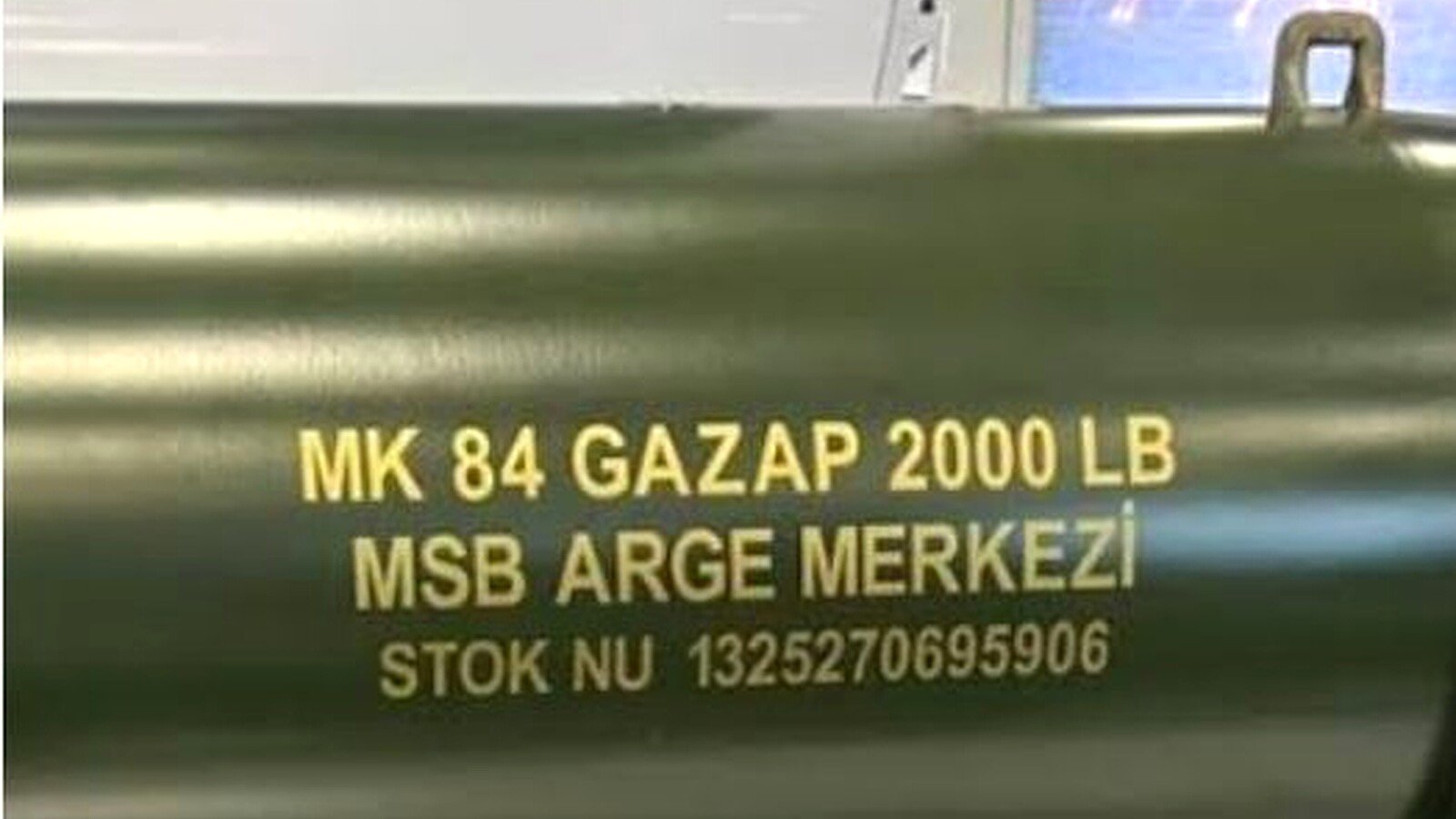




ISLAMABAD: Reports circulating in defence circles suggest that Pakistan has expressed interest in acquiring Turkey’s GAZAP bomb, a high-explosive thermobaric munition unveiled recently as one of Ankara’s most powerful non-nuclear weapons.
The claim originates from Turkish defence and aviation expert Hakan Kılıç, who stated that Islamabad seeks to import the GAZAP for potential integration onto its ballistic and cruise missiles.
Such adaptation would represent a significant upgrade to Pakistan’s long-range conventional arsenal, allowing for deeper penetration strikes without invoking nuclear escalation thresholds.
The GAZAP, developed by Turkey’s Ministry of National Defense Research and Development Centre, weighs approximately 970 kilograms and features a thermobaric warhead combined with dense fragmentation.
Unveiled at the International Defence Industry Fair (IDEF) in 2025, the munition disperses around 10,000 fragments at a density of 10.16 per square metre, markedly exceeding the fragmentation patterns of standard Mk-84 class bombs.
Its thermobaric design disperses a fuel-air mixture that ignites upon detonation, consuming oxygen rapidly to generate intense overpressure and sustained heat.
This mechanism produces devastating effects over wide areas, particularly against personnel, light structures, and enclosed targets, while remaining classified as a conventional explosive under international norms.
Hakan Kılıç further explained that thermobaric warheads leave no living organisms in the immediate target zone due to oxygen depletion and extreme thermal conditions, distinguishing them from chemical or nuclear weapons.
Speculation links Pakistan’s interest to enhancing deterrence in South Asia, with reports indicating potential use against Indian air bases.
Analysts note that equipping cruise missiles such as the Babur with a GAZAP-derived warhead could extend destructive reach against hardened or dispersed targets.
The Babur cruise missile, with its subsonic speed and terrain-hugging flight profile, already offers precision strike options; a high-yield thermobaric payload would amplify its effectiveness in suppressing air operations.
Defence cooperation between Turkey and Pakistan has deepened in recent years, encompassing drone technology, naval systems, and joint ventures.
Turkey has supplied Bayraktar TB2 unmanned aerial vehicles to Pakistan, contributing to surveillance and strike capabilities.
This partnership reflects broader strategic alignment, with both nations pursuing indigenous defence production to reduce external dependencies.
However, no official confirmation has emerged from either Ankara or Islamabad regarding negotiations for the GAZAP.
Defence publications and intelligence assessments describe the reports as unverified, originating primarily from social media commentary and expert statements rather than governmental announcements.
Mainstream sources, including international defence journals, focus on the GAZAP’s unveiling and technical specifications without substantiating export discussions involving Pakistan.
Persistent chatter in February 2026 suggested evaluation of GAZAP integration into platforms like the Shaheen ballistic missiles or Babur cruise variants.
Such a development could recalibrate conventional balances in the region, enabling high-impact strikes calibrated below nuclear red lines.
Thermobaric munitions, while highly destructive, align with global trends toward advanced conventional weapons that maximise lethality without prohibited classifications.
Pakistan’s missile program emphasises credible minimum deterrence, blending conventional and nuclear elements to counter perceived asymmetries.
Integration of foreign-derived warheads would require engineering adaptations, including fuze compatibility, guidance interfaces, and structural modifications.
Turkish expertise in modular munitions could facilitate such transfers through licensed production or technology sharing.
Regional observers caution that enhanced conventional deep-strike options might heighten escalation risks during crises.
India maintains a robust air force with dispersed bases and advanced air defences, potentially mitigating single-munition impacts.
Nevertheless, the prospect underscores evolving defence dynamics in South Asia.
Turkey’s rapid advancements in precision-guided munitions position it as a key supplier to allied nations.
The GAZAP exemplifies this progress, combining blast, fragmentation, and thermal effects in a single package.
If formalised, any agreement would likely involve strict end-use assurances and compliance with export controls.
As of now, the matter remains in the realm of expert speculation and defence enthusiast discourse.
Pakistan’s strategic priorities continue to focus on multi-domain capabilities amid ongoing geopolitical pressures.
Turkey-Pakistan defence ties offer mutual benefits in technology and operational experience.
The GAZAP’s potential role highlights how conventional innovations influence regional stability calculations.
Further developments would depend on diplomatic engagements and technical feasibility assessments.