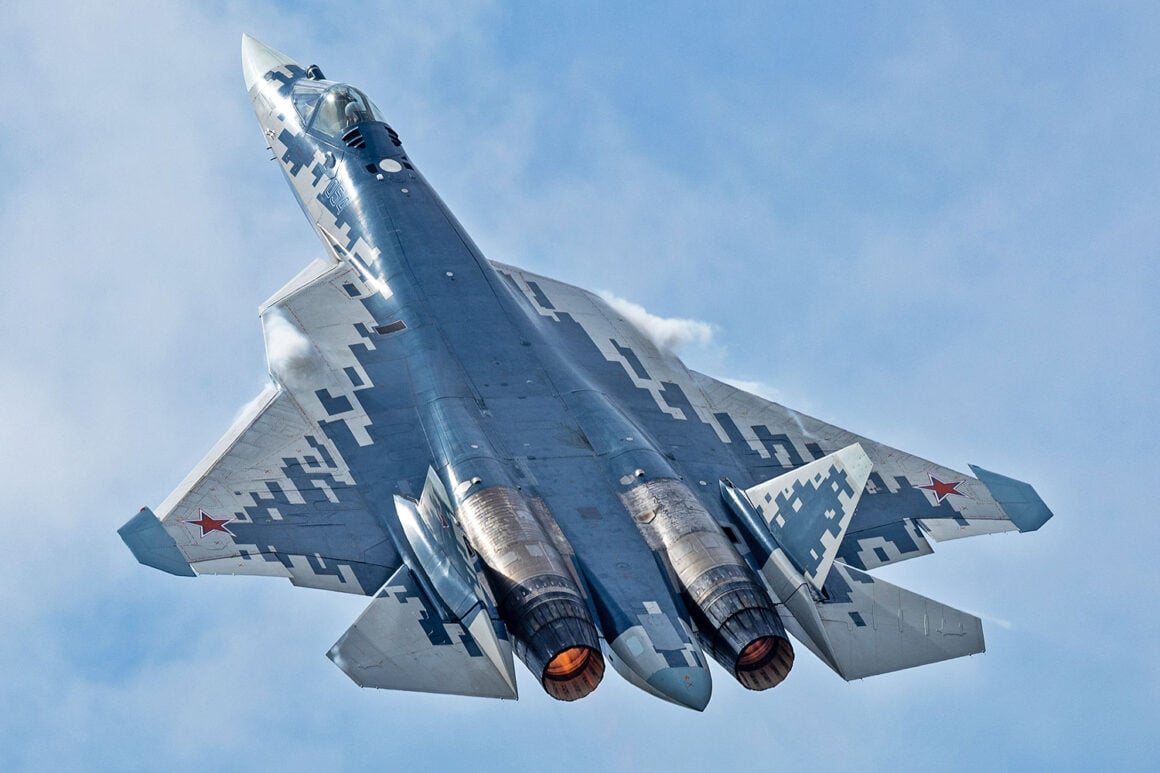




ISLAMABAD: India’s consideration of acquiring Russia’s Sukhoi Su-57 fifth-generation fighter jet encounters significant obstacles rooted in Moscow’s constrained production capabilities and historical delivery challenges.
Recent assessments indicate that Russia maintains a modest inventory of the Su-57, with estimates placing the total number built—including prototypes—at approximately 42 as of early 2026. Operational figures remain lower, often cited between 20 and 32 aircraft in active service with the Russian Aerospace Forces.
Production rates have shown limited acceleration despite announcements of expanded facilities. In 2025, deliveries to the Russian military appeared minimal, with reports confirming only two aircraft transferred that year. This contrasts sharply with Russia’s stated ambition to field 76 Su-57s by 2027 under a 2019 contract.
Early 2026 has seen some resumption, including a batch of upgraded fighters delivered in February featuring enhanced avionics and weapon systems. However, the overall pace suggests priorities remain with fourth-generation platforms such as the Su-34 and Su-35, which dominate annual output.
India’s interest in the Su-57 revives elements of the discontinued Fifth Generation Fighter Aircraft program, from which New Delhi withdrew in 2018 over concerns regarding technology transfer, costs, and performance. Current discussions focus on licensed production of the export variant, Su-57E, with talks reaching advanced technical stages in early 2026.
Russian officials have proposed local assembly through Hindustan Aeronautics Limited, potentially integrating Indian systems and supporting infrastructure. Preliminary audits suggest HAL possesses around 50 percent readiness for such manufacturing, drawing on extensive Su-30MKI experience.
Proponents view the Su-57 as an interim solution to bridge capability gaps until India’s indigenous Advanced Medium Combat Aircraft enters service around 2035. Regional dynamics, including China’s expanding J-20 fleet and potential exports to Pakistan, heighten urgency for fifth-generation assets.
Despite these strategic imperatives, skepticism persists regarding Russia’s capacity to fulfill substantial export commitments. Algeria’s reported contract for 12 Su-57s, with phased deliveries starting in 2025, underscores export promotion amid domestic shortages. Yet Russia’s own fleet remains small, limiting the basis for reliable large-scale supplies to partners.
Historical precedents amplify doubts. Deliveries of the S-400 air defence system to India, contracted in 2018 for five squadrons, faced notable delays. Initial units arrived in 2021, with subsequent transfers progressing slowly due to production strains and external factors. The fourth squadron is now slated for May 2026, with the fifth expected in 2027—extending the timeline beyond original projections.
Such patterns raise questions about the feasibility of timely Su-57 deliveries, particularly for an aircraft Russia itself has inducted in limited quantities. Export variants would compete for production slots, potentially exacerbating delays.
Geopolitical complications further complicate prospects. The United States has signaled readiness to apply Countering America’s Adversaries Through Sanctions Act provisions against entities acquiring significant Russian defence equipment. Recent warnings directed at Algeria’s Su-57 deal highlight this risk, with implications for secondary sanctions on partners.
For India, potential CAATSA measures could affect ongoing acquisitions from the United States, including drones, helicopters, and missiles, as well as indigenous programmes reliant on American components such as engines for the Tejas fighter. Past S-400 procurement avoided full sanctions through strategic waivers, but evolving bilateral dynamics introduce uncertainty.
India’s multi-alignment policy seeks diversified sources, yet the Su-57’s appeal diminishes when weighed against production realities. Moscow’s emphasis on export to sustain the programme contrasts with constrained output, suggesting optimism for rapid scaling may prove premature.
Analysts note that without demonstrated acceleration in serial production, any Indian order—whether fly-away or licensed—risks extended timelines incompatible with pressing operational needs. Focus on indigenous development through the AMCA programme offers greater long-term autonomy, though interim gaps persist.
The Su-57 case illustrates broader challenges in Russia-India defence cooperation amid global supply chain pressures and sanctions. While strategic ties endure, practical limitations temper expectations for advanced platforms.
In conclusion, India’s pursuit of fifth-generation capabilities demands careful evaluation of reliable delivery prospects. Russia’s limited Su-57 fleet and production history provide scant assurance for foreseeable acquisitions, underscoring the need for diversified strategies in airpower modernisation.