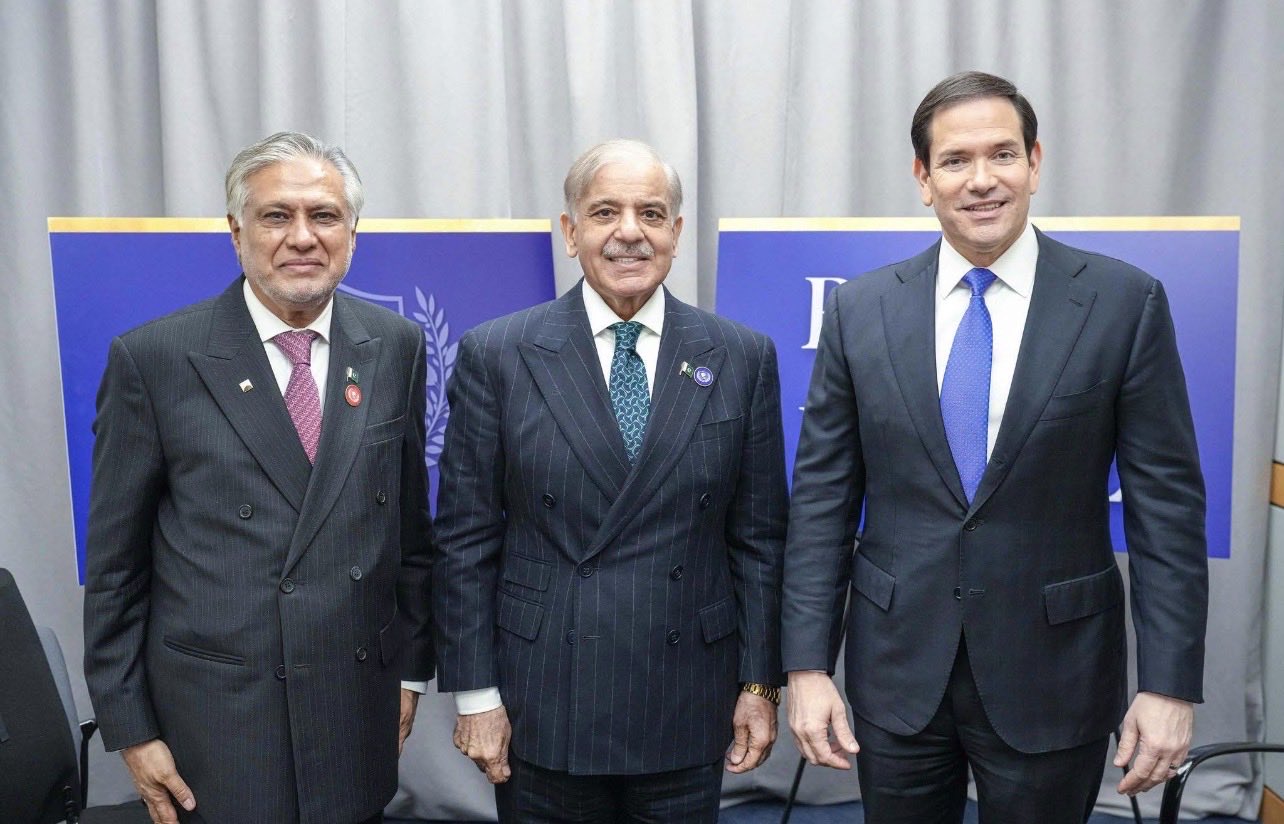




ISLAMABAD: US Secretary of State Marco Rubio met Pakistan Prime Minister Shehbaz Sharif in Washington DC, expressing appreciation for Islamabad’s backing of President Donald Trump’s Gaza peace initiative and its role as a founding member of the Board of Peace.
The meeting, held amid heightened diplomatic engagements, underscored Pakistan’s strategic participation in the newly established Board of Peace, which held its inaugural session recently to advance reconstruction and stability in Gaza following a fragile ceasefire.
Secretary Rubio specifically thanked Pakistan for its ongoing support of President Trump’s Peace Plan for Gaza, a comprehensive 20-point framework endorsed under UN Security Council Resolution 2803, aimed at ending conflict, securing reconstruction, and fostering long-term peace.
Pakistan’s involvement as a founding member positions it alongside over 40 nations, including key players from the Middle East and beyond, in overseeing the implementation of Gaza’s post-conflict roadmap, including pledges for billions in aid and an international stabilization force.
The Board of Peace, chaired by President Trump and involving figures such as Jared Kushner and former UK Prime Minister Tony Blair, has mobilized commitments exceeding $17 billion for Gaza rebuilding, with the US contributing $10 billion and member states adding $7 billion.
Pakistan’s Prime Minister Shehbaz Sharif attended the inaugural Board of Peace meeting, where he emphasized the need to end ceasefire violations and secure an independent Palestinian state, aligning with Islamabad’s longstanding support for Palestinian rights.
Both sides reaffirmed their commitment to counterterrorism cooperation during the bilateral talks, with Secretary Rubio offering condolences for recent terrorist attacks in Balochistan on January 31 and in Islamabad on February 6, highlighting the shared resolve against extremism.
The discussions extended to economic domains, particularly critical minerals and energy sector development, reflecting growing US interest in diversifying global supply chains away from dominant players.
Pakistan’s participation in the recent Critical Minerals Ministerial in Washington was welcomed, as both countries explore partnerships in mining rare earth elements, copper, gold, and other strategic resources vital for advanced technologies and clean energy transitions.
Notable progress includes US approval of $1.3 billion financing for the Reko Diq copper-gold project, a flagship initiative that enhances Pakistan’s role in global mineral security while attracting foreign investment.
Earlier agreements, such as the $500 million deal between Pakistan’s Frontier Works Organisation and US Strategic Metals for processing critical minerals, signal deepening commercial ties in this sector.
Energy cooperation featured prominently, with officials discussing opportunities for American companies in Pakistan’s power generation, renewables, and infrastructure projects to address energy shortages and promote sustainable development.
The talks also touched on broader US investment prospects in Pakistan, with assurances of a secure environment for foreign investors amid efforts to boost economic resilience.
This high-level engagement occurs against the backdrop of evolving US-Pakistan relations under the current administration, balancing security imperatives with economic opportunities in a multipolar world.
Pakistan’s decision to join the Board of Peace, despite regional sensitivities, demonstrates its constructive approach to international diplomacy and commitment to Middle East stability.
Analysts view the meeting as a positive step in reinforcing bilateral trust, particularly in counterterrorism, where continued intelligence sharing and joint efforts remain crucial for regional security.
The focus on critical minerals aligns with global trends, as nations seek resilient supply chains for electric vehicles, defence systems, and renewable energy technologies.
Pakistan possesses significant untapped reserves, including in areas like Reko Diq and other mineral-rich regions, positioning it as a potential key supplier in strategic partnerships.
Both leaders expressed optimism about expanding collaboration, with Secretary Rubio emphasizing commercial opportunities that could benefit American firms and contribute to Pakistan’s economic growth.
The meeting concluded with mutual agreement to sustain dialogue on these fronts, paving the way for further high-level interactions and concrete outcomes in trade, security, and development.
This encounter highlights Pakistan’s active role on the global stage, from supporting Gaza peace efforts to forging economic alliances with major powers.