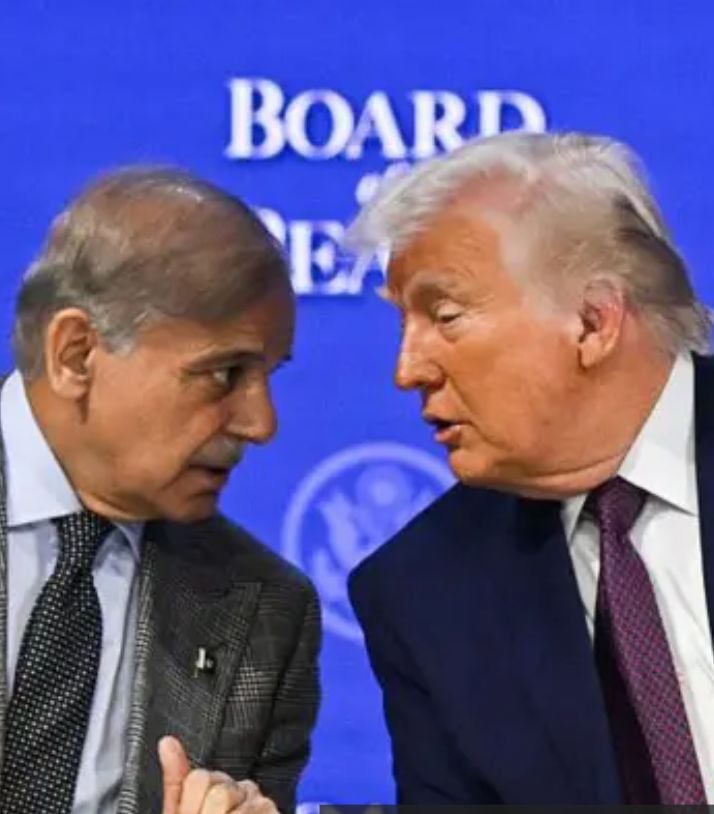




ISLAMABAD: Prime Minister Shehbaz Sharif received high praise from United States President Donald Trump during the inaugural summit of the Board of Peace in Washington, where global leaders convened to address the fragile ceasefire in Gaza and plans for reconstruction.
The Board of Peace, an initiative launched by President Trump, held its first formal meeting on February 19, 2026, at the US Institute of Peace. Representatives from over 40 countries attended, though several traditional US allies were notably absent. The gathering focused on reinforcing the Gaza ceasefire, securing billions in reconstruction pledges, and discussing an international stabilisation force to support demilitarisation efforts in the enclave.
President Trump singled out Prime Minister Sharif for commendation, recalling his earlier statements crediting the US leader with averting a major catastrophe. Trump recounted how, during the May 2025 conflict between Pakistan and India, he intervened decisively. He described phoning both sides amid escalating aerial engagements and downings of aircraft, warning that trade deals would be off the table unless hostilities ceased.
According to Trump, the threat proved effective. “They sort of softened up all of a sudden, there was a little bit of a pullback by one and the other and all of a sudden we worked out a deal,” he said. The US president quoted Prime Minister Sharif as saying privately that Trump had saved 25 million lives by halting the war between the two nuclear-armed neighbours.
Trump expressed admiration for Pakistan’s military leadership as well. He described Chief of Army Staff Field Marshal Asim Munir as a “great, great general; great guy” and a “tough man, a good serious fighter.” The remarks underscored warming ties between Washington and Islamabad, built partly on Trump’s claimed role in the swift ceasefire that ended the four-day clash in May 2025.
Pakistan has joined the Board of Peace, signing its charter in late January alongside nations from the Gulf, Central Asia, and others. Islamabad’s participation aligns with its longstanding support for Palestinian statehood and a just resolution to the Gaza conflict. However, the country has firmly denied intentions to contribute troops to any international stabilisation force tasked with demilitarising Hamas.
Foreign office sources indicated that Pakistan seeks clarity on the mandate of any such force before considering involvement. Officials emphasised that Pakistani forces would only participate in a genuine peacekeeping mission, not operations aimed at disarming militant groups. This stance reflects caution amid the fragile nature of the Gaza truce, where questions persist over Hamas’s compliance and the withdrawal of Israeli forces.
The Board of Peace has secured pledges exceeding $5 billion for Gaza’s rebuilding, with contributions expected from Gulf states like the United Arab Emirates and Kuwait. Trump announced US commitments potentially reaching $10 billion, though funding sources remain unspecified. The body positions itself as a pragmatic alternative to traditional UN mechanisms, with Trump describing it as a means to “strengthen up the United Nations” while overseeing effective implementation.
Pakistan’s engagement highlights its strategic positioning in global peace efforts. By attending the summit and receiving public endorsement from Trump, Prime Minister Sharif bolsters Islamabad’s diplomatic profile. The praise comes against the backdrop of Pakistan’s contributions to regional stability, including its role in de-escalation following the 2025 crisis.
Observers note that Trump’s repeated emphasis on the Pakistan-India ceasefire serves to highlight his administration’s foreign policy successes. He has often linked such achievements to broader Middle East gains, including the Gaza ceasefire. Pakistan, in turn, has publicly thanked Trump for his “bold and decisive leadership” in averting escalation between nuclear powers.
The summit also featured Vice President JD Vance and other senior US officials. Discussions centred on postwar governance in Gaza, involving Palestinian technocrats rather than militant representation. Reconstruction estimates far exceed initial pledges, with some assessments placing the required funds at up to $70 billion.
Pakistan maintains that its involvement in the Board of Peace advances the goal of an independent Palestinian state alongside a durable ceasefire. The government’s position underscores a commitment to humanitarian relief and long-term stability in Gaza without compromising on core principles regarding any stabilisation force.
The event marks a significant moment in US-Pakistan relations, reinforced by mutual recognition of efforts to promote peace. As the Board of Peace evolves, its ability to deliver on reconstruction and security will test the viability of this new multilateral approach outside conventional frameworks.